

The era of "QR code scanning"
At a convenience store on Nguyen Dinh Chieu Street, Ban Co Ward, Ho Chi Minh City, during the afternoon school dismissal time, we observed many students in their junior and senior high school uniforms choosing afternoon snacks, then opening their phones and scanning QR codes to pay via apps. Only occasionally did a few students use cash. At various times throughout the day, at many cafes, bubble tea shops, fried chicken stalls, and even street food vendors selling mixed rice paper snacks near school gates, students were also using QR codes to pay.
Ms. Thai Trang, a parent with a child in 12th grade at Gia Dinh High School (Ho Chi Minh City), said that nowadays, whenever she and her husband give their child pocket money, the child always asks for it to be transferred to their bank account. They also exchange Lunar New Year lucky money or gifts for their child to transfer to their account, which they then use for taxi rides, food orders, etc.
Nguyen Thai Hong Ngoc, a 12th-grade student at Phu Nhuan High School, said that based on her observations and personal experience, high school and university students nowadays don't use cash but have developed a habit of transferring money. Electronic wallets and bank payment apps have become popular among young people. This is partly because of convenience, and partly because students don't like carrying cash.
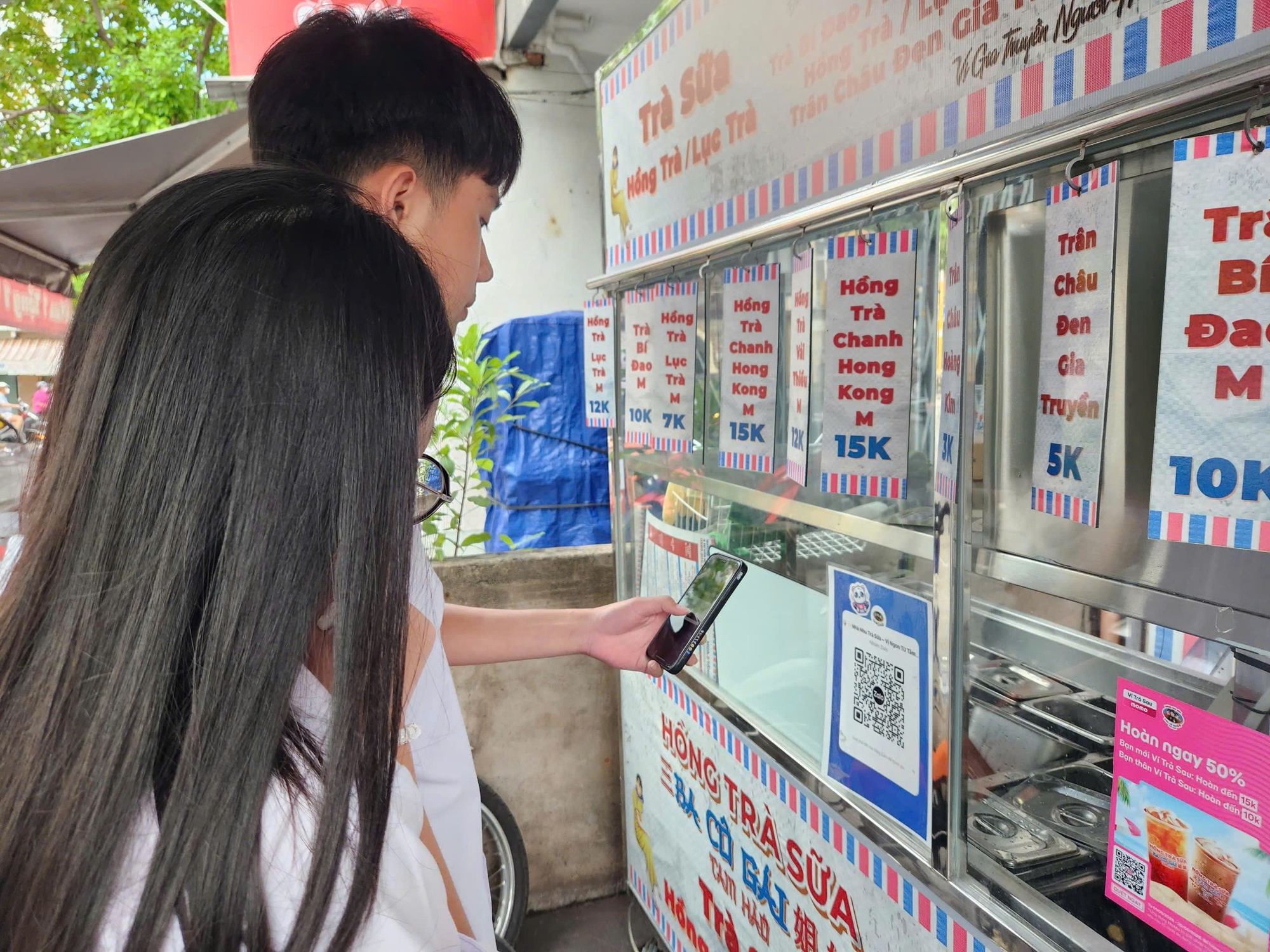
High school students in Ho Chi Minh City bought bubble tea by scanning QR codes on the afternoon of May 21st.
PHOTO: THUY HANG
"My friends often ask each other to convert cash to bank accounts to transfer to delivery drivers. But the school canteen only accepts cash, not bank transfers, so every morning when we want to go to the canteen, everyone rushes to convert to cash. Young people these days seem to be 'penniless,' from small expenses like parking fees, buying vegetables at the traditional market to eating out, everyone scans QR codes or transfers money," Ngoc said.
According to Ngoc, banking apps and e-wallets are popular among high school and university students because many offer discount codes/promotions for cashback; and they don't need to carry bulky wallets anywhere, just a smartphone. "However, there are also frustrating moments when the phone doesn't have an internet connection, and people have to find a way to get Wi-Fi to make payments. Besides, it's even more inconvenient for some banks that frequently undergo maintenance." The 12th-grade student also realized there are some security risks, mainly arising when users activate QR codes for payment, as someone behind them can see and photograph the code to withdraw money from the account, or the risk of online fraud…
YOU SHOULD TEACH YOUR CHILDREN FINANCIAL MANAGEMENT FROM AN EARLY AGE.
Ms. Hoang Thi Man, who works at Ngan Tin Group and has a daughter in 11th grade in Ho Chi Minh City, said that since the beginning of this school year, she has had her daughter open an online account. Every week, she transfers money to her daughter for breakfast, drinks, and grocery expenses for the three of them for the week. "Since my daughter entered 10th grade, I have guided her in cooking, grocery shopping, and managing finances. For example, every week I transfer 1 million VND to her to buy enough food for 7 days. Now, she manages money better and even knows to set aside a reserve fund in case I'm late getting my salary," Ms. Man said.
She believes that children should be taught financial management from a young age, because currently, in the 2018 General Education Program, students are already taught about currency and recognizing money. From grades 2 and 3, students are taught to calculate the appropriate price for products, integrated into math lessons and experiential activities… "Teaching about financial management is not just about teaching how to spend and save money, but also about teaching children the value of money, understanding that their parents work hard to earn it, so that they learn to appreciate it, and nurture their dreams and motivation to have a good job and an honest income of their own in the future," Ms. Man shared.
Ms. Nguyen Thi Song Tra, Director of TH Education and Training Company Limited (THedu), believes that in the modern era, it's impossible to prevent students from using money or prohibit the use of e-wallets/banking apps. What's important is how parents talk to their children about using money correctly and reasonably, according to their age. For example, teaching children where to buy goods, how much is enough, identifying safe products, securing accounts, or solving problems together such as building a spending plan for a summer trip with 2 million VND... "When children are in high school, the experience is that you shouldn't give them too much money, to avoid many risks, including fraud and online bullying," Ms. Tra said.
Nguyen Thai Hong Ngoc believes that students need financial education from primary school because, in reality, there have been many cases of primary school students being caught stealing money from their parents to spend. Ngoc suggests that the content of financial education needs to be innovative and engaging in its delivery so that the message reaches students naturally, without being forced.
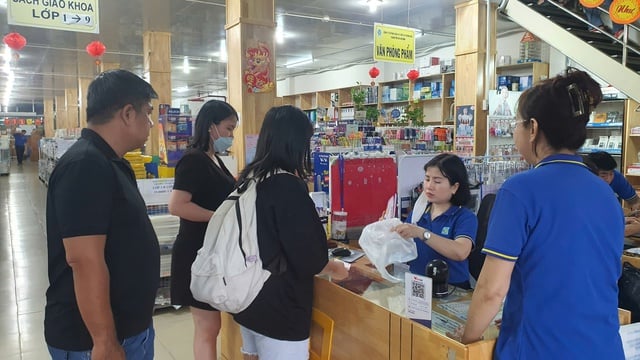
Banking apps and e-wallets are popular payment methods for high school students, university students, and young people when making purchases.
Photo: Thuy Hang
WHAT LEVEL OF USE IS IT, AND HOW IS IT CONTROLLED?
According to Master Tran Viet An, a lecturer in the Marketing Department at the National Economics University, allowing high school students to manage their own spending money and use e-wallets at an early age is an understandable trend in the context of digital payments becoming increasingly popular in Vietnam.
According to the State Bank of Vietnam, by 2025, Vietnam will have more than 30 million active e-wallet accounts, showing that e-wallets are no longer unfamiliar tools but have become part of daily consumer life, especially in large cities where students frequently buy food, order rides, shop online, or pay for small services via phone.
"On the positive side, giving students access to e-wallets can help them develop personal financial skills earlier: learning to track balances, plan spending, distinguish between needs and wants, and reduce the risks of carrying large amounts of cash. For parents, e-wallets also facilitate quick money transfers, checking transaction history, and supporting their children in necessary situations. Therefore, the issue is not whether or not to allow their use, but rather to what extent and how to control it," said Master An.
However, according to a lecturer at the National Economics University, students under 18 years old still lack the ability to self-regulate their finances and identify digital risks. They are easily influenced by promotions, discount codes, shopping as a game, peer pressure, or the psychology of buying according to "trends." When payments can be made with just a few taps on a phone, they easily lose the sense of consideration they have when using cash. "The digital consumer environment can completely expose students to fraud, impersonation, manipulation, bullying, or coercion to transfer money online," Mr. An warned.
Therefore, according to Mr. An, parents should consider e-wallets as a supervised financial education tool, not a free wallet. Several essential principles should be established: setting weekly or monthly spending limits; not directly linking to bank accounts with large balances; enabling biometric authentication, OTP, and transaction notifications; checking spending history regularly; instructing students not to transfer money to strangers, not to click on suspicious links, not to share OTP codes/passwords, and to immediately report any threats, blackmail, or coercion to keep secrets to their parents.
"Even university students can be victims of online scams, so for high school students, family support is essential. Digital financial security for students is not just a technological issue, but also an educational one," Mr. An said.
Source: https://thanhnien.vn/the-he-khong-mot-xu-dinh-tui-18526052119315714.htm
































































































Comment (0)