

Ensuring the role of locomotive, driving force, and leadership
After the merger, Ho Chi Minh City has expanded its development space with an area of over 6,700km2 , a population of 13.6 million people; of which, the labor force is about 7.281 million people, accounting for 14% of the total labor force nationwide; GRDP is estimated at 3.03 million billion VND (equivalent to 123 billion USD), accounting for 23.5% of the country's GDP.
This condition opens up opportunities for spatial restructuring, planning integrated urban areas to develop according to the mindset of "1 center, 3 regions, 1 special zone", optimizing the sharing of comparative advantages of each region, forming a multi-center megacity developing along three corridors, with five pillars (including: industrial center, logistics, international financial center, tourism and cultural industry, education - health - science and technology center), with specific targets on: average GRDP growth rate of 10 - 11%/year; by 2030, GRDP per capita will reach about 14,000 - 15,000 USD; total average social investment capital in 5 years will be 35 - 40% of GRDP; the proportion of digital economy will account for 30 - 40% of GRDP.
To realize the goals in the next 5 years, the city is expected to need to mobilize an additional 8-12 billion USD each year; meanwhile, budget resources can only meet about 30% of the demand (1.2 million billion VND/3.5 million billion VND total demand), not enough to lead the socio-economic development in the area.
To achieve the above goal, ensure the role of a locomotive, driving force, leading, contributing to realizing the double-digit growth target from 2026, the city needs to supplement outstanding, breakthrough solutions other than the law into Resolution 98/2023/QH15 to take advantage of opportunities to attract investment and immediately resolve bottlenecks, unblock resources; focus on large-scale, breakthrough strategic projects with spillover effects, especially key infrastructure in traffic, urban areas, tourism infrastructure, environmental treatment, water resource management, climate change adaptation, high technology, healthcare, education ; establish free trade zones.
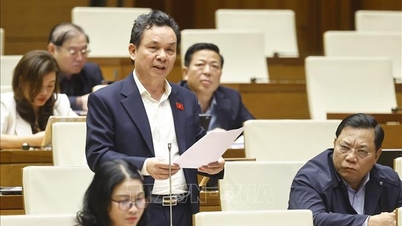
The National Assembly deputies agreed on the necessity and urgency of adding outstanding, breakthrough solutions that are different from the law to Resolution 98/2023/QH15. National Assembly deputy Hoang Van Cuong (Hanoi) emphasized that Ho Chi Minh City is a major development center of the South, especially after the reorganization, it has become a strong development pole, with a lot of potential and many conditions to attract outstanding investment; therefore, there needs to be a truly special institution for the city named after Uncle Ho.
“Until now, the newest thing in the country has always come from Ho Chi Minh City and then spread throughout the country.” Therefore, delegate Hoang Van Cuong also suggested, “turning Ho Chi Minh City into an institutional sandbox , a place that is allowed to experiment and create new policies ahead of the rest of the country. Ho Chi Minh City must be the place to go first, create institutions, create policies, and create new ways of doing things.”
Giving specific comments on the draft Resolution, delegate Hoang Van Cuong said that instead of listing specific regulations in detail, we should focus on providing a framework of principles for the City People's Council to proactively decide, ensuring that Ho Chi Minh City truly has the right to act freely within the supervision framework. For example, it is unnecessary to specify and list the types of strategic investors. Listing too specifically will not be able to cover all newly arising issues.
Supporting stronger empowerment for Ho Chi Minh City, Head of the Ho Chi Minh City National Assembly Delegation Nguyen Van Loi also said that the draft Resolution still has contradictions when it stipulates a special mechanism but requires compliance with the law.
According to delegate Nguyen Van Loi, the special mechanism needs to go beyond current regulations because it is of a pilot nature. However, "if the current legal regulations are more favorable, the law will be applied, and vice versa, if the Resolution's regulations are better, the Resolution will be applied." Noting this issue, the delegate suggested that this should be clearly affirmed in the draft Resolution to avoid future legal consequences due to ambiguity in compliance.
Creating a unique and superior institutional space for the Free Trade Zone
The draft Resolution supplements Article 7a stipulating the establishment of a complete legal framework for the Free Trade Zone model, including: location, functional area structure, management mechanism, authority, land policy, investment incentives, simplification of administrative procedures and special customs mechanism.
This addition aims to create a unique and outstanding institutional space for the free trade zone in Ho Chi Minh City similar to Hai Phong and Da Nang to attract high-quality investment, develop modern services and promote innovation, contributing to making Ho Chi Minh City an economic, financial and international trade center of the region, while at the same time, piloting new models and testing policies before expanding to other localities.
According to the draft Resolution, specific policies include: granting the authority to the City People's Committee to decide on the establishment, expansion and adjustment of the boundaries of the Free Trade Zone, considering this as a decision to locally adjust the city's general planning. At the same time, the City People's Council stipulates the order and procedures for establishing, expanding and adjusting the boundaries of the Free Trade Zone; assigning the Management Board of Export Processing and Industrial Zones as an agency under the City People's Committee, performing the functions and tasks of direct state management of the Free Trade Zone; allowing land allocation and land lease without auction or bidding for investment projects in the Free Trade Zone (except for commercial housing projects), in order to accelerate investment attraction and infrastructure development of the zone; reforming administrative procedures and investment conditions; tax incentives...
The Government's submission affirmed that the proposed mechanisms and policies applied to the Free Trade Zone in Ho Chi Minh City are mostly similar to the mechanisms applied to Hai Phong city in Resolution No. 226/2025/QH15, Da Nang city in Resolution No. 136/2024/QH15 and the points being proposed to be newly added for Da Nang city.
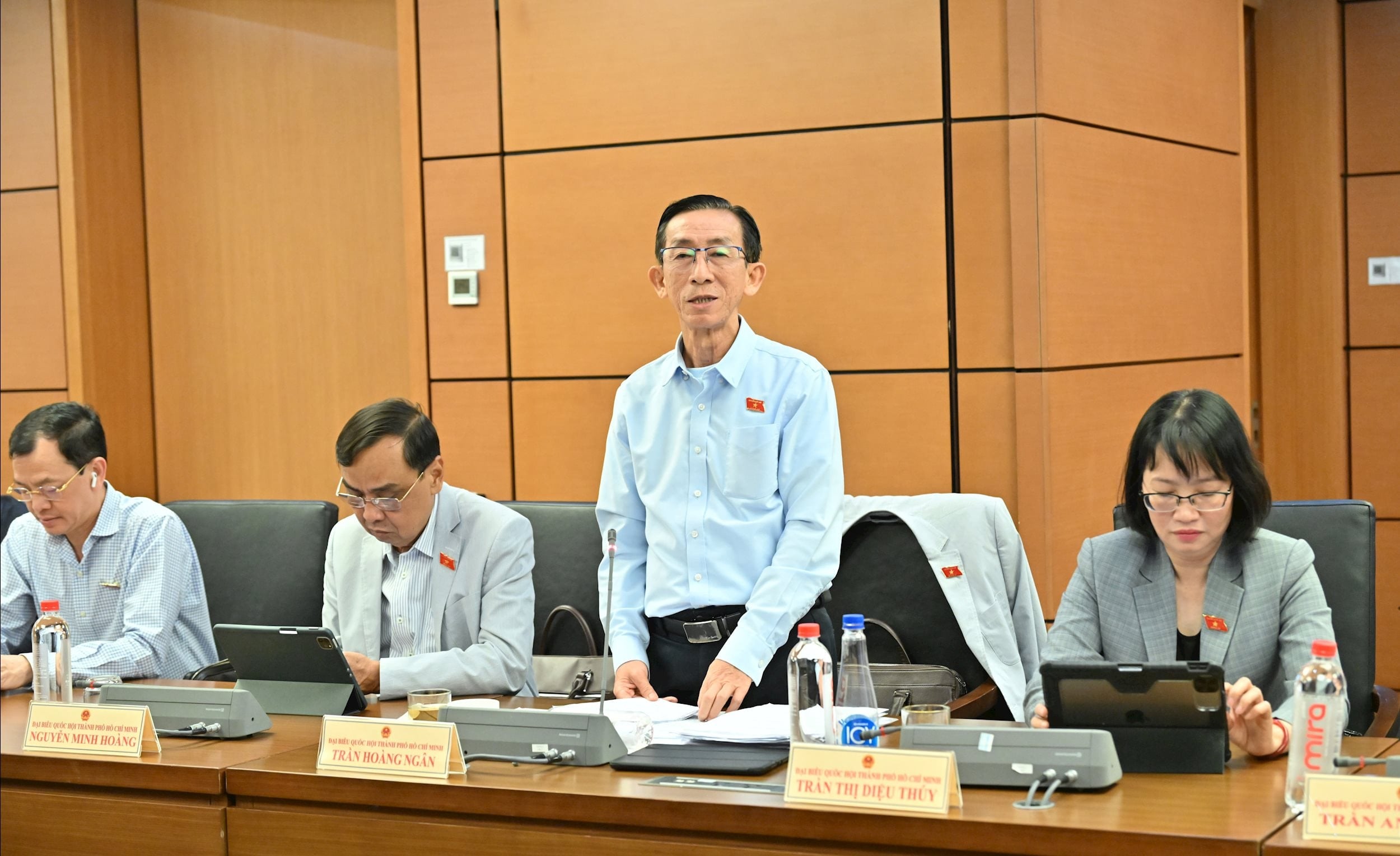
Agreeing with the preferential mechanisms for attracting strategic investors, using land resources obtained from TOD, payment mechanisms for investors and preferential mechanisms in the Free Trade Zone, National Assembly Delegate Tran Hoang Ngan (Ho Chi Minh City) also suggested that it is necessary to link the Free Trade Zone with the International Financial Center to create a very important growth pole for the city.
“We can develop financial markets, futures markets, link with free trade zones and together with Can Gio international transit port, Thi Vai - Cai Mep port become a logistics center of Asia. That is an extremely important growth pole,” delegate Tran Hoang Ngan emphasized.
National Assembly Deputy Nguyen Tam Hung (Ho Chi Minh City) highly agreed with the policy of establishing a Free Trade Zone in Ho Chi Minh City, aiming to pave the way for the development of high-quality services, logistics, industry and high technology. In order for the model to be effective and avoid exploitation, the delegate proposed adding two requirements: a mechanism to control cash flow and manage foreign exchange within the Free Trade Zone, in order to prevent the risk of transfer pricing or money laundering. The delegate also suggested that the Government soon issue a set of criteria to evaluate the operational efficiency of the Free Trade Zone, including: added value of production, localization rate, new jobs, budget revenue, goods flow, and customs efficiency. These are necessary criteria for the Free Trade Zone model to operate effectively and substantially.
Source: https://daibieunhandan.vn/them-dong-luc-de-thanh-pho-mang-ten-bac-but-pha-10399564.html




![[Photo] Urgently help people soon have a place to live and stabilize their lives](/_next/image?url=https%3A%2F%2Fvphoto.vietnam.vn%2Fthumb%2F1200x675%2Fvietnam%2Fresource%2FIMAGE%2F2025%2F12%2F09%2F1765248230297_c-jpg.webp&w=3840&q=75)





































![[Photo] General Secretary To Lam works with the Standing Committees of the 14th Party Congress Subcommittees](https://vphoto.vietnam.vn/thumb/402x226/vietnam/resource/IMAGE/2025/12/09/1765265023554_image.jpeg)
























Comment (0)