

The statement by Indian Prime Minister Jawaharlal Nehru on the occasion of President Ho Chi Minh's visit in February 1958 probably reflects the general perception of the Vietnamese people, as well as international friends and politicians, regarding President Ho Chi Minh. He was not only loved and honored by the Vietnamese people but also deeply admired by people around the world for the noble ideological, moral, and humanistic values he left behind.
Recalling the Spring of 1946, the first spring of the country's independence, journalists, especially foreign journalists, wanted to interview President Ho Chi Minh . His answer surprised everyone; no one expected it, because it was concise, simple, and complete: "I absolutely do not desire fame or wealth at all. Now I have to bear the position of President because the people have entrusted me with it, so I must do my best, just like a soldier obeying the orders of the nation to go to the front. Whenever the people allow me to retire, I will gladly retire. I only have one desire, an ultimate desire, which is to see our country completely independent, our people completely free, everyone having enough food and clothing, everyone having access to education. As for myself, I would like to build a small house in a place with green mountains and clear water to fish, plant flowers, and spend my days and evenings with old people gathering firewood and young children tending buffaloes, without being involved in the pursuit of fame and fortune" ([1]).
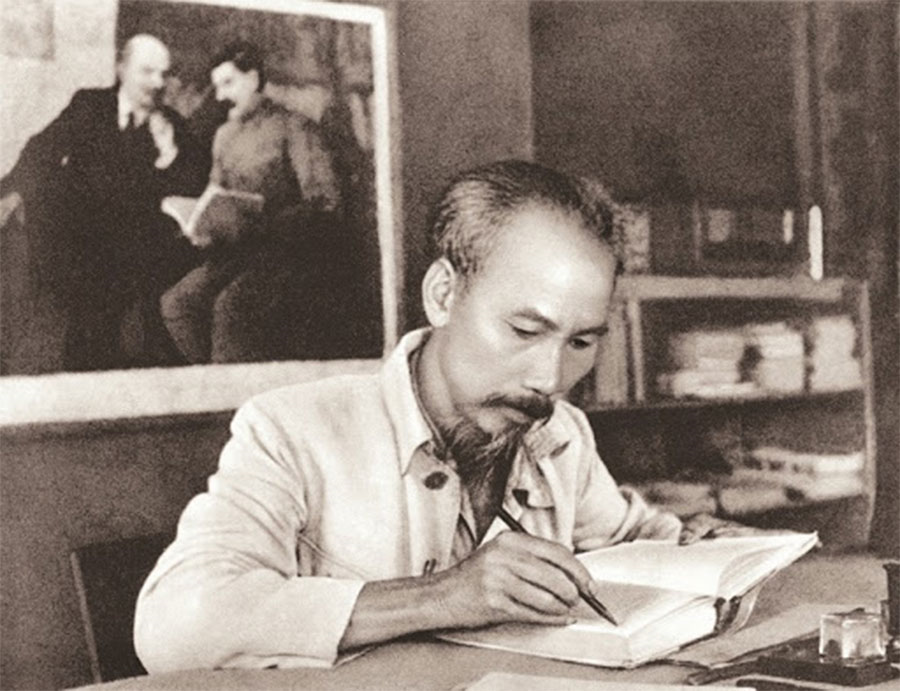 |
| President Ho Chi Minh. Archival photo. |
Our beloved Uncle Ho was like that! Throughout his life, he dedicated himself to the country and the people, living a life of serenity and composure! The things he called for, instructed, and taught to cadres, Party members, and all strata of the people were not just empty slogans from a leader, but things he put into practice throughout his life. Therefore, learning from and following Uncle Ho is not enough if we only stop at studying his teachings. Besides his writings and speeches expressing his revolutionary ideology and direction, his life of revolutionary activity is the most vivid and convincing proof.
Uncle Ho demanded that all cadres and Party members regularly cultivate a simple, healthy, and clean lifestyle. Noble revolutionary thoughts and ethics must become habits in each person's life. Regarding self-cultivation, Uncle Ho said something profound to the young cadres in his office: "Everything becomes familiar, my friends. Being diligent becomes familiar, and being lazy also becomes familiar; it happens quickly, not quickly. What is difficult? Difficulty is something unfamiliar. If you cultivate familiarity, then even the difficult things will no longer be difficult. With persistent self-cultivation, there will come a time when even the difficult things seem not difficult." Regarding the spirit of self-reliance in life, Uncle Ho also taught: "When we talk about self-reliance, we should be self-reliant in big things and in small things in daily life. Whatever we can still do, we should do it."
He said that, and he upheld it as a principle throughout his life. Even when he was in the Viet Bac Resistance Zone, he would still go down from his stilt house on the hilltop to the stream to fetch water without needing any assistance from his comrades. If he had to move around to ensure safety, he would carry his own bag containing blankets, clothes, and documents; his comrades only had to carry his typewriter. Towards the end of his life, as old age and illness took their toll, he became even more self-reliant. To make walking less difficult in front of the people, so that no one would see his fatigue, he practiced walking daily.
Both in his work and in his daily life, Uncle Ho's benevolent heart shaped his natural, sincere, and simple demeanor. He – the nation's first citizen, the most beloved leader – always helped, guided, and advised everyone with kindness and without discrimination or formality. Once, when Uncle Ho was receiving guests, the servants, after pouring the water, immediately placed the first cup before him before offering it to the guest. Uncle Ho remained calm and composed. When Uncle Ho was at home, he said: "Listen, my dear servants, I am the host. Foreigners, or those of you who come to work, are guests. I entertain them. Next time, after pouring the water, please offer it to all the guests first and then to me, not to me first."
Uncle Ho took care of countless important matters, yet he never overlooked the small ones. For example, at the end of a film screening, he raised his hand to order everyone to be quiet so that the children could go out first, avoiding chaos and preventing them from getting lost. Or, after a meal, with dishes and chopsticks scattered on the tables, he calmly "cleaned up the battlefield," saying, "Let's tidy up a little, to ease the burden on the comrades who served us." Everyone admired and followed Uncle Ho's noble and democratic attitude towards life: "One for all, all for one." If each person is willing to take on a little of their own burden, it will ease much of the hardship for others.
On President Ho Chi Minh's birthday, we remember everyday stories. Each story holds a different meaning, and from these seemingly small stories, we discover so many profound things to reflect upon, to learn from, and to follow in his footsteps.
[1] , National Political Publishing House, Hanoi 2023, Vol. 4, p. 187
Source: https://www.qdnd.vn/chinh-polit/cac-van-de/theo-guong-bac-tu-nhung-dieu-gian-di-1040229













































































Comment (0)