


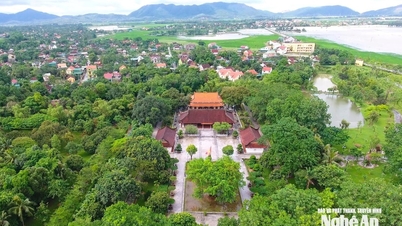
Le Van Huu Temple. Photo: Khac Cong
In the preface to the Complete Annals of Dai Viet, historian Ngo Si Lien respectfully honored Le Van Huu as "the great writer of the Tran dynasty." Just four words, but enough to portray the stature of an exceptional intellect, a great personality, and a pen that contributed to the national lineage, defining the country's boundaries, and nurturing the cultural essence of the nation.
Amidst the turbulent 13th century, the Dai Viet Chronicle was not merely a book recording historical events, but also a unique spiritual springboard. This is because the creation of a national history was a way to affirm that a nation wanting to endure must have historical memory; a country wanting to be stable must have spiritual roots.
History is not just for remembering, but also for guiding the way. From historical records, future generations understand who they are, where they come from, what ups and downs they have experienced, and what mission they carry for the nation. Every time we mention Le Van Huu, we are reminded of a great ideology: valuing morality, strict discipline, and cherishing talented people. This is the core value system that our homeland today needs to continue to preserve and translate into practical action.
Thieu Trung is a special land, where the traditions of learning, craftsmanship, culture, and life all contribute to shaping the character of its people. Ke Ry - Phu Ly evokes the tradition of brilliant scholars, the birthplace of those who pioneered the history of Vietnam. Tra Dong - Ke Che, with its fiery bronze castings passed down through generations, embodies the skillful hands and meticulous work ethic of the local craftsmen.
Today, Thieu Trung encompasses not only Ke Ry and Ke Che, but also Tra Thuong, Hong Do, Co Do, Van Quy, Lac Do, Quy Xa, My Ly, Nguyet Lang, Ho Dam, Vien Noi, Vien Ngoai, Phu Thu, Nguyet Quang, Ba Che, and other residential areas converging under one common "roof." Each place name represents a layer of sediment, each village a source of memory, contributing to the region's broad and profound character. In this land, literature, occupations, fields, markets, foundries, looms, traditional kitchens, houses, and village customs have blended together through generations. Writing history requires accuracy and erudition; bronze casting requires skill and artistry; silk weaving requires softness and durability; rice cultivation requires diligence and adaptation to nature. Handicrafts, processing, trading, and services require skill, integrity, and adaptability... All of these qualities have blended perfectly to create the character of the people of Thieu Trung: whatever they do, they do it wholeheartedly, with dedication and complete loyalty.
The 2026 Le Van Huu Temple Festival, held to commemorate the 704th anniversary of the passing of our ancestor, carries a broader significance than a traditional festival. It is an opportunity for Thieu Trung to respectfully express gratitude for the merits of our ancestors, to educate about historical traditions, to foster patriotism, national pride, a love of learning, and respect for talent. At the same time, it promotes the value of historical sites, traditional crafts, and local products, contributing to socio -economic development.
According to the plan, the festival will take place from May 8th to 10th, 2026 (corresponding to March 22nd to 24th in the year of the Horse) at the temple, tomb of Le Van Huu, and other cultural spaces in the commune. The ceremonial part will be held solemnly with rituals such as opening the temple doors, the bathing ceremony, the procession of the palanquin, the procession of the symbol of the Dai Viet History Chronicle, the opening of the writing ceremony, incense offerings, the main ceremonial announcement, the presentation of the congratulatory address, and the thanksgiving ceremony. The festival part will include a traditional craft village fair, OCOP (One Commune One Product) and cultural events; a public art program, sports activities, traditional games, and an experience in Tra Dong bronze casting; a meeting with delegates and fellow villagers from Thieu Trung; and the announcement of the Le Van Huu Scholarship and Talent Promotion Fund.
The most valuable aspect of this year's festival is the emphasis on the people's role as the main actors. The festival is not only organized by the government for the people to participate in, but is also a collaborative effort of the entire community. Villages, schools, organizations, artisans, businesses, expatriates, cultural, artistic, and sports forces, and a large number of citizens are involved. From rituals and folk art performances to the theatrical portrayal of historical figures, fairs, landscape beautification, welcoming delegates, ensuring security and order, and environmental sanitation... each task represents a heartfelt respect for our ancestors and a concrete action for our homeland.

Traditional bronze casting craft in Tra Dong village. Photo: Khac Cong
Paying tribute to Le Van Huu is not just about lighting an incense stick before the spirit of our ancestor, but also about igniting in each person in Thieu Trung the will to learn, the aspiration to contribute, the spirit of valuing talent, and the responsibility to build our homeland. For cadres and Party members, it is the responsibility to set an example, to serve the people with dedication, to work with discipline, intelligence, and efficiency. For schools, it is the responsibility to sow the seeds of learning, nurture dreams, and cultivate character in the younger generation. For artisans, businesses, and production households, it is the responsibility to preserve and improve their crafts, making our homeland's products more valuable and accessible to a wider audience. For each citizen, it is the responsibility to live civilized, compassionate, and united lives, working together to build an increasingly better community.
Thieu Trung today stands before new opportunities. In this new development space, the commune has more conditions to connect resources and promote its historical, cultural, traditional craft, educational , and human values. The ancient villages, hamlets, and neighborhoods today are not only administrative landmarks, but also sources of memory, culture, and hometown sentiment, contributing to the identity of a more open, dynamic, and aspirational Thieu Trung.
To go far, a rural area must rely on its cultural foundation. For sustainable development, a locality must care for its people, for education, for livelihoods, and for community values. Therefore, the legacy of Le Van Huu cannot remain confined to temples, tombs, or old historical records; it needs to be continued in every action taken for the children of Thieu Trung today.
The Le Van Huu Temple Festival in 2026 is an invitation to return to our roots, and also a reminder to move forward together. Return to pay tribute to our ancestors who laid the foundation for Vietnam's national history; move forward to write new chapters in our homeland's history through unity, wisdom, creative labor, and aspiration for development.
Drawing inspiration from the Đại Việt Chronicle, from the literary tradition of Kẻ Rỵ - Phủ Lý, from the craft traditions of Trà Đông - Kẻ Chè, from the memories of Hồng Đô, from the rice paddies, craft villages, and markets, and from the love of the homeland in ancient villages and hamlets, the Party Committee, government, and people of Thiệu Trung pledge to continue preserving traditions, promoting heritage, valuing education, professions, and talented individuals; using culture as a springboard and talented individuals as pillars; building a homeland that is increasingly prosperous, beautiful, and civilized, worthy of the land that gave birth to the founder of Vietnamese national history.
The Le Van Huu Temple Festival 2026 - a cultural destination of Thanh Hoa province, where the sacred past meets the present, where the spirit of the homeland shines brightly, the lifeblood extends far, and the aspirations of Thieu Trung burst forth in the new era.
Do The Bang
Secretary of the Party Committee, Chairman of the People's Council of Thieu Trung Commune
Source: https://baothanhhoa.vn/nbsp-thieu-trung-hon-que-tu-sang-mach-doi-vuon-xa-286854.htm









































![[Photo] Hue: Admire the 2.4 trillion VND sea bridge, the longest in Central Vietnam.](https://vphoto.vietnam.vn/thumb/402x226/vietnam/resource/IMAGE/2026/05/24/1779614018347_anh-man-hinh-2026-05-24-luc-16-13-29.png)
























Comment (0)