

Natural disasters in the country are becoming increasingly extreme, breaking many records.
According to a report by the Ministry of Agriculture and Environment , 2025 is projected to be one of the most severe years in terms of natural disasters in recent years, with a series of extreme weather events occurring on a large scale, causing serious damage to people and property globally.
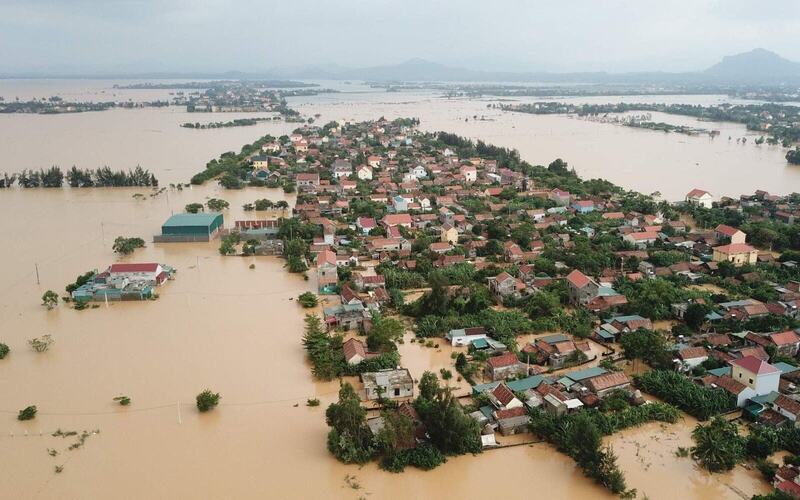
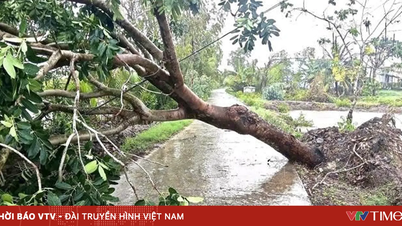
Throughout 2025, natural disasters caused 484 deaths and disappearances, injured over 800 people, and resulted in total economic losses exceeding 104.7 trillion VND. (Illustrative image)
According to international statistics, several major disasters have occurred in quick succession, such as floods and landslides in Indonesia that killed and left more than 1,300 people missing; torrential rains in Pakistan that killed more than 1,000 people; and flash floods in Texas (USA) that killed 135 people. An earthquake in Myanmar also had devastating consequences, killing more than 3,800 people.
In the United States, large-scale wildfires in California, with over 1,500 incidents, have burned nearly 27,000 hectares and destroyed tens of thousands of structures. Particularly noteworthy is Hurricane Melissa, a Category 5 storm that struck Jamaica, causing economic damage equivalent to approximately one-third of the country's GDP.
According to reinsurance firm Swiss Re, total global disaster losses in 2025 are estimated at $220 billion, marking the sixth consecutive year that this figure has exceeded $100 billion – indicating a clear upward trend in climate risks.
In Vietnam, natural disasters in 2025 also occurred frequently, unusually, and surpassed many historical records. A total of 21 typhoons and tropical depressions were active in the East Sea, the highest number ever, exceeding even the number in 2017.
Many storms have complex trajectories, are very strong, and move rapidly, defying normal patterns. Notably, early-season storms have made landfall in the Central region, while storms affecting the Northern region still occurred towards the end of the year.
Extreme heavy rainfall has caused historically high flood levels on numerous rivers in Northern and Central Vietnam, resulting in severe flooding in many major cities such as Hanoi , Thai Nguyen, Bac Ninh, Thanh Hoa, Hue, and Da Nang. Simultaneously, tidal surges in the lower reaches of the Tien and Hau rivers have also exceeded historical levels, increasing pressure on the Mekong Delta region.
A series of typical natural disasters have caused severe consequences. Typhoon No. 10 was one of the most damaging storms, resulting in 65 deaths and missing persons and nearly 24,000 billion VND in damages. The floods in Central Vietnam at the end of the year caused over 17,000 billion VND in damages, resulting in 153 deaths and missing persons.
In 2025 as a whole, natural disasters caused 484 deaths and disappearances, injured over 800 people, and resulted in total economic losses exceeding 104.7 trillion VND – a very significant amount of damage that directly impacted economic growth and people's lives.
Proactive response and improved forecasting capabilities.
According to the assessment of natural disasters and forecasts by the National Center for Hydro-Meteorological Forecasting, in 2026, heatwaves are likely to appear early, be prolonged and intense, with increased risk of drought, water shortage, and saltwater intrusion, especially in Central Vietnam, the Central Highlands, and Southern Vietnam; the number of typhoons and tropical depressions in the East Sea will be lower than the multi-year average (the multi-year average is 12.7 storms in the East Sea, 5.1 storms making landfall), however, special attention should be paid to the risk of strong, even very strong, typhoons that intensify rapidly (potential risk of super typhoons), with complex and unpredictable trajectories and timings; floods on rivers in Central and South Central Vietnam (from Quang Tri to Lam Dong) and small rivers, and the upper reaches of major rivers in Northern Vietnam will be at alarm levels 2-3, with some rivers exceeding alarm level 3, and there is a risk of flash floods and landslides in mountainous provinces.
Against this backdrop, the Ministry of Agriculture and Environment has identified its focus as improving forecasting and early warning capabilities, and strengthening the application of science and technology in disaster prevention and control.
This includes accelerating the expansion of the meteorological and hydrological monitoring network, especially the weather radar system. Simultaneously, modern forecasting models combining physics, statistics, and artificial intelligence (AI) will be applied to improve the accuracy and timeliness of forecast information.
A key focus is the development of a digital reservoir operation support system that integrates hydrological models and flow forecasting. This system helps management agencies make comprehensive decisions on interconnected reservoir regulation, minimizing risks to downstream areas.
In addition, the installation of specialized disaster monitoring systems, including cameras to monitor reservoirs and dams, rain gauges, and water level monitoring stations, will be enhanced, connecting data in real time to support operational management.
In addition to technological solutions, disaster prevention and control efforts in the coming period will focus on improving the quality of human resources and perfecting the data system. Relevant agencies will promote the training of experts and technical staff, while also attracting the participation of research institutes, universities, and technology companies to form a research-application ecosystem in this field.
Updating and improving the national database on disaster prevention and control has also been identified as a key task, creating a foundation for forecasting, management, and policy planning.
In addition, communication and public awareness campaigns continue to be intensified, helping people and businesses to be more proactive in preventing and responding to natural disasters.
In the context of increasingly evident climate change, natural disasters are not only natural risks but have become factors directly impacting economic growth and sustainable development. Therefore, proactively adapting and enhancing disaster prevention and mitigation capabilities is not only an urgent requirement but also a fundamental condition for ensuring long-term socio-economic stability.
Entering 2026, specialized agencies predict that the risk of natural disasters will continue to be complex. Heatwaves may appear earlier and last longer, leading to the risk of drought, water shortages, and saltwater intrusion, especially in Central Vietnam, the Central Highlands, and Southern Vietnam.
Although the number of storms predicted is lower than the multi-year average, the risk of strong storms, even superstorms with unpredictable developments, remains high. Flash floods and landslides continue to be a major threat in mountainous areas.
Source: https://congthuong.vn/thoi-tiet-nam-2026-co-gi-can-luu-y-449822.html



































































































Comment (0)