

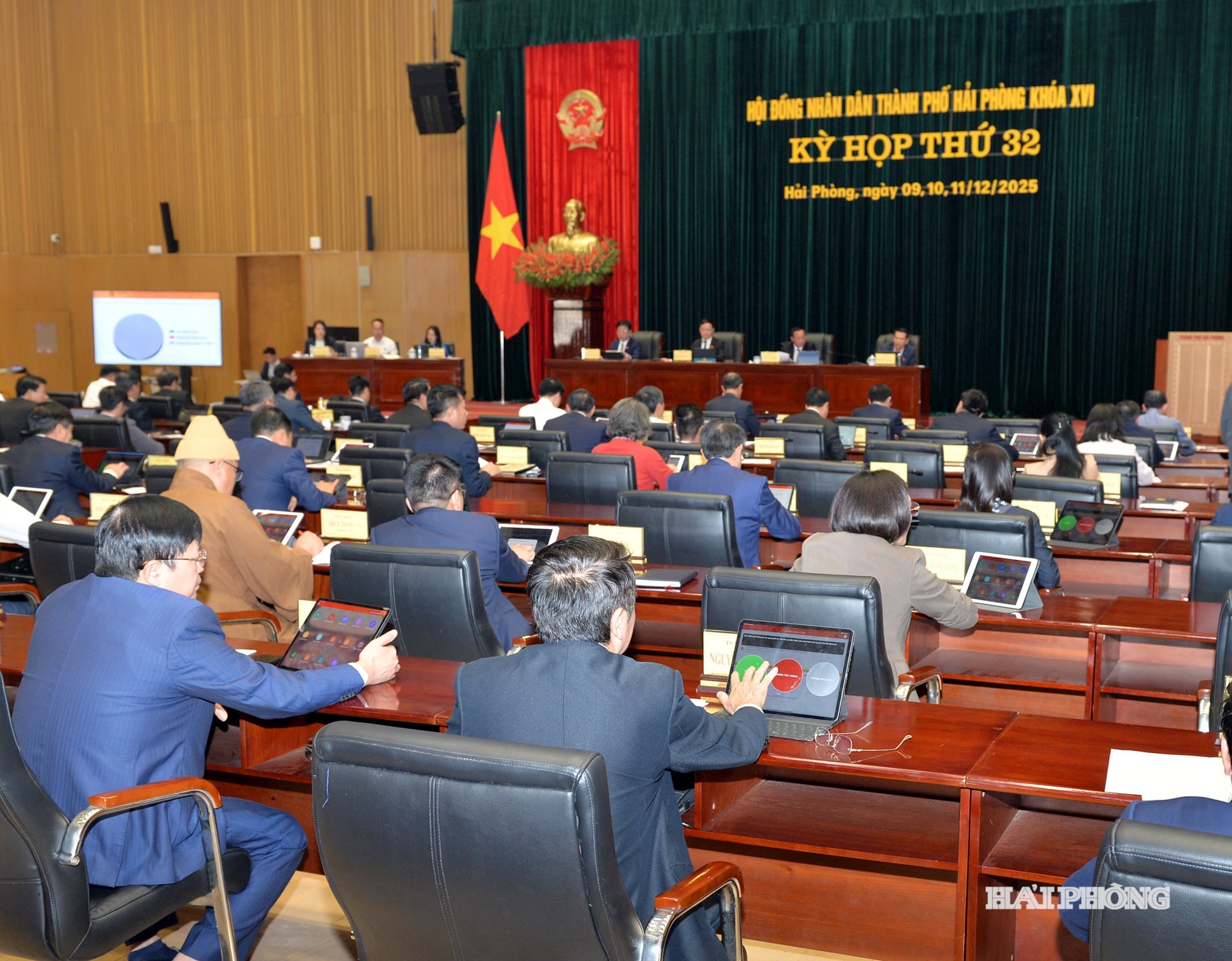
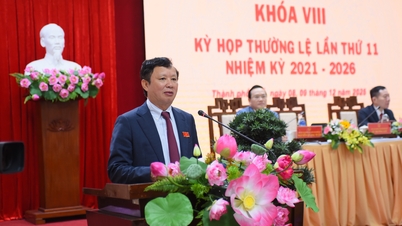
On the afternoon of October 9, at the 32nd Session, the Hai Phong City People's Council passed a Resolution on decentralization of revenue sources, expenditure tasks and the percentage (%) of revenue division between the city budget and commune-level budgets of Hai Phong city in 2026.
This Resolution stipulates the decentralization of revenue sources, expenditure tasks and the percentage of revenue division, excluding land use fee revenue, between the city budget and commune-level budgets in Hai Phong city in 2026.
According to the resolution, the Hai Phong City People's Council stipulates five principles for decentralizing revenue sources, expenditure tasks and dividing revenues among the budgets of local authorities at all levels.
Accordingly, the budget of each local government level is decentralized in terms of revenue sources and specific spending tasks. The decentralization of revenue sources must be based on the characteristics and nature of each revenue source and the revenue capacity of each locality. The decentralization of spending tasks must be consistent with the decentralization of state management of socio-economics, national defense, security and the management capacity of each local government level, along with ensuring the autonomy and self-responsibility of each budget level.
The city budget plays a leading role in the local government budget system, ensuring the implementation of important tasks in the city; at the same time, ensuring balance for localities that cannot balance themselves, helping localities to be proactive in balancing their budgets.
Implement the percentage division of revenue divided between budgets at all levels and the additional amount from the higher-level budget to the lower-level budget on the basis of ensuring stability, fairness, publicity, transparency, and balanced development among commune-level administrative units in the city to proactively perform assigned tasks; encourage all levels to strengthen revenue management and prevent revenue loss; ensure centralized management of budgets at all levels within the management scope of local authorities.
At the end of the fiscal year, if the commune-level budget has a revenue shortfall compared to the estimate due to objective reasons, after adjusting to reduce a number of expenditures according to regulations and using other legal financial resources of the same-level budget but still not ensuring budget balance, the city budget shall consider supporting the commune-level budget according to the city budget's capacity.
In special cases where there is a revenue source of 100 billion VND from a newly operated enterprise or project that has not been calculated when constructing and assigning the revenue estimate to the commune level, causing the commune level budget to increase revenue significantly, the increased revenue must be paid to the city budget. The City People's Committee reports to the Standing Committee of the City People's Council to decide to collect this increased revenue for the city budget, and reports to the City People's Council at the nearest session.
Hai Phong City People's Council stipulates that 21 city-level budget revenues are enjoyed 100%, 16 commune-level budget revenues are enjoyed 100%, and 8 revenues are divided according to percentages between budget levels.
Regarding the decentralization of local budget expenditure tasks, there are 9 city budget expenditure tasks and 4 commune-level budget expenditure tasks.
See details here.
Previously, when examining the draft resolution, the Economic - Budget Committee of the City People's Council approved and proposed that the City People's Council pass the draft resolution.
SNOW AND WINDSource: https://baohaiphong.vn/thong-qua-nghi-quyet-phan-cap-nhiem-vu-thu-chi-va-ty-le-phan-chia-cac-khoan-thu-giua-2-cap-o-hai-phong-529097.html





![[Photo] Urgently help people soon have a place to live and stabilize their lives](/_next/image?url=https%3A%2F%2Fvphoto.vietnam.vn%2Fthumb%2F1200x675%2Fvietnam%2Fresource%2FIMAGE%2F2025%2F12%2F09%2F1765248230297_c-jpg.webp&w=3840&q=75)

















































![[Photo] General Secretary To Lam works with the Standing Committees of the 14th Party Congress Subcommittees](https://vphoto.vietnam.vn/thumb/402x226/vietnam/resource/IMAGE/2025/12/09/1765265023554_image.jpeg)





















Comment (0)