

"Springboard" for quality Vietnamese products to accelerate
Deployed since March 2024, the “Responsible Green Tick” Program implemented by Ho Chi Minh City not only adds a product identification label, but is actually creating a “trust rebuilding” in urban consumption. In the context of a market full of information about fake goods, poor quality goods, and unsafe food, a transparent control and traceability mechanism like the green tick becomes an important support for people to make purchasing decisions.
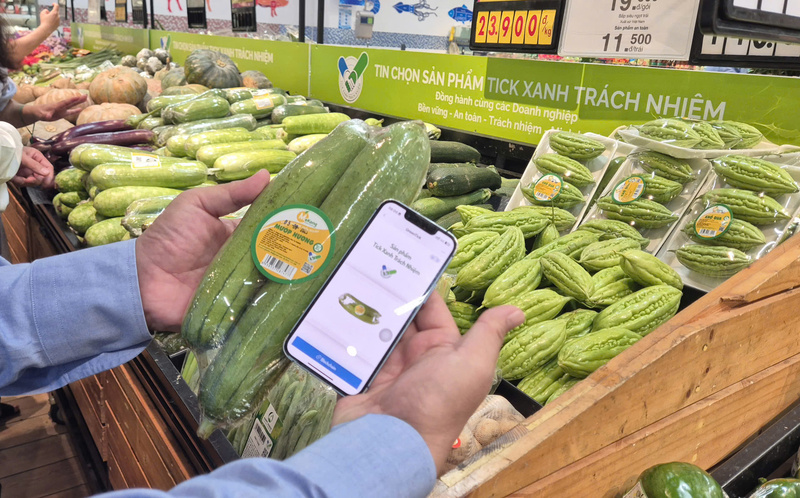
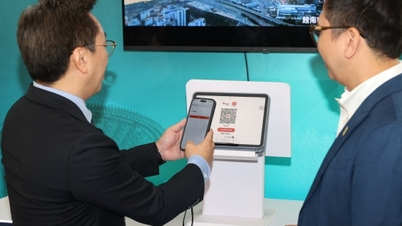
The "Green Tick of Responsibility" program was implemented by Ho Chi Minh City in many retail systems (Photo: VTV)
Therefore, wherever the green tick appears, consumer behavior changes. People no longer just look at the price and expiry date, but look deeply into the origin, process, and testing - things that were previously difficult for them to access. This is a fundamental change, because for the first time, trust is "quantified" through QR traceability data and a public evaluation process.
After more than a year and a half of implementation, according to the Department of Industry and Trade of Ho Chi Minh City, the program has attracted 12 large retail systems, 389 suppliers and 4,012 qualified products. The numbers not only show a wide level of participation, but more importantly, reflect a shift: businesses no longer consider safety and transparency as a “compliance burden”, but as a condition for survival in the new market competition.
The more than 20% increase in sales of the blue tick group is clear evidence. A small label but a big impact: encouraging suppliers to invest in traceability, cold storage systems, quality testing; forcing retailers to follow the monitoring process more closely; and most importantly, putting consumers at the center of quality management activities.
The green tick is therefore not only an identification label but also a new standard of civilized retail.
From December 1 to 31, 2025, the simultaneous implementation of “Responsible Green Tick Month” by 12 retail systems shows that the impact of the program is no longer limited to the management scope, but is becoming a real stimulus tool for the market. This is a strategic move, as the year-end shopping season is always a sensitive time for product quality and food safety.
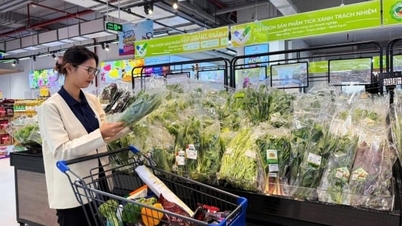
Major retailers have chosen to “boost quality” along with promotions. Saigon Co.op offers a 10-30% discount on more than 100 green-ticked items, MM Mega Market offers an average discount of 20% on more than 220 items; Bach Hoa Xanh aims for 100% of its fresh food products to meet green-tick standards; Central Retail has set up a separate display area and released a catalog with instructions for safe shopping.
These moves are not simply trade incentives. They are signals of market repositioning. In a period when consumers are price-sensitive but increasingly demanding about quality, the dense appearance of the blue tick helps Vietnamese goods gain a competitive advantage over goods of unknown origin.
The remarkable point is that all businesses voluntarily speed up the progress and expand the number of qualified products. This "self-conscious initiative" shows that the green tick is creating a natural screening mechanism: businesses that invest systematically will access a wider market; businesses that stay out will be pushed to the edge of the game.
In addition to activities at the point of sale, Focus Media's deployment of broadcasting the blue tick recognition on public screens throughout Ho Chi Minh City in December also created a strong media effect. When people see the blue tick in supermarkets, shopping malls, elevators, streets, etc., this green label is no longer a personal choice, but becomes a "market signal" promoting responsible consumption.
This is also the reason why the Department of Industry and Trade proposed expanding the "Green Tick Market" model, helping safe products reach residents, especially during Tet - when demand increases but the risk of counterfeit goods is also high.
Competitive "leverage"
In the context of the Vietnamese retail system moving from the stage of expanding quantity to the stage of competing by quality, the blue tick appears at the right time. It does not replace businesses, but forces them to change. It is this positive binding that is the long-term value of the program.
The green tick motivates Vietnamese suppliers to seriously invest in quality, instead of chasing low prices. When traceability is standardized, domestic products have the opportunity to demonstrate their natural advantages: high freshness, clear origin, competitive prices. This helps Vietnamese products not only stand firm, but also increase their value in the domestic market.
However, the program also exposed a reality: many small businesses are still hesitant to participate because of the costs of packaging, testing, and tracing. Some distribution systems are not deployed evenly due to a lack of responsible personnel or intermittent information. This shows that in order for the green tick to become a common standard, it is necessary to continue to perfect a unified set of criteria, invest in regional-scale inspection centers, and standardize "green" logistics infrastructure.
Nevertheless, the progress that has been made is clear. With more than 4,000 certified products, strong sales growth, supermarkets launching dedicated display areas, and people shifting to responsible consumption, the green tick is becoming a “common language” between managers, retailers and consumers.
It is in this process that quality Vietnamese goods are gradually regaining their position: not only because of good prices, but also because of transparency, safety and responsibility. That is the sustainable key to conquering the market.
The Blue Tick Responsibility Program is a voluntary supplier responsibility program that is ready to recall defective products. Retailers are jointly committed to cross-monitoring, while consumers are invited to participate in testing, monitoring and feedback. In the long term, the program opens up opportunities for sustainable cooperation between manufacturers and distributors, enhancing market reputation for transparent and responsible products.
Source: https://congthuong.vn/tick-xanh-trach-nhiem-tai-thiet-niem-tin-trong-tieu-dung-do-thi-433042.html



![[Photo] Worshiping the Tuyet Son statue - a nearly 400-year-old treasure at Keo Pagoda](/_next/image?url=https%3A%2F%2Fvphoto.vietnam.vn%2Fthumb%2F1200x675%2Fvietnam%2Fresource%2FIMAGE%2F2025%2F12%2F02%2F1764679323086_ndo_br_tempimageomw0hi-4884-jpg.webp&w=3840&q=75)
![[Photo] Parade to celebrate the 50th anniversary of Laos' National Day](/_next/image?url=https%3A%2F%2Fvphoto.vietnam.vn%2Fthumb%2F1200x675%2Fvietnam%2Fresource%2FIMAGE%2F2025%2F12%2F02%2F1764691918289_ndo_br_0-jpg.webp&w=3840&q=75)













































































Comment (0)