

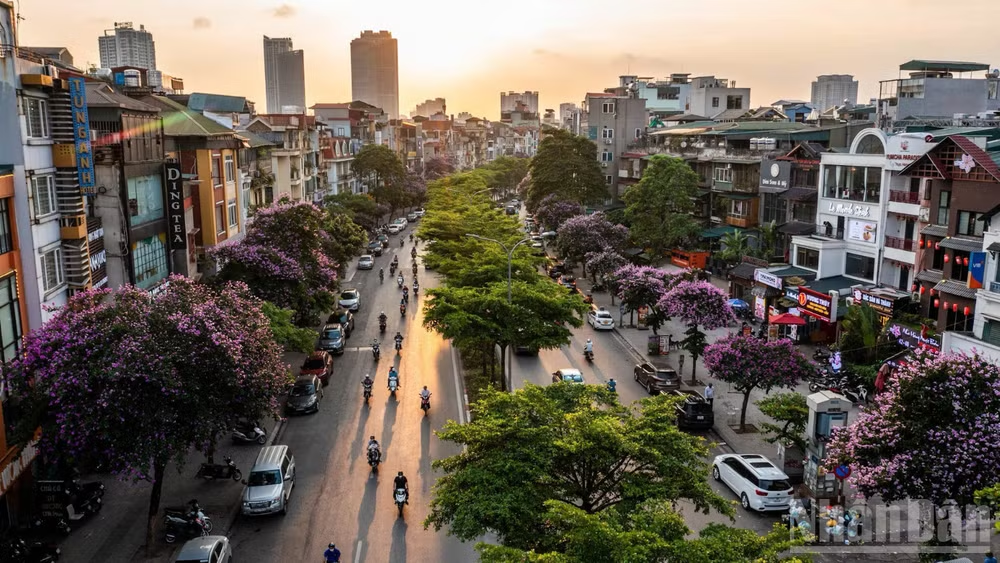
According to the Vietnam National Tourism Administration, the development of the "Developing Tourism into a Key Economic Sector in the New Era" project was carried out in a very short time, with high demands on both progress and quality. The Vietnam National Tourism Administration worked urgently and continuously, coordinating closely with many relevant agencies and units, as well as experts, to ensure the comprehensiveness of the project's content.
Promoting digital transformation and human resource development.
Assessing the development of the tourism industry, the Director of the Vietnam National Tourism Administration, Nguyen Trung Khanh, stated: "Although Vietnam's tourism has recovered strongly and regained high growth momentum, realizing the goals of welcoming 45-50 million international tourists, serving 160 million domestic tourists, and contributing approximately 14% to GDP by 2030 remains a huge challenge, given that Vietnam's tourism industry has been severely affected by the Covid-19 pandemic, which has slowed down its growth by about 5 years."
Emphasizing the need to improve the economic efficiency of the tourism industry, the Director of the Vietnam National Tourism Administration, Nguyen Trung Khanh, stated that tourism should not only grow in terms of the number of tourists but also increase the real value that the Vietnamese economy gains from tourism. Many major issues such as the quality and scale of tourism businesses, human resource development, and policies to promote digital transformation in the tourism industry also need to be considered.
Against this backdrop, groundbreaking and innovative solutions are needed, along with a high level of resource allocation. Many issues require simultaneous solutions, such as visa policies, infrastructure investment, product development, marketing and promotion, and especially digital transformation.
Although Vietnam's tourism industry has recovered strongly and regained high growth momentum, realizing the targets of welcoming 45-50 million international tourists, serving 160 million domestic tourists, and contributing approximately 14% to GDP by 2030 remains a huge challenge, especially considering that Vietnam's tourism industry has been severely affected by the Covid-19 pandemic, which has slowed down its growth by about 5 years.
Director of the Vietnam National Tourism Administration, Nguyen Trung Khanh
Mr. Dang Ha Viet, Director of the Department of Science, Technology, Training and Environment (Ministry of Culture, Sports and Tourism), stated: "The project needs to clearly identify digital transformation, science and technology, and innovation as the breakthrough pillars of the tourism industry in the coming period."
To clearly define Vietnam's tourism development model in the new era, it is necessary to promote data-driven tourism governance, build a national tourism database, accelerate the application of AI, Big Data, and digital twins in destination management, and enhance tourist experience and management efficiency. In addition, attention should be paid to new trends such as green tourism, low-carbon tourism, energy transition, and the development of a system of indicators to assess the quality of tourism growth in the new context.
Sharing the same view, Deputy Director of Phenikaa University, Tran Thi Minh Hoa, said that the project needs to update new trends such as the impact of artificial intelligence (AI) technology on the tourism industry and the emergence of the slow travel trend. In addition, it is necessary to carefully review the growth targets to ensure they are feasible and relevant to reality.
According to representatives from Phenikaa University, tourism needs to be closely linked with the cultural industry, sports, and major events to create new growth drivers and enhance destination attractiveness. The entire industry also needs to focus more on developing the private sector, public-private partnerships, and large enterprises in forming a tourism ecosystem that is competitive regionally and internationally.
Based on that, to further clarify the goal of developing tourism into a key economic sector, the plan needs to include quantitative analyses of tourism's contribution to GDP. Simultaneously, comparisons and analyses both domestically and internationally should be made to clarify the sector's leading role.
According to Mr. Doan Manh Cuong, representative of the National Assembly's Committee on Culture and Society, the Project needs to clarify the role and position of tourism in the new development phase of the country, placing it in close connection with the development of the cultural industry, digital economy, creative economy, and promoting the soft power of Vietnamese culture.
Mr. Doan Manh Cuong also emphasized the need to develop breakthrough mechanisms and policies for key tourist areas, promote night-time economy, cultural tourism, and new tourism models. Simultaneously, strengthening linkages between tourism and related industries is crucial to improving growth quality, enhancing experiences, increasing spending value, and boosting the competitiveness of Vietnamese tourism in the coming period.
Developing tourism in conjunction with creativity, culture, and the unique advantages of each region.
The central focus of the draft plan "Developing tourism into a key economic sector in the new era" is to assess the results of implementing Resolution 08-NQ/TW of the Politburo on developing tourism into a key economic sector. This content not only focuses on leadership, guidance, and institutionalization of the Resolution but also comprehensively reviews the development results of the tourism industry after nearly 10 years of implementation, including the contribution of tourism to the economy, market development, products, infrastructure, businesses, human resources, and state management.
Based on that, the draft plan focuses on identifying existing shortcomings, limitations, causes, and especially major bottlenecks hindering the development of the tourism industry. The plan also includes research on international experiences to draw lessons and suggest appropriate directions for Vietnam in the context of tourism being a sector with deep international integration.
According to Nguyen Thi Thu Phuong, Director of the Vietnam Institute of Culture, Arts, Sports and Tourism, the draft plan has shown significant improvements in structure, content, and logic compared to previous drafts. However, to ensure persuasiveness and meet the requirements for submission to competent authorities, she believes the plan needs to further clarify the meaning of "new era," affirming more clearly the role of tourism not only as a comprehensive, interdisciplinary economic sector but also as a field closely linked to the cultural industry and a national soft power.
Nguyen Thi Thu Phuong, Director of the Vietnam Institute of Culture, Arts, Sports and Tourism, also emphasized the need to highlight the groundbreaking nature of the Project through specific mechanisms and policies on decentralization and delegation of power, superior policies for businesses, and mechanisms for linking tourism with culture, trade, transportation, urban areas, and related sectors.
In the context of reorganizing development spaces and local government models, it is necessary to clarify the development orientation of tourism centers and destinations, linking them with creativity, culture, and the unique advantages of each region.
Mr. Nguyen Manh Hung, Deputy Director of the Social Affairs Department (Central Committee for Policy and Strategy), suggested that the Project should conduct a thorough and comprehensive assessment of the implementation of Resolution 08-NQ/TW, clarifying the achievements, bottlenecks, and shortcomings in the implementation process.
"It is necessary to clarify the meaning of tourism as a key economic sector, supplementing breakthrough solutions in institutions and inter-sectoral and inter-regional coordination mechanisms. In addition, it is crucial to improve the quality of tourism statistics and data to serve policy planning, develop large-scale private tourism enterprises capable of leading the market and creating a competitive tourism ecosystem in the new era, as well as prioritize the development of high-quality tourism segments with high added value…," Mr. Nguyen Manh Hung added.
The draft plan outlines eight key tasks and solutions, including: innovating thinking, raising awareness and leadership responsibility in tourism development; perfecting institutions and policies, creating strategic breakthroughs, and unlocking resources for tourism development; developing infrastructure, mobilizing resources, and forming highly competitive tourism centers; restructuring the market, developing high-value tourism products, and improving the economic efficiency of tourism.
Alongside this, breakthroughs in tourism promotion and marketing are needed to elevate the brand of Vietnamese tourism; develop human resources, businesses, and the tourism community to meet new development requirements; promote the application of science and technology, innovation, digital transformation, and the development of smart tourism; and innovate methods of state management to improve the quality of green, smart, safe, and sustainable tourism destinations.
Source: https://nhandan.vn/tim-giai-phap-de-du-lich-dot-pha-trong-ky-nguyen-moi-post962962.html












![[Video] Weather forecast for May 25, 2026: Intense heat will blanket Northern and Central Vietnam, with temperatures exceeding 40 degrees Celsius in some areas.](https://vphoto.vietnam.vn/thumb/402x226/vietnam/resource/IMAGE/2026/05/25/1779663766038_thumb-sang-png.webp)
































































Comment (0)