

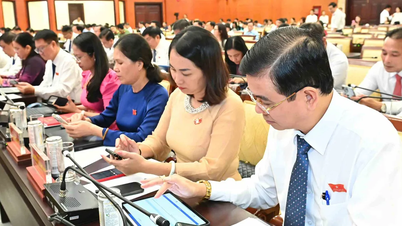
The Ho Chi Minh City People's Committee has just submitted a document to the Ho Chi Minh City People's Council, proposing specific policies to strengthen and improve the capacity of medical stations throughout the city.
Currently, the city's health care network includes 164 hospitals, 38 health centers, 168 health stations and 296 stations, along with more than 10,000 private clinics. In recent years, this network has shouldered a huge volume of medical examination and treatment, with nearly 45.6 million visits in 2024 (in Ho Chi Minh City) and a large number of patients from neighboring provinces.
However, the HCMC People's Committee assessed that health stations are still a "weak link" due to a lack of doctors, unsynchronized human resources, inadequate treatment, and difficulty in attracting and retaining young health workers. Many places have not yet fully promoted the role of "gatekeeper" in primary health care.
After the merger, these limitations became more evident in rural, suburban and island areas, while the need for health care increased rapidly.
In the 2022-2025 period, Ho Chi Minh City has implemented specific policies according to 2 Resolutions of the People's Council, helping to increase the number of doctors at health stations to 617 people (including 153 retired doctors attracted by the policy), expanding 94 health stations operating according to the principle of family medicine and 213 health insurance examination stations.
However, the specific policies under the above two resolutions will expire at the end of 2025 and have not yet covered the entire Ho Chi Minh City after the merger.
Therefore, the City People's Committee proposed to issue a new Resolution applicable to the entire city after the merger, inheriting suitable policies and adjusting them to the new legal and organizational context.
Specifically, Ho Chi Minh City proposed two main policy groups.
First, the policy is to attract elderly workers with medical expertise to participate. These are retired doctors, nurses, midwives, physicians or those in the group of elderly workers who are still healthy and have a practice license (except for preventive medicine).
Doctors will be supported with 9 million VND/month/person along with compulsory insurance contributions as prescribed. Nurses, midwives, and medical assistants will be supported with 7 million VND/month/person along with corresponding insurance policies. The city emphasizes that this is a way to take advantage of experienced human resources to compensate for the current shortage of human resources at the grassroots level.
Second, the policy supports the cost of contract staff, janitors, and security guards at medical stations and stations, for those who do not receive salaries from the budget or salary fund of the public service unit. The support level is calculated according to the minimum wage of region I and includes the compulsory social insurance, health insurance, and unemployment insurance contributions for employees, to ensure that each station and station has enough staff to serve and protect, so that the medical team can focus on their expertise.
The total estimated budget for implementing the two groups of policies mentioned above is about 150 billion VND/year, from the city budget. In addition, the city proposed a transitional provision to continue paying support for 274 doctors participating in the "general hospital attached to health station" practice course according to the old policy until the program is completed.
Adjusting investment policy for High-tech Treatment Center of Children's Hospital 2
The Ho Chi Minh City People's Committee also submitted a document to adjust the investment policy of the project to build a high-tech treatment center of Children's Hospital 2, with a proposal to maintain the scale of 350 beds, 16 operating rooms, but add a series of technical systems, synchronous equipment (operating room furniture, clean air system, RO, UPS, BMS, IT, nurse call...), increase the total investment from 752 billion VND to 1,052 billion VND, extend the implementation period until the end of 2026 and move the project from group B to group A.
The adjustment aims to ensure that when completed, the new building will have a full range of specialized technical systems, ready for the goal of building Children's Hospital 2 into a leading pediatric surgery and organ transplant center in the Southern region.
Source: https://www.sggp.org.vn/tphcm-de-xuat-chi-hon-150-ty-dongnam-de-nang-cao-nang-luc-tram-y-te-post827515.html




![[Photo] Urgently help people soon have a place to live and stabilize their lives](/_next/image?url=https%3A%2F%2Fvphoto.vietnam.vn%2Fthumb%2F1200x675%2Fvietnam%2Fresource%2FIMAGE%2F2025%2F12%2F09%2F1765248230297_c-jpg.webp&w=3840&q=75)



















































































Comment (0)