

Gardeners here say: "Necessity is the mother of invention", going against the grain to "avoid" salinity helps protect the garden from climate change; helps gardeners avoid the situation of "good harvest, low price"...
|
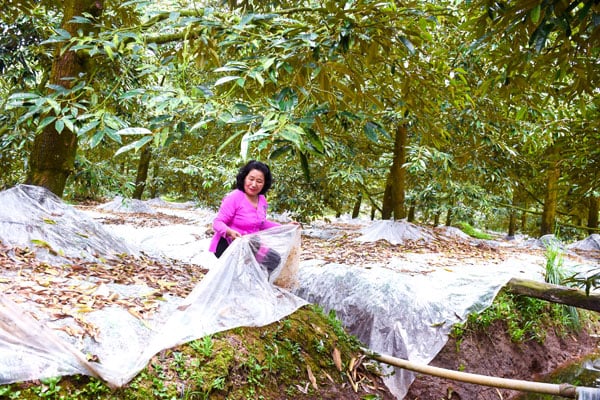
Covering the base of the tree with tarpaulin is one of the necessary techniques to handle durian flowering in the off-season. |
"Avoid" saltiness effectively
“Avoiding salinity” and avoiding “good harvest, low price” are the reasons why Tan Phu Agricultural Cooperative has shifted 3/4 of its growing area from seasonal production to off-season fruit cultivation. Ms. Nguyen Thi Thinh, Director of Tan Phu Agricultural Cooperative, said that the Cooperative currently has more than 300 members, with 800 hectares of SR cultivation.
The conversion of SR production for off-season fruit to avoid salinity brings high efficiency to the members of the Cooperative. Although the investment cost of SR cultivation for off-season fruit increases by 30-40%, but with the yield of 2.5-3 tons/1,000m2 and the selling price 2-3 times higher than the normal crop, the economic efficiency is greater.
Ms. Cao Thi Chien - Head of the Tan Phu SR Cooperative (member of Tan Phu Agricultural Cooperative) analyzed: It takes more than 6 years from planting to harvesting SR plants. If cultivation encounters drought and salinity, the plants will be exhausted and die, causing farmers to suffer huge losses. Off-season production is a creative way of doing things for the people, bringing many advantages.
Because after the harvest, after Tet is the time when the salt water rises, the tree will no longer bear fruit so it will not need much water. Therefore, it will be less exhausted due to water shortage during the drought season.
The trees bear fruit from now until Tet, the harvested fruit can be sold for 2-3 times higher, because it does not overlap with other provinces.
Therefore, in recent years, the Cooperative has recommended that people should do the off-season crop. Although it is more difficult, the profit is higher. The salt-capped trees will maintain better health, easily overcome the drought and salinity season and recover more quickly.
Off-season production is a combination of technical solutions to adjust flowering time, cover, drip irrigation, nutrient treatment and disease prevention, to ripen fruit before the severe salinity period hits or after the salinity subsides.
This model requires higher input costs, more care and skillful techniques, but in return, the selling price increases sharply because of reduced supply during the market cycle and standard fruit quality.
Mrs. Chien took us to visit 2 SR gardens, with a total area of over 1.1 hectares. Both gardens were processed in the opposite season, to produce fruit at 2 different times. Looking at the SR trees bearing fruit from the roots to the top, we could not help but be surprised. Because, it is rare to produce in the opposite season and have such a good harvest.
“The techniques of the people in Tan Phu are now very good, they can produce fruit at any time. If the weather is favorable, the harvest will be better than the whole season” - Mrs. Chien happily said.
Official export opportunities
Mr. Nguyen Van Hung - owner of Nguyen Vu SR warehouse (Tan Phu Agricultural Cooperative) said that in recent years, the price of off-season SR has been stable at a high level.
This year's off-season crop is currently priced at 60,000-70,000 VND/kg. Farmers are quite satisfied with profits of 20,000-30,000 VND/kg. There was a time when the price of off-season SR fluctuated from 120,000-170,000 VND/kg, farmers earned 3-5 times more profit than the season crop.
Currently, the whole province has more than 6,000 hectares of SR. Tan Phu Agricultural Cooperative alone has about 800 hectares; of which, 200 hectares meet VietGAP standards, 6 growing area codes are licensed for official export to China.
SR products of Tan Phu Agricultural Cooperative are recognized to meet 4-star OCOP standards.
Associate Professor Dr. Lam Van Tan - Director of the Department of Agriculture and Environment said that applying production standards, maintaining transparent cultivation records, registering growing area codes, affixing traceability stamps and accessing food safety certificates are necessary conditions like a "passport" to help bring Tan Phu SR fruit into high-end consumption channels and official export.
In recent times, SR Tan Phu has met export standards to large and demanding markets such as the US and China.
Since the historic drought and salinity in 2016 and 2020, "avoiding" salinity by going against the grain has become a survival solution for SR growers in Tan Phu commune.
This unique model can be replicated in other SR growing areas in and outside the province. This is also the story of a farmer who knows how to adapt to challenges, quickly using technology and organization to turn risks into opportunities.
With flexible and effective scientific and technical farming methods, while strictly following safe production processes and maintaining links between gardeners, businesses, authorities and scientists, SR Tan Phu will soon achieve 5-star OCOP standards, sustainable development, and climate change adaptation.
Article and photos: CAM TRUC
Source: https://baovinhlong.com.vn/kinh-te/nong-nghiep/202512/trong-sau-rieng-ne-man-hieu-qua-cao-98b460a/


![[Photo] National Assembly Chairman Tran Thanh Man receives First Vice Chairman of the Federation Council of the Federal Assembly of the Russian Federation](/_next/image?url=https%3A%2F%2Fvphoto.vietnam.vn%2Fthumb%2F1200x675%2Fvietnam%2Fresource%2FIMAGE%2F2025%2F12%2F02%2F1764648408509_ndo_br_bnd-8452-jpg.webp&w=3840&q=75)














































![[Photo] General Secretary To Lam and his wife attend the 50th Anniversary of Laos National Day](https://vphoto.vietnam.vn/thumb/402x226/vietnam/resource/IMAGE/2025/12/02/1764644139308_1.jpeg)





















Comment (0)