

 |
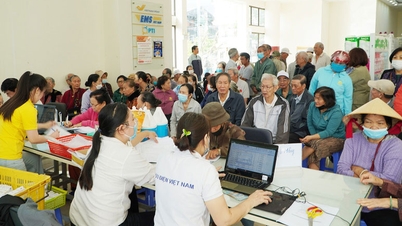
| Retired officials are happy to receive their pensions through their bank accounts. Photo: Ngoc Hoa |
Expanding voluntary savings channels
After many years working in the tourism industry in Hue, 34-year-old Nguyen Thi Thu Ha, residing in Thuan Hoa ward, began to think more about her old age. Unlike previous generations, she is not entirely secure about her pension from mandatory social insurance. "My current income is stable, but I'm not sure what will happen after retirement. Having some personal savings would make me feel more secure," Ms. Ha shared.
To implement the Social Insurance Law of 2024, on March 25, 2026, the Government issued Decree 85/2026/ND-CP on supplementary pension insurance (effective from May 10, 2026), replacing Decree 88/2016/ND-CP. The purpose is to further improve the legal framework for the operation of the supplementary pension insurance fund, while contributing to diversifying the social security system, reducing pressure on the state budget, and promoting the development of the capital market in accordance with international practices.
Supplementary retirement insurance is a voluntary, market-based scheme designed to supplement mandatory social insurance retirement benefits. Participants will have a personal retirement account, accumulated from their own contributions or those of their employer, and invested to generate long-term returns.
A notable aspect of Decree 85 is the improvement of the contribution-payment mechanism, the expansion of the investment portfolio, and the strengthening of management and supervision. The fund is permitted to invest in government bonds, listed securities, investment fund certificates, etc., ensuring both safety and increased profitability. Simultaneously, the regulatory authority strengthens supervision through reporting mechanisms, information disclosure, and regular and unscheduled inspections.
Workers and businesses are starting to pay attention.
Although the concept of supplementary retirement insurance is still relatively new, some businesses and employees have begun to explore it. Mr. Tran Van Hung (29 years old, an employee of a travel company in Hue City) said: “Before, I only knew about mandatory social insurance. Recently, my company mentioned supplementary retirement insurance, so I've been looking into it. If there's a suitable policy, I'll participate, because this is my long-term savings.”
From a business perspective, Ms. Le Thi Minh Trang, a representative of a service company in Hue, believes this could be a tool for retaining employees. If businesses contribute to the retirement fund for their employees, it would also be a long-term benefit. However, the important thing is that the policy must be clear and transparent to build trust.
In reality, supplemental retirement insurance is not mandatory, but entirely voluntary on the part of both employees and businesses. Participants will own a personal retirement account, accumulated from contributions and investment profits. These funds are operated by licensed insurance companies or investment fund management companies.
According to the plan, in the coming period, the Ministry of Finance will continue to refine policies, including researching tax incentives to encourage workers and businesses to participate. At the same time, it will strengthen supervision to ensure that the funds operate transparently, safely, and effectively. Another issue under study is allowing individuals to directly participate in supplementary retirement insurance, instead of only through businesses as is currently the case. If implemented, this would be a significant expansion, helping more workers access this financial tool.
For Ms. Thu Ha, the most important thing is still proactiveness: "While we're young, we should think early. Having some savings for the future, even a small amount, is a way to feel more secure later on." In the changing social security landscape, options like supplemental retirement insurance may not be immediately widespread, but they are gradually becoming a part of workers' long-term financial plans.
Source: https://huengaynay.vn/doi-song/tru-cot-an-sinh-moi-tu-quy-huu-tri-bo-sung-165581.html




































































































Comment (0)