

The story of the rise of China's robotics industry exploded from a heated debate on social network X (formerly Twitter) in mid-November. The center of attention was UBTECH Robotics - a technology "unicorn" from Shenzhen.
When the company released a video of hundreds of Walker S2 humanoid robots lined up in a warehouse, turning their heads, waving their arms in unison, and entering a shipping container, viewers immediately thought of the sci-fi movie "I, Robot." The scene was so smooth, so synchronized, and so futuristic that Brett Adcock, founder and CEO of Figure, a leading robotics company in the US, couldn't believe his eyes.
"Look at the reflection. The robot in front is real, and everything behind is fake. Just by looking at the reflection of the ceiling light, you can tell it's CGI (computer-generated imagery)," the American CEO asserted on his personal page. This accusation is not just a technical comment, but also reflects the general psychology of the West: deep skepticism about the true capabilities of Chinese technology.
However, the response to that doubt was not silence, but a strong affirmation from UBTECH. The company representative claimed that the video was "100% real footage", filmed in one take, and invited critics to come directly to Shenzhen to "open their eyes". According to them, the American doubt stems from a lack of understanding of the supply chain strength and large-scale manufacturing capabilities that China holds.
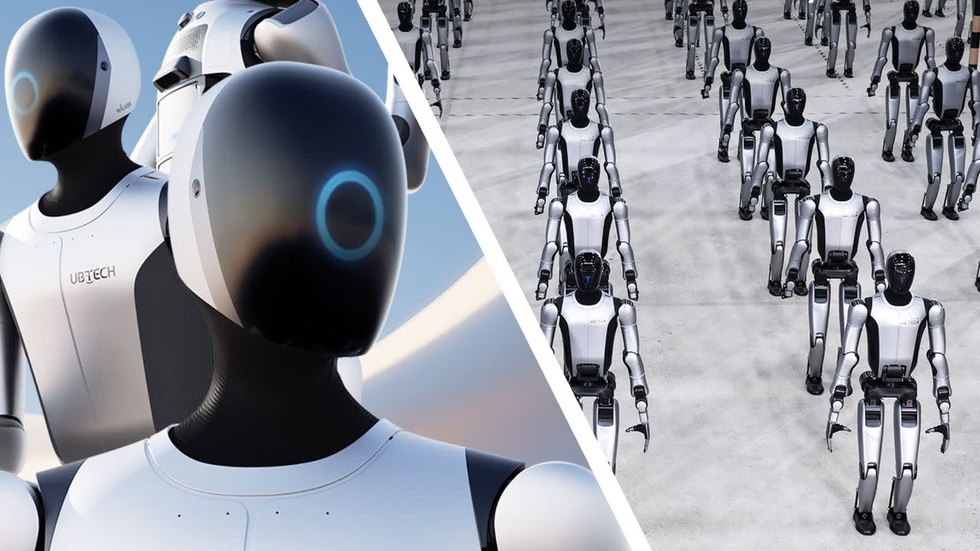
China's robot army is so perfect that the CEO of an American robot company accused: "This is definitely fake" (Photo: UBTech).
This “true-false” story is just the tip of the iceberg. It reveals a reality that Western investors and policymakers are facing: China is no longer a low-cost manufacturing factory, but is transforming itself into a robotics powerhouse with a speed and scale that makes the whole world wary.
The flood of robots in the factory and the dramatic change of position
According to the latest report from the International Federation of Robotics (IFR), a dramatic "change of throne" has been taking place quietly but drastically in the global robot industry.
China is now the clear leader in the race to put robots in factories. In the past year alone, factories in the country installed nearly 300,000 new robots. This is not only a record, but also a terrifying statistic: China has installed more new robots than the rest of the world combined.
To put this gap in perspective, look to the US – the world's largest economy – where factories installed only about 34,000 robots during the same period.
This disparity is no coincidence. It is the result of a long-term national strategy called “Made in China 2025,” where Beijing has identified robotics as a strategic front in restructuring the economy. For more than a decade, huge amounts of capital from the state budget and preferential loans from state-owned banks have flowed into the sector, creating an unprecedented acceleration.
What’s more worrying for Western rivals is that China isn’t just importing and using. It’s rapidly mastering the technology. Whereas in the past Chinese factories were filled with Japanese or German robot arms, the tide has turned. Last year, nearly 60% of the robots installed in China were domestic products. China’s share of the global robot market jumped to 33%, while the “former king” Japan sadly dropped to 29%.
Analysts point out that China has a dual advantage that no other country has: a huge domestic market to consume products, and a flexible hardware manufacturing capacity that allows them to test, fail, and fix errors at the speed of light. The "trial - error - improvement - iteration" cycle in Shenzhen or Hefei is much faster than in Silicon Valley.
Once a prototype is proven effective, the factory system here can produce thousands of units in just a few weeks - which explains the "robot army" images that the American CEO thought were artificial.
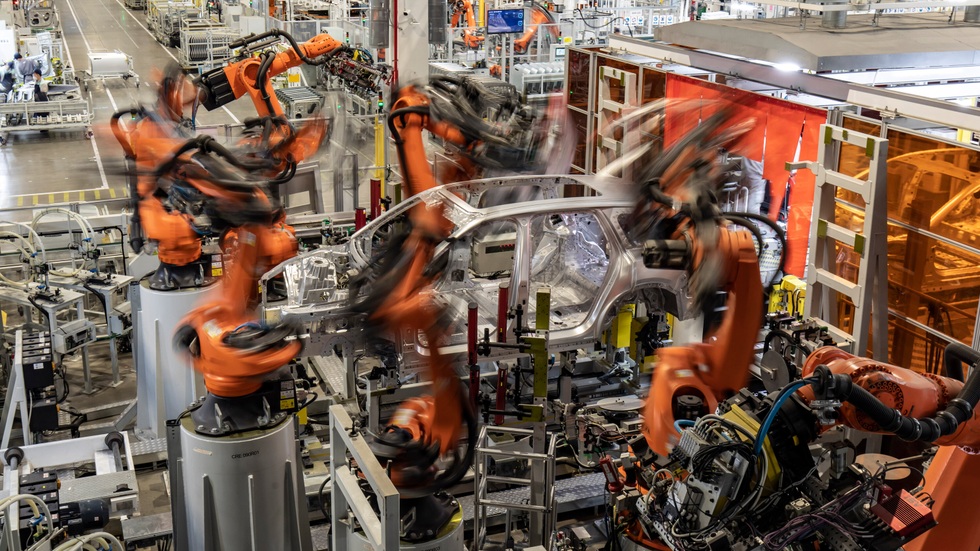
China is manufacturing and installing robots in factories at a rate far exceeding every other country, while the US - the third-ranked country - is far behind (Photo: NYT).
The survival war of 150 unicorns
Besides the well-established industrial robotics (robotic arms), another more fierce race is taking place: Humanoid robots. This is where the competition in China is reaching a "melting pot".
At the beginning of this year, the world recorded about 100 companies developing humanoid robots. But just a few months later, in China alone, that number jumped to 150. The boom was so strong that China's National Development and Reform Commission (NDRC) had to issue a warning about "duplicated innovation" and resource surplus.
Why the boom? The answer lies in a combination of venture capital and government support, estimated to be as much as $138 billion for the national robot push. Startups like Hangzhou-based Unitree Robotics are disrupting the market by claiming to sell basic humanoid robots for as little as $6,000—a “unimaginable” price compared to products from Boston Dynamics (USA) that cost tens or even hundreds of thousands of dollars.
Many Western economists look at this phenomenon and call it a "bubble". However, economic history shows that bubbles are not always bad. Dr. Robert Ambrose, former head of NASA's Robotics & AI department, compared China's current situation to the dot-com bubble in the US in the 1990s. At that time, a series of internet companies went bankrupt, investors lost everything, but from the ashes, giants like Amazon or Google rose and dominated the world.
In China, the pressure to survive among 150 companies is creating a veritable Roman arena. To survive, they are forced to constantly innovate, cut costs and commercialize products as quickly as possible. This fierce competition is the driving force behind products that are "killer" in price and performance. Even if 100 companies go bankrupt, the remaining 50 will be able to overwhelm the number of American companies.
However, the fatal weakness of this "army" still lies at the heart of the robots: semiconductor chips and high-end sensors. China can produce the chassis, joints and control AI programming, but the most sophisticated components still depend on German or Japanese technology. As Lian Jye Su, an expert from Omdia, commented: "If you want to assemble a truly top-notch humanoid robot, there will be almost no Made in China components inside."
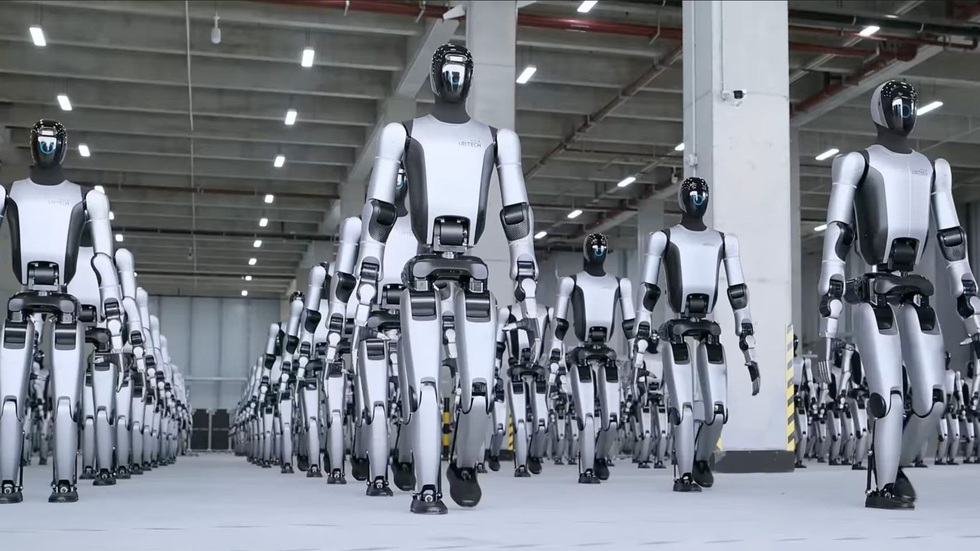
In China, there are about 150 businesses developing humanoid robots (Photo: UBTech).
A Warning for America and the Future of Geopolitics
The robot race today is not simply a story about business or profit, but it is becoming the new foundation for geopolitical power of the 21st century.
Dr. Robert Ambrose makes a haunting comparison: In 1900, New York was filled with horse-drawn carriages. Just 13 years later, the same place was dominated by automobiles. That rapid change transformed America into an economic superpower thanks to the automobile industry. Today, robots are playing a similar role. The nation that masters this machine workforce will solve the problem of aging populations, bring manufacturing back home, and gain military superiority.
China is using AI to "scrutinize" each machine in the factory, optimizing performance down to the second, something the West has yet to truly implement synchronously. The combination of AI and Robots (artificial intelligence embodiment) is helping China compensate for increasingly expensive labor costs, maintaining its position as the "world's factory".
Meanwhile, the United States seems to be falling behind in the very game it once led in innovation. Despite still possessing brilliant minds and a “chaotic but groundbreaking” startup culture, the lack of consistent government support policies is leaving American companies outpaced by the huge capital flows from competitors on the other side of the hemisphere.
Dr. Ambrose's warning is perhaps the most profound one for investors and policymakers to ponder right now: "If we do nothing, Japan will probably rise to number two. China will certainly be number one. And America? We will slide into a race to the bottom. And that prospect of falling behind, in my opinion, is not very American."
Source: https://dantri.com.vn/kinh-doanh/trung-quoc-lap-300000-robotnam-cuoc-dua-khong-doi-thu-20251206211455467.htm




























































































Comment (0)