

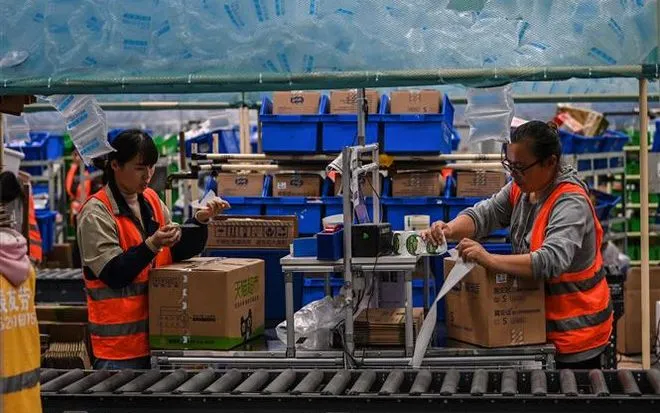
Employees pack goods at an Alibaba logistics branch in Wuxi, Jiangsu province, China. (Photo: AFP/VNA)
China's tax authorities have for the first time asked major e-commerce platforms, including Amazon, AliExpress, Temu and Shein, to provide sales data for domestic sellers, in a bid to curb underreporting of sales to evade taxes and to strengthen oversight of cross-border businesses.
Platforms have begun handing over data, giving tax authorities an accurate picture of the actual scale of their businesses. Many sellers said that after the data was provided, they received messages, calls and even tax officers visiting their places asking them to pay taxes. Faced with pressure, some businesses have chosen a “wait and see” strategy to assess the determination of tax authorities.
Under current law, companies with annual revenues exceeding 5 million yuan (about $703,000) are subject to VAT of up to 13%, in addition to corporate tax. To qualify for tax exemption, sellers need to provide valid export documents, which many online businesses struggle to meet. Reporting data that matches reality can cost many sellers their profit margins.
The explosion of Chinese sellers into global markets is clear. The September Marketplace Pulse report showed that, for the first time, Chinese sellers accounted for more than half of all sales on Amazon globally. The tax collection comes as China needs to boost its budget and support small exports that are under pressure from international trade barriers, including the US’s removal of the de minimis threshold.
The move is seen as the next step in China's comprehensive effort to strengthen tax collection and fight tax evasion, following measures on overseas income and the implementation of the Common Reporting Standard (CRS) system.
Source: https://vtv.vn/trung-quoc-siet-thue-voi-nha-ban-hang-tren-san-thuong-mai-dien-tu-100251114155011079.htm

![[Photo] Unique art of painting Tuong masks](https://vphoto.vietnam.vn/thumb/1200x675/vietnam/resource/IMAGE/2025/11/14/1763094089301_ndo_br_1-jpg.webp)


![[Photo] Unique architecture of the deepest metro station in France](https://vphoto.vietnam.vn/thumb/1200x675/vietnam/resource/IMAGE/2025/11/14/1763107592365_ga-sau-nhat-nuoc-phap-duy-1-6403-jpg.webp)


























![[Photo] Special class in Tra Linh](https://vphoto.vietnam.vn/thumb/1200x675/vietnam/resource/IMAGE/2025/11/14/1763078485441_ndo_br_lop-hoc-7-jpg.webp)
































































Comment (0)