

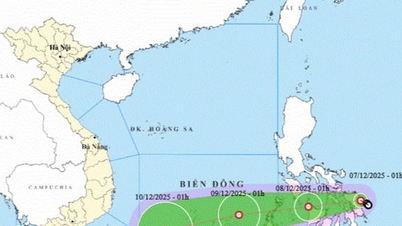
Currently, in the eastern sea of the central Philippines, there is a tropical depression located at about 14 degrees North latitude - 135 degrees East longitude, moving slowly in the North - Northwest direction.
It is forecasted that around December 6-7, this tropical depression will likely pass over the central region of the Philippines and enter the East Sea, possibly strengthening into a storm (storm number 16). The storm is likely to directly affect the mainland of the Central and South Central regions, causing moderate to heavy rain in the provinces from Hue City to Khanh Hoa .
In December 2025, in the Central and South Central regions, there is a possibility of 1-2 widespread moderate and heavy rains, in which rainfall in the area from South Quang Tri to the North of the South Central Coast tends to be higher than the average of many years, so it is necessary to guard against the risk of flash floods and landslides.
In December 2025, cold air will continue to increase in frequency and intensity, and severe cold may appear in the North, concentrated in the northern mountainous areas. Cold air will continue to be active in January and February 2026, causing severe cold spells.
The Southern region is likely to experience heat waves from around early March 2026 in the Southeast region; then from late March to early April 2026, heat waves tend to increase in intensity and gradually expand to the Southwest region (equivalent to the average of many years). The Northwest region and the area from Thanh Hoa to Hue are likely to experience heat waves from around April 2026.
According to a representative of the Department of Hydrometeorology (Ministry of Agriculture and Environment), unusual storm activity and severe, widespread floods in 2025 in Vietnam as well as around the world are clear evidence that traditional flood patterns are changing, reflecting increasingly extreme and unpredictable weather trends due to the impact of climate change.
* Regarding the field, on December 4, the People's Committee of Khanh Hoa province issued an official dispatch requesting agencies, units, and localities to proactively respond to heavy rain, floods, inundation, flash floods, and landslides in the province.
According to Khanh Hoa Hydrometeorological Station, from 8am on December 3 to 8am on December 4, the province will have moderate to heavy rain, the western mountainous area will have very heavy rain; the average rainfall is 50mm - 120mm, some places will be higher. Flood warnings are in the communes and wards of Suoi Dau, Suoi Hiep, Dien Khanh, Dien Dien, Dien Lac, Dien Tho, Tay Nha Trang, Bac Nha Trang, Nam Nha Trang..., the area is likely to continue to spread. Flood depth is 0.5m - 2m, in low-lying areas, it can be over 3m deep.
To proactively respond to heavy rains, floods, inundation, flash floods, and landslides, the Chairman of the Provincial People's Committee requested the People's Committees at the commune level to continue to inspect and review high-risk areas; proactively deploy the relocation and evacuation of people to safe places in accordance with the "4 on-site" motto.
In areas that have been warned by specialized agencies to be at a dangerous level, the evacuation must be completed urgently before the flood situation becomes more complicated. In case people do not comply or deliberately stay in dangerous areas, the Chairman of the Commune People's Committee will resolutely apply coercive measures according to regulations to ensure the safety of people's lives.
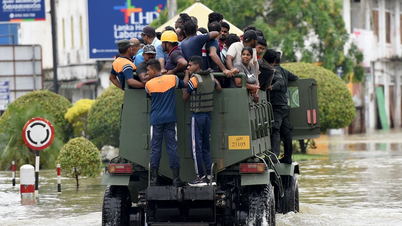
The Provincial Military Command and the Provincial Police mobilized forces and vehicles to flooded localities to support the locality in evacuating people from flooded areas to safe places. The Department of Agriculture and Environment and the Department of Industry and Trade proactively monitored, inspected, and guided the units managing irrigation and hydropower reservoirs to operate in accordance with weather developments and hydrometeorological forecasts and warnings, ensuring water storage for production, construction safety, and flood prevention and control in downstream areas. Reservoir management units adjusted the discharge flow and regulated it appropriately to reduce flood peaks and minimize the risk of flooding in downstream areas.
Source: https://baophapluat.vn/trung-tam-du-bao-khi-tuong-thuy-van-quoc-gia-trong-thang-12-2025-bien-dong-co-the-xuat-hien-tu-1-2-con-bao-ap-thap-nhiet-doi.html


































































































Comment (0)