

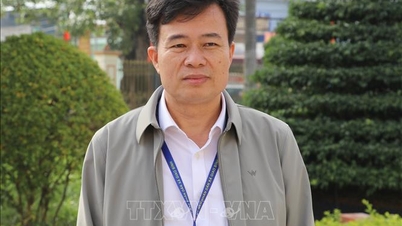
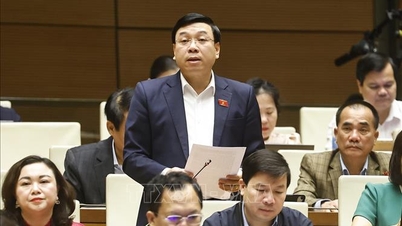
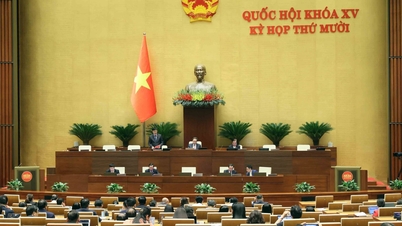
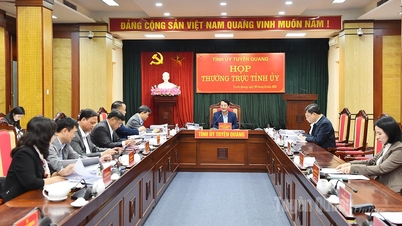
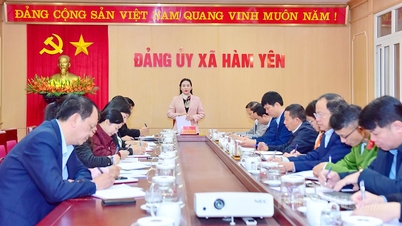
Participating in the discussion, comrade Ly Thi Lan, member of the Provincial Party Standing Committee, Head of the National Assembly Delegation working full-time in the province, raised 5 key groups of recommendations, originating from the practical implementation of tasks in mountainous localities.
 |
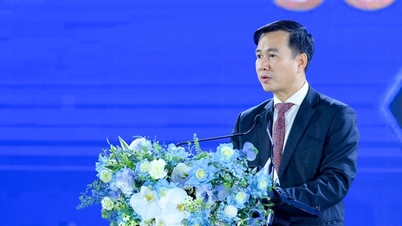
| Delegate Ly Thi Lan spoke in the discussion. |
The delegate said that after studying the proposed documents for acceptance and revision, he found that there were still some issues that needed to be clarified in the policy design and implementation mechanism. Resolution No. 72 of the Politburo identified 6 very large groups of tasks, but in the documents submitted to the National Assembly, the boundaries between the contents that needed to be institutionalized by Law, by Resolution of special mechanism or by National Target Program were not really clear. If not clearly defined, the implementation could lead to resource dispersion, overlapping tasks, difficulty in determining responsibilities and causing difficulties for supervision.
Especially at the commune level, the lack of clarity can cause confusion in policy implementation, especially when management capacity and human resources are limited. To ensure effective implementation of the Program in the coming time, delegates proposed to add Appendix 1 attached to the Resolution to clearly indicate the tasks of Resolution 72 that are implemented by which policy tools, such as the contents on strengthening the grassroots health care model in Article 4, the content of population and development in Article 5, the content of digital transformation in Article 8. At the same time, in Article 10 of the National Target Program, it is necessary to add regulations on the completion roadmap and the agency responsible for each task, thereby ensuring connectivity and transparency in implementation.
Regarding resources for the “population and development” sector, the delegate commented that the current capital ratio is still not commensurate with the requirements of population restructuring, especially in the context of declining birth rates, population aging occurring faster than expected, increasing gender imbalance at birth and low population quality in disadvantaged areas. The delegate suggested reviewing and increasing the capital ratio for the population and development sector in Clause 2, Article 1 of the Program, in the direction of clearly defining the minimum allocation level and commensurate with the target of population restructuring in the new context.
At the same time, in Clause 3, Article 3, it is necessary to add mandatory indicators such as prenatal screening, newborn screening, maintaining reasonable birth rates and elderly care, as a basis for resource allocation and evaluation of implementation results. In addition, in Article 7 of the Resolution on specific mechanisms, delegates proposed to clarify the mechanism linking population policy and health policy so that these two areas can be implemented synchronously in the same program.
Regarding the grassroots health workforce, the delegate emphasized that this is the biggest bottleneck in many mountainous areas. Many localities only have less than 10 doctors per 10,000 people; the ratio of nurses and technicians has not met the recommended standards; the regime for village health workers and population collaborators is still limited. Meanwhile, the facilities at many commune health stations are degraded, the equipment is not synchronized and outdated. The capacity of regional health centers has not met the requirements for technical support and staff rotation for commune level.
When implementing the two-level local government model, these shortcomings are more evident when the commune level has to undertake a large amount of tasks but lacks the minimum resources to ensure the task of primary health care. Delegates proposed to add "Sub-project 1a - Developing human resources at the commune level" in Clause 4, Article 2 of the National Target Program, including policies to support doctors' contracts for 3-5 years working in the commune; training family doctors and community doctors; continuous training and transfer of non-communicable disease management techniques to the grassroots level.
At the same time, it is proposed to amend Point c, Clause 2, Article 5 of the Resolution on special mechanisms in the direction of increasing the level of support, ensuring a stable regime and truly creating motivation for the village health team and population collaborators; amend Point b, Clause 1, Article 3 to clarify the role of the regional health center as a place to provide technical support, training and rotation of staff for the commune level. "These are very urgent contents, suitable for the two-level local government model and the characteristics of many mountainous provinces and ethnic minority areas" - Delegate Ly Thi Lan emphasized.
Regarding digital transformation of healthcare, delegates said that the goal of 100% of people having electronic health records by 2030 is in line with the development trend, but without synchronous investment, it could increase the gap between mountainous areas and urban areas. Delegates proposed to add regulations on spending on digital transformation infrastructure at commune health stations and regional health centers; develop a unified national health data platform, ensuring connectivity from commune to central levels; and at the same time, propose to add content to pilot the model of "digital family doctor" and "remote consultation" in difficult areas.
Regarding coordination and supervision, delegate Ly Thi Lan said that the simultaneous implementation of many programs at the commune level can easily lead to overlap, resource dispersion and increased reporting burden. Therefore, the delegate proposed to amend Article 9 of the Program to stipulate a focal agency at the provincial level to coordinate the entire National Target Program, in accordance with the two-level local government model.
PV
Source: https://baotuyenquang.com.vn/thoi-su-chinh-tri/202512/truong-doan-dbqh-chuyen-trach-tinh-ly-thi-lan-gan-ket-chinh-sach-dan-so-va-chinh-sach-y-te-de-nang-cao-chat-luong-cham-soc-suc-khoe-nhan-dan-e0b0eb9/
![[Photo] National Assembly Chairman Tran Thanh Man receives First Vice Chairman of the Federation Council of the Federal Assembly of the Russian Federation](/_next/image?url=https%3A%2F%2Fvphoto.vietnam.vn%2Fthumb%2F1200x675%2Fvietnam%2Fresource%2FIMAGE%2F2025%2F12%2F02%2F1764648408509_ndo_br_bnd-8452-jpg.webp&w=3840&q=75)












































































Comment (0)