

Counterfeit goods haven't been completely eradicated yet.
As the most populous locality in the country, Ho Chi Minh City has long been a major consumer market for counterfeit and pirated goods. From mid-2025 to the present, authorities have regularly monitored, detected, and apprehended numerous cases of illegal trading, but the counterfeit goods situation remains sophisticated.
Statistics from the Ho Chi Minh City Market Management Agency show that the areas with the highest concentration of counterfeit goods cases are Hoc Mon commune and Dong Thanh commune (formerly Hoc Mon district). A Market Management officer explained that these areas have large land areas, sparse populations, and many vacant warehouses, making them popular storage locations for goods distributed through various channels, especially social media.

Market management forces destroy confiscated counterfeit goods.
PHOTO: PROVIDED BY MARKET MANAGEMENT DEPARTMENT
For example, in the case of the seizure of an electronics warehouse in this area, authorities discovered 26,200 products of various types with a total value of over 1 billion VND. To conceal its contents and evade detection by investigators, the warehouse displayed no signage and was frequently closed, making surveillance and monitoring extremely time-consuming and labor-intensive.
In reality, the issue of counterfeit and fake goods remains a serious problem in many parts of the country. Recently, through monitoring business activities on the social media platform TikTok, Team 4 of the Market Management Department of Dong Thap province discovered an account named C. regularly livestreaming the sale of ready-made clothing suspected of having unclear origin and source. After identifying the location and verifying signs of violations, Team 4 conducted a surprise inspection of this business in Cho Gao commune and discovered that the establishment was selling 1,100 women's t-shirts of various types with unclear origin and source, lacking labels and certificates of origin. Team 4 issued an administrative penalty decision against business owner C. with a fine of 25 million VND, and confiscated all infringing goods worth 55 million VND.
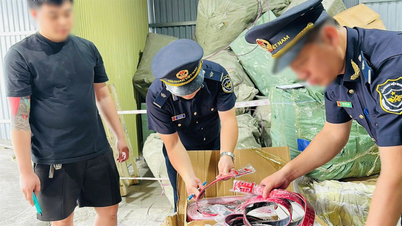
On March 20th, Team No. 1 of the Market Management Department of Tuyen Quang province inspected two pickup trucks suspected of transporting illegal goods. The team proactively coordinated with the Traffic Police and Economic Police Departments of Tuyen Quang Provincial Police to stop the vehicles for inspection. They discovered 2.3 tons of food products, including sausages, crab sticks, dumplings, squid patties, and chicken fillets, all of unknown origin. Team No. 1 has temporarily seized all the illegal goods and the two vehicles for further investigation, completion of the case file, and strict handling in accordance with the law.

Authorities in Tuyen Quang province seized a shipment of smuggled food on March 20, 2026.
PHOTO: PROVIDED BY MARKET MANAGEMENT DEPARTMENT
In Hanoi, during the first three months of the year, the Hanoi City Market Management Department inspected 1,623 cases and handled 1,716 cases; including 660 cases in coordination with the police, 18 cases in coordination with relevant functional agencies, and 24 cases transferred to the investigative agency. The total amount of administrative fines was 30.419 billion VND; the amount of illegally collected goods was 581.57 million VND; and the value of goods sold was 4.385 billion VND. The value of goods destroyed or recycled was 26.3 billion VND, and the value of confiscated goods was 9.9 billion VND…
Bringing counterfeit goods online under scrutiny.
Speaking to a reporter from Thanh Nien newspaper, an officer from Team 4 of the Ho Chi Minh City Market Management Department said: "The internet is a platform that helps those who sell counterfeit goods do so quickly, exploiting the desire for cheap and convenient products among a segment of consumers. Therefore, in addition to improving skills and effectively applying information technology in performing our duties, we are also stepping up propaganda, guidance, and dissemination of legal regulations on e-commerce and encouraging people to proactively report violations."
Hanoi's Market Management Department leaders also agreed that social media has become a popular place for people to trade and shop for goods. Therefore, the 2026 plan outlines focused and targeted inspections; promptly detecting and strictly handling acts of smuggling, commercial fraud, counterfeit goods, goods infringing intellectual property rights, food safety violations, and violations in the e-commerce environment. This will contribute to maintaining market stability, protecting consumer rights, and creating a healthy business environment in the capital city.
In particular, the Ho Chi Minh City Steering Committee 389 has just issued a plan to combat smuggling, trade fraud, counterfeit goods, and intellectual property infringement in the city in 2026. The plan affirms that Ho Chi Minh City is determined to strictly handle acts of smuggling, trade fraud, and counterfeit goods; and identifies that the fight against smuggling, trade fraud, counterfeit goods, and intellectual property infringement must be implemented regularly, continuously, with a focus on key areas, and in strict compliance with the law. Specifically, specialized forces will closely monitor civil airports, road, rail, and waterway routes, wholesale markets, commercial centers, and other trading areas in the interior to effectively detect and prevent smuggling and illegal transportation of goods across borders; trading and transporting prohibited goods, smuggled goods, and goods of unknown origin; tax evasion and trade fraud; and the production and sale of counterfeit goods. Continue to strengthen inspection, control, and handling of cases involving the production and sale of counterfeit goods such as medicines, food, dietary supplements, cosmetics, etc.
A business expert commented that the current solutions in Ho Chi Minh City and other localities are quite comprehensive and accurately assess the increasing concentration of social media platforms. However, in reality, the detection and handling by functional units are still slow, or only deal with large-scale cases. Meanwhile, household and individual businesses are very flexible and have many ways to evade authorities.
To effectively manage the situation, authorities need to enhance the application of digital technology, using artificial intelligence (AI) and big data in monitoring e-commerce, e-commerce platforms, and social networks, in order to promptly detect and handle smuggling, trade fraud, and counterfeit goods.
Currently, the Ho Chi Minh City Department of Industry and Trade and the Market Management Sub-department are strengthening management in the area, compiling a list of organizations and individuals engaged in business activities to develop a monitoring and supervision plan to promptly detect, inspect, and handle violations in trade, services, and e-commerce. This is especially focused on controlling business activities in online environments such as e-commerce platforms, websites, and social networks like Facebook, Zalo, and TikTok.
Online shopping is on the rise.
According to data from the Metric data aggregation and mining platform, it is estimated that in the first three months of 2026, sales on the four e-commerce platforms (Shopee, TikTok, Lazada, Tiki) reached VND 134.6 trillion, a 32.7% increase compared to the same period last year. Of this, more than 1 billion products were sold, a 9% increase. The most frequently traded products on these platforms were cosmetics, fashion, food, and beauty products.
Source: https://thanhnien.vn/truy-quet-hang-gia-tren-mang-185260321164802779.htm

































































































Comment (0)