

According to industry experts, the Korean webtoon industry is at a crucial juncture as the emergence of artificial intelligence (AI) tools is causing heated debate.
The creative industry is one of the first to feel the impact of emerging technology. While webcomic creators are concerned that adopting this technology will affect their uniqueness, they understand that failing to embrace this technology could result in being eliminated from the market.
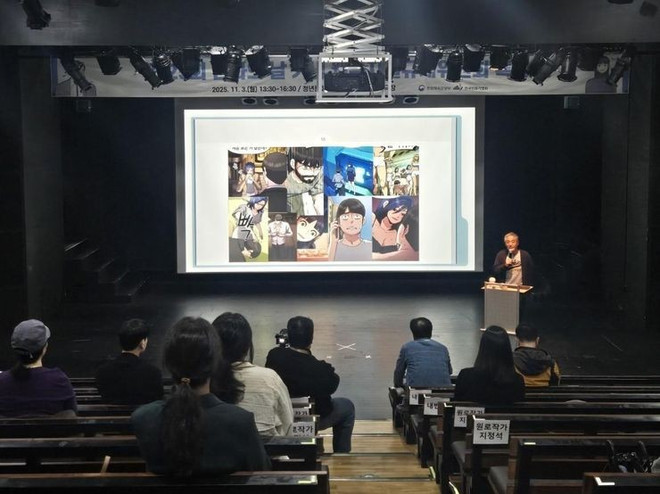
This conflict was a major point of contention during the 25th Korean Comics Day celebration on November 3, where stakeholders gathered to discuss the future of Korean comics.
Organized by the Korea Cartoonists Association, the event attracted more than 160 industry officials and featured a presentation focusing on the challenge of integrating AI.
At the event, cartoonist Kwak Baek-soo said AI is a necessary solution for authors facing fierce competition.
Kwak explains how this technology helps comic artists survive in a fiercely competitive market where major studios create a lot of work in a short amount of time by hiring multiple artists for one work.
“AI assists with scene creation, coloring, and even storyboarding, allowing an artist to overcome time and resource constraints,” says Kwak.
Han Chang-wan, a professor at the Department of Comics and Animation Technology at Sejong University in South Korea, also supports this view. He believes that applying AI tools when creating comics is inevitable.
“I believe AI is not an option but a decisive transformation in the industry,” Han told The Korea Times.
“AI is the only way for a single artist to gain a competitive advantage over large, multi-artist webtoon studios. AI tools, increasingly personalized, will allow artists to upload three times a week or even daily.”
Despite the obvious benefits, webtoon artists remain cautious. According to the Korea Creative Content Agency’s 2024 webtoon industry survey of 800 webtoon artists, only 18.3% of respondents said they had ever used generative AI, and only 36.1% said they intended to use the technology in the future. This is in stark contrast to the 63.8% of webtoon businesses that plan to use AI technology.
Opposition largely stems from ethical and legal concerns: 41.3% of artists said that lack of experience with AI is a burden related to legal issues such as ethics and copyright. Next, 31.3% expressed concern about reducing the uniqueness of their work.
Han said this reluctance stems from the backlash that webtoon artists can face.
"Naver Webtoon introduced an AI-generated work. When the work was made public, readers organized a membership registration boycott," the professor said.
An official in the local webtoon industry said there is still no social consensus on whether works created using this technology can be considered independent works of the author.
“There are different opinions among artists and readers about accepting AI-generated content with unclear origins,” the official said, speaking on condition of anonymity. “In addition, social and legal consensus has not yet been fully reached.”
Meanwhile, in Japan, digital animation has also sparked heated debate between fans of the traditional style and those who favor new technology.
Anime is slowly moving to digital, in varying ways and to varying degrees. The transition has been successful at the box office: “The First Slam Dunk” ($152 million and counting) and “Dragon Ball Super: Super Hero” ($86 million) have been incredibly profitable for Toei Animation, and both are among the highest-grossing anime titles of all time.
However, for the core fan base, this trend is not satisfactory, and has led to many heated debates. Forums and social networks are full of complaints about the look of computer-generated animation, especially 3DCG. On YouTube, videos highlighting the crude animation always attract millions of views./.
Source: https://www.vietnamplus.vn/truyen-tranh-truc-tuyen-giua-nhung-thach-thuc-ve-phap-ly-va-dao-duc-post1080193.vnp


![[Photo] Parade to celebrate the 50th anniversary of Laos' National Day](/_next/image?url=https%3A%2F%2Fvphoto.vietnam.vn%2Fthumb%2F1200x675%2Fvietnam%2Fresource%2FIMAGE%2F2025%2F12%2F02%2F1764691918289_ndo_br_0-jpg.webp&w=3840&q=75)

![[Photo] Worshiping the Tuyet Son statue - a nearly 400-year-old treasure at Keo Pagoda](/_next/image?url=https%3A%2F%2Fvphoto.vietnam.vn%2Fthumb%2F1200x675%2Fvietnam%2Fresource%2FIMAGE%2F2025%2F12%2F02%2F1764679323086_ndo_br_tempimageomw0hi-4884-jpg.webp&w=3840&q=75)














































































Comment (0)