

Over the past few years, artificial intelligence, particularly generative AI, has become the focus of an unprecedented investment race. Major technology corporations are spending tens, even hundreds of billions of dollars on chips, data centers, platform models, personnel, and cloud computing infrastructure. Investors are accepting these enormous costs in the expectation that AI will create the next wave of growth, just as the internet, smartphones, and cloud computing once did.
But as the initial excitement faded, the market began asking more difficult questions: How much money can AI make? Will revenue be enough to cover infrastructure costs? Can large-scale models become mass-market products, business tools, and platforms for the digital economy ?
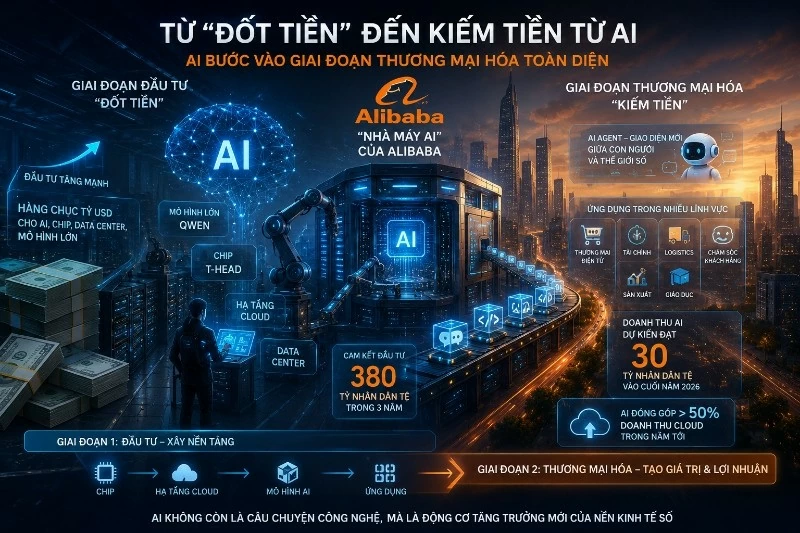
It is in this context that Alibaba's latest announcement becomes noteworthy. In a letter to shareholders, Chairman Joe Tsai and CEO Eddie Wu stated that the group's significant investments in AI have moved beyond the "initial" stage and into the "full commercialization" phase. Alibaba forecasts that recurring annual revenue from AI models and applications could reach 30 billion yuan by the end of 2026; AI products are expected to contribute more than half of cloud computing revenue next year.
 |
| Source: ChatGPT |
Alibaba and its ambition for an "AI factory"
A key aspect of Alibaba's strategy is that the company doesn't just want to create a chatbot, an AI model, or a single cloud computing service. Alibaba aims to build a comprehensive AI ecosystem, encompassing everything from T-Head chips and cloud infrastructure to modeling platforms, the Qwen platform model, and AI applications for users and businesses. An Alibaba Cloud executive called this "China's artificial intelligence factory."
The term "AI factory" reflects Alibaba's view of AI as a new production line. If, in the industrial era, factories transformed raw materials into finished goods, then in the digital age, "AI factories" transform data, models, chips, and computing power into services, automation, and business decisions.
This is also why Alibaba wants to control multiple layers of the value chain. If AI truly becomes the new infrastructure of the digital economy, revenue will not only come from a specific product, but from the entire ecosystem: businesses leasing cloud services, using models, deploying AI agents, integrating applications, and optimizing operational processes.
Why does Alibaba need AI right now?
The drastic shift toward AI isn't happening in a vacuum. Alibaba's core e-commerce business is facing intense competition. The rise of PDD, Douyin, JD.com, and content commerce platforms has changed shopping habits in China. The traditional e-commerce model is no longer growing as easily as it once did.
Meanwhile, cloud computing and AI have emerged as bright spots. According to Alibaba's announcement, cloud revenue increased sharply, while revenue from AI-related products reached 8.97 billion yuan, accounting for 30% of cloud computing revenue and marking the 11th consecutive quarter of triple-digit growth for this segment.
These figures show that AI is no longer just a technology showcase. It has begun to make its way into financial reporting. For Alibaba, AI is both a tool to protect its existing business and a new engine for growth.
In e-commerce, AI can improve product recommendations, advertising, customer service, search, store design, and supply chain optimization. In the cloud, AI attracts more enterprise customers, increasing demand for servers, storage, data, and modeling services. In other words, Alibaba is not only betting on AI because of the trend, but also because the corporation needs a new growth pillar as traditional e-commerce enters a more fiercely competitive phase.
AI agents and the race for new interfaces.
A key point in Alibaba's message is the role of AI agents. According to the group's leaders, a large number of AI agents will take on increasingly more jobs in the digital economy and become the main interface between humans and the digital world .
While first-generation chatbots primarily answered questions, AI agents are expected to perform more complex tasks: searching for information, comparing options, scheduling appointments, writing code, analyzing data, processing orders, providing customer service, or coordinating multiple different software programs. This represents a shift from "AI that can speak" to "AI that can do."
For Alibaba, AI agents are particularly important because the corporation owns a massive e-commerce and cloud ecosystem. An agent can help sellers optimize advertising, automatically respond to customers, forecast inventory, write product descriptions, translate content, or suggest pricing strategies. For buyers, the agent can become a personal shopping assistant.
If this trend materializes, the internet interface could change. Users wouldn't necessarily need to open multiple applications, type in numerous keywords, or compare dozens of results themselves. They could delegate tasks to an agent. In that case, the company that controls the agent, its model, and its underlying infrastructure would have a very strong position in the digital value chain.
From large-scale models to profitability problems
Alibaba's statement reflects a broader trend: the global AI industry is shifting from a race to "who has the more powerful model" to a race to "who makes more money." In the early stages, companies competed based on model size, reasoning ability, text, image, video , or code generation. But as infrastructure costs rise too rapidly, technical capability alone is no longer enough.
AI generation differs from many traditional software programs in that each time a user asks a question, creates content, runs code, or requests an agent to perform a task, it consumes computing power. As usage scales, operating costs also increase. Therefore, sustainable profitability depends not only on having a large user base but also on the ability to optimize inference costs, price products, retain business customers, and create enough value for customers to be willing to pay for it.
This is a major test for Alibaba. The conglomerate has announced a target of spending 380 billion yuan over three years on AI and cloud services. If demand for AI continues to grow, this investment could help Alibaba take the lead. But if revenue doesn't grow fast enough, or competition drives down AI service prices significantly, the pressure on profits will be considerable.
The risk of an AI bubble, therefore, doesn't lie in AI being "worthless." The question is who will receive that value, for how long, and at what profit margin. The internet created giant companies, but also wiped out countless businesses during the dot-com bubble. AI could follow a similar trajectory: the biggest opportunities belong to companies that control infrastructure, data, application ecosystems, and enterprise customers.
Implications for the world
From the Alibaba story, the biggest lesson for countries is that AI should not be viewed as a technology race between corporations. When AI enters the commercialization phase, it will directly impact productivity, jobs, education, public administration, data security, and national competitiveness.
Countries need to avoid two extremes: either letting AI freely regulate itself in the market, or restricting it to the point of stifling innovation. AI needs space to develop, but it also needs standards regarding data, privacy, copyright, algorithmic responsibility, and system security. At the same time, AI needs to be considered a development infrastructure, linked to data centers, high-performance computing, open data, cybersecurity, and algorithm validation capabilities.
For Vietnam, the lesson from Alibaba is that instead of chasing a "money-burning" race at all costs, it should focus on applied AI, AI for Vietnamese languages, AI for small and medium-sized enterprises, AI in the public sector, and industries with advantages such as manufacturing, agriculture, e-commerce, finance, tourism, and education.
These are areas where Vietnam has real needs, real data, and the potential for quick results. An AI system supporting small businesses in order management, customer service, and market analysis can create far more tangible value than a large-scale model with few users. A Vietnamese-language AI tool serving education, primary healthcare, public services, or smart agriculture could also have a clear social impact.
"From burning money to making money from AI" is not just Alibaba's story. It's a turning point for the entire technology industry. After the initial excitement surrounding generative models, AI is entering a phase of being tested by the market, customers, and financial reports.
Alibaba is trying to prove that AI is not just a demonstration tool, but can also become the production infrastructure of the digital economy. But that very ambition also puts the corporation before a major test: Can AI generate sustainable profits or merely prolong a costly investment cycle?
The answer will not only determine Alibaba's future, but also shed light on how countries, including Vietnam, can prepare for a phase where AI is no longer just a technological slogan, but a real competitive advantage.
Source: https://baoquocte.vn/tu-dot-tien-den-kiem-tien-tu-ai-397357.html









































































































Comment (0)