

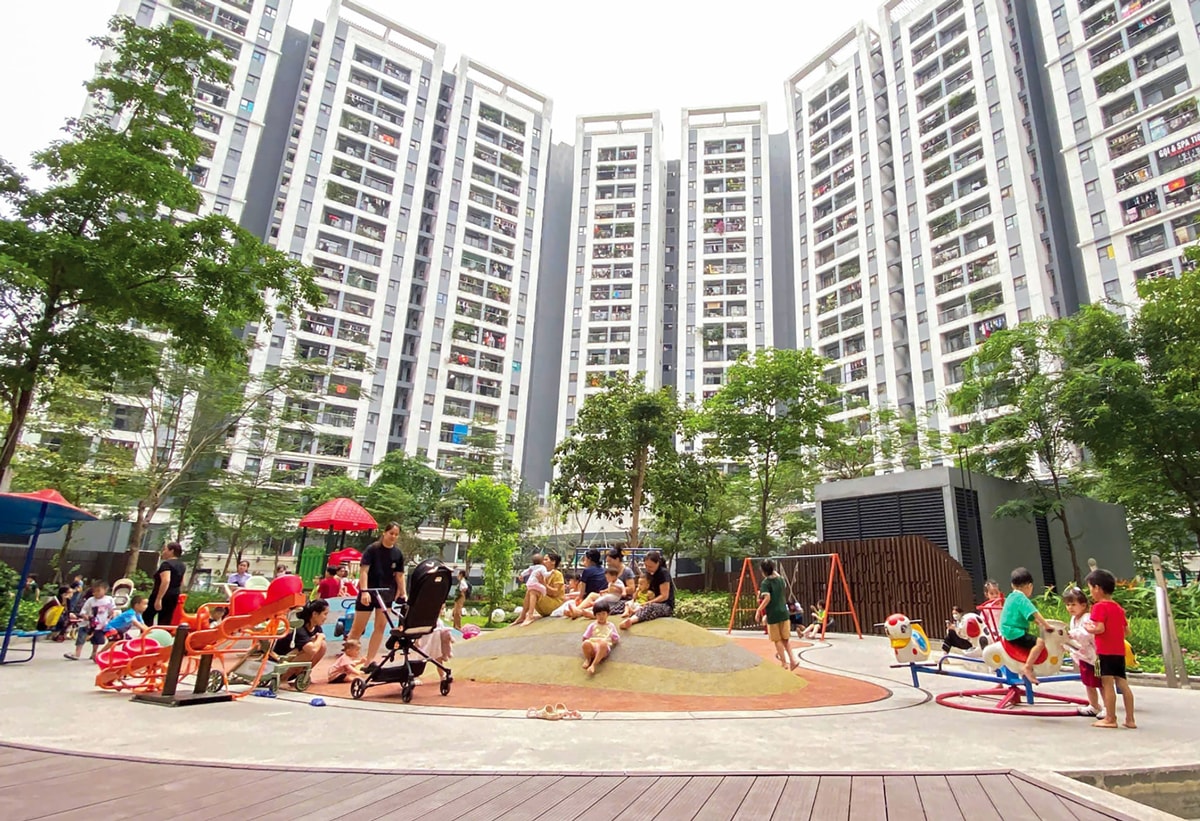
A lifetime dedicated to the happiness of the people.
During his lifetime, President Ho Chi Minh did not discuss happiness in an abstract philosophical sense, but rather defined it in the language of the working people as having enough food and clothing, access to education, healthcare, and fair treatment. Just over a month after reading the "Declaration of Independence" at Ba Dinh Square, in his "Letter to the People's Committees of the regions, provinces, districts, and villages," published in the newspaper Cuu Quoc No. 69 on October 17, 1945, he wrote: "Today, we have built the Democratic Republic of Vietnam. But if the country is independent but the people do not enjoy happiness and freedom, then independence is meaningless." This was the responsibility placed upon the entire fledgling state apparatus at that time to ensure the practical well-being of the people.
Following the victory in the general election on January 6, 1946, foreign journalists approached him with questions about the biography and ideals of the newly elected President. To inform both his compatriots at home and foreign intellectuals, he published his answer in the newspaper Cuu Quoc on January 21, 1946: “I have only one desire, an overwhelming desire, which is to see our country completely independent, our people completely free, and all our compatriots having enough food and clothing, and access to education.”
In 1947, in his work "Revising Working Methods," he directly stated the limits of the Party's power: "The Party is not an organization for gaining power and wealth. It must fulfill the task of liberating the nation, making the country prosperous and strong, and the people happy." And in his sacred "Testament" of 1969, President Ho Chi Minh's final wish was "to build a peaceful, unified, independent, democratic, and prosperous Vietnam."
Dr. Doan Van Bau, Director of the Department of Political Theory, Central Propaganda and Mass Mobilization Committee, shared: President Ho Chi Minh always took the freedom of the country and the happiness of the people as the driving force and the highest goal in his entire revolutionary life.
President Ho Chi Minh's view on the happiness of the people was not limited to national independence, but was also linked to the right to a prosperous, free, and comprehensively developed life for each individual. The state must be a state of the people, by the people, and for the people; cadres and Party members must be "servants" of the people, always placing the interests of the people above all else. He always paid special attention to the lives of the working people, from food and clothing, education, to the right to healthcare and a peaceful life. "This entire ideology has become the guiding principle for the birth and activities of the Communist Party of Vietnam, and throughout its revolutionary leadership, our Party has always set the highest goal as serving the people, building a prosperous and strong country, and improving the material and spiritual lives of the people," affirmed Dr. Doan Van Bau.
Dr. Doan Van Bau believes that what remains highly relevant, and even more so in the current era, is the inseparable relationship between the happiness of the people and the ethics of the ruling power. Dr. Doan Van Bau emphasized: “True happiness must come through the conscience of those in power. A corrupt official, a bureaucratic system, and an unfair policy can negate all economic achievements that the people do not receive in full. The fight against corruption and negative practices being vigorously waged by our Party is the practice of Ho Chi Minh Thought in its deepest sense.”
Studying and following Ho Chi Minh's ideology, ethics, and style means continuing to promote the spirit of "the people are the foundation," caring for the lives of the people so that all citizens can live in peace, prosperity, and happiness. In the context of globalization creating an ever-widening gap between rich and poor, this ideology is not outdated, but serves as a guiding principle for all policies on distribution, social security, and welfare.
Realizing Uncle Ho's ideal of happiness.
Right from the 5th National Congress (1982), during a period when the country was still facing numerous difficulties after the war, the Party set forth the motto "All for the socialist Fatherland, for the happiness of the people." For the first time, the happiness of the people was placed in the overall motto of a National Congress.
Throughout 40 years of reform, the 13th National Congress Document (2021) affirmed: "Taking the well-being and happiness of the people as the goal to strive for." At the 14th National Congress (2026), for the first time, "the happiness of the people" was added to the lessons learned from 40 years of reform, placed on par with lessons on steadfastly adhering to the Party's line and building the Party. The Resolution of the 14th National Congress of the Party clearly states: "All policies and guidelines must truly stem from the needs and aspirations of the people; the happiness and satisfaction of the people should be the measure of the effectiveness of the work of Party organizations and the entire political system." The 14th National Congress also set an unprecedented quantitative goal: Vietnam strives to be among the top 40 countries with the highest happiness index in the world by 2030.
Dr. Doan Van Bau assessed this as a significant methodological step, not just an addition to the content but a fundamental change in how leadership results are measured. “Previously, we were accustomed to evaluating the effectiveness of work by economic indicators, by the number of resolutions, by the percentage of plan completion. Now, we have a new measure, and that measure is not scored by superiors, but by the people's perception and satisfaction. When happiness is defined as belonging to the people, all growth targets and tasks in the resolution must be directed towards genuinely improving the material and spiritual lives of the people, not just stopping at reported numbers,” said Dr. Doan Van Bau.
Hanoi, the political and administrative center of the country, is where the intellect, essence, and resources of the entire nation converge. Therefore, whenever Hanoi sets a development direction, it is not just a matter for the capital city alone, but also symbolic and guiding for the whole country.
In October 2025, the 18th Congress of the Hanoi City Party Committee will open with the theme "Promoting the thousand-year tradition of culture and heroism; uniting to build a clean and strong Party Committee; pioneering and breakthrough in the new era; developing a civilized, modern, and happy capital city," in which the word "happiness" appears for the first time. Resolution No. 02-NQ/TW of the Politburo on building and developing Hanoi in the new era (issued on March 17, 2026) affirms the goal of building a "Cultural - Civilized - Modern - Happy" capital city, with people as the center, subject, objective, and driving force of development. By 2035, Hanoi must be a peaceful city with happy people. By 2065, Hanoi must be among the capital cities with a high quality of life and happiness in the world. It is noteworthy that Resolution 02-NQ/TW places happiness at the center of the strategy, alongside and on par with growth targets. This represents a shift in the logic of development, directly reflecting the thinking that President Ho Chi Minh laid the foundation for from the very beginning of the nation's founding.
Pointing out three key areas for the 2025-2030 term that, if Hanoi achieves them, the people will genuinely feel – fairness in access to basic services, quality of living spaces, and quality of administrative service – Dr. Doan Van Bau shared: “My expectation is not grandiose projects or impressive numbers. My expectation is that by the end of the 2025-2030 term, an ordinary citizen in Hanoi, whether a native or a newcomer, will feel satisfied when asked if their life has improved, if their children have received a full education, if their health is guaranteed, and if the government has resolved their problems. If that is achieved, including the word 'happiness' in the Congress document for the first time will truly be meaningful.”
Source: https://hanoimoi.vn/tu-mong-muon-cua-bac-den-su-menh-thu-do-hanh-phuc-750365.html


















































































Comment (0)