

In just the first few months of 2026, Chinese youth teams made a series of impressive performances on the continental stage. The Chinese U23 team reached the knockout round of the AFC U23 Championship for the first time, even finishing as runners-up. Meanwhile, the Chinese U17 team made a huge impact by returning to the AFC U17 Championship final after a 22-year wait.
Shifting the focus
Last year, the Chinese U20 team also repeated their streak of reaching the continental quarterfinals twice in a row, after three previous attempts where they were eliminated early or failed to qualify.
Notably, the young Chinese players have become increasingly confident with each match. At the U17 tournament currently taking place in Saudi Arabia, the East Asian representatives unexpectedly lost to Indonesia in their opening match. However, they narrowly escaped qualification with a 2-0 victory over Qatar in the final match to secure their World Cup spot.
In the quarter-finals and semi-finals, both the defending runners-up U17 Saudi Arabia and U17 Australia were eliminated by the Chinese team. In these two victories, China demonstrated solid defense, quick transitions, and excellent finishing ability.
In the recent semi-final match, both the Chinese and Australian U17 teams had nearly the same number of shots on goal. However, the "Socceroos" were unable to beat goalkeeper Qin Ziniu, while the East Asian representatives scored two goals and advanced to the final.
Behind this progress lies a systemic reform of Chinese football over the past five years. Following a financial crisis that crippled many major clubs in the Chinese Super League, the country was forced to change its approach to football development. Instead of continuing to spend money on foreign stars, they shifted their focus to youth development.
Building a launchpad
In 2022, the China Youth Football League (CYFL) was established, becoming the first unified youth competition system from U8 to U19 on a national scale. Simultaneously, school football received unprecedented investment. The Chinese government allocated a huge budget to develop football in secondary schools, building a talent scouting network at multiple levels.
According to the "Guidelines for Implementing Reforms and Development of Youth Football in China" issued in 2024, the principle is stated as follows: "China needs to persistently promote the popularization of football among all young people, and persistently integrate sports and education to comprehensively train football talents."

China U17 (right) return to the Asian U17 Championship final after a 22-year wait. (Photo: AFC)
This approach has brought about a significant shift in the mindset regarding football in the world's most populous nation. Thousands of school teams, academies, and professional clubs have the opportunity to compete regularly, giving young players a continuous competitive environment instead of just training in isolation as before. Gradually, the new generation of Chinese footballers has not only improved their technical skills but also significantly enhanced their endurance on the field.
Furthermore, several major academies such as Shandong Taishan, Shanghai Port, and Zhejiang have begun adopting modern training models based on European standards. Sports science , GPS data, nutrition, and professional fitness training programs are incorporated into the training process from a very early stage.
In recent years, the Chinese Football Association (CFA) has shifted its training philosophy towards encouraging more creative players. This is perhaps the biggest difference in current Chinese youth football. They are no longer just creating "football athletes" but are trying to train players with genuine footballing intelligence.
Of course, there is still a considerable gap between the success of youth football and the senior national team level. However, recent events suggest that China has found the right path. During the FIFA Days in March, coach Shao Jiayi called up eight players from the U23 team to the senior national team. As a result, they defeated Curacao, a newcomer to the 2026 World Cup.
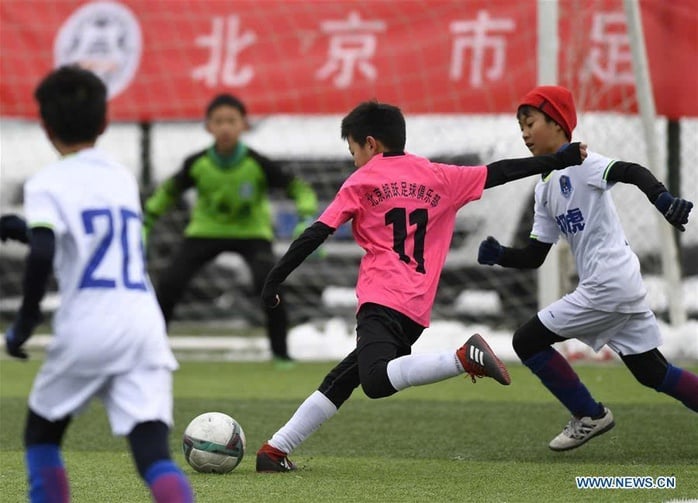
China aims for sustainable football based on systematic youth training (Photo: Xinhua)
In the early hours of May 23rd, the Chinese U17 team will face the Japanese U17 team in the continental final, a team that has won the title four times. Regardless of the outcome, no one can deny the potential of Chinese youth football today.

Source: https://nld.com.vn/giai-ma-bong-da-tre-196260520202010481.htm



































































































Comment (0)