

Operational pressure in volatile weather conditions
Many localities in the Central region have experienced the fourth flood of the year, causing widespread flooding downstream and great pressure on the upstream reservoir system. According to Mr. Pham Cong Thanh, Head of the North Central Water Resources Planning Department, Institute of Water Resources Planning ( Ministry of Agriculture and Environment ), 2021 is one of the years with many strong floods and storms in river basins across the country. From the North to the South, unusual floods have been recorded, while the South Central and Central Highlands regions continue to face complex situations.
As a consulting unit for operating large reservoirs, the Institute of Water Resources Planning cooperates with the University of Water Resources, the Vietnam Institute of Water Resources and the Southern Institute of Water Resources to provide calculations and forecasts to support management agencies and reservoir owners in making timely decisions.

Mr. Pham Cong Thanh, Head of the North Central Irrigation Planning Department, Institute of Irrigation Planning (Ministry of Agriculture and Environment). Photo: Minh Phuc.
Mr. Pham Cong Thanh acknowledged that the current operating system has important advantages, including close direction from the Government, the Ministry of Agriculture and Environment and the local Disaster Prevention Command Board. Before and during the flood season, documents guiding the lowering of flood water levels and construction safety inspections are issued continuously, helping operating units to be more proactive.
According to Mr. Pham Cong Thanh, the Central region is an area that regularly suffers from large floods, so reservoir operators have extensive experience and good situation handling ability. The flood in late October and early November is a clear example. Ta Trach reservoir lowered the water level to receive the flood according to the procedure, creating space to store water and significantly reducing the flood peak of the Huong River when it flows into Hue city. "The regulatory efficiency of Ta Trach reservoir during the recent flood was clearly demonstrated through the actual water level downstream. This is the result of flexible operation and effective coordination between units," Mr. Thanh emphasized.
However, the difficulties are still very great. Recent floods often exceed forecast thresholds, even surpassing international meteorological models. Mr. Pham Cong Thanh cited that on October 27, Bach Ma station recorded rainfall of approximately 151 mm per hour, and Khe Tre nearly 120 mm per hour. With the characteristic of floods coming quickly after only 2 to 3 hours of heavy rain, Ta Trach reservoir must operate under continuous calculation pressure. In recent years, in about ten peak days, four to five flood peaks can appear, forcing operating staff to work at a rapid intensity to ensure effective regulation.
Coordinated operation of inter-reservoirs creates room to reduce downstream flooding
Assigned to manage and operate Ta Trach reservoir, Mr. Nguyen Quy An, Deputy of Ta Trach reservoir management board, said: The most important task is to strictly comply with the Inter-reservoir Operation Procedures prescribed by the Government and the Ministry of Agriculture and Rural Development. The unit must closely monitor weather developments, meteorological and hydrological conditions, and forecast calculations to develop response scenarios at each time.
Mr. Nguyen Quy An shared that every time there is a storm or heavy rain is forecast, the pressure on the unit increases significantly because it has to make decisions to harmonize the requirements of construction safety, flood reduction goals and ensuring socio-economic activities downstream.
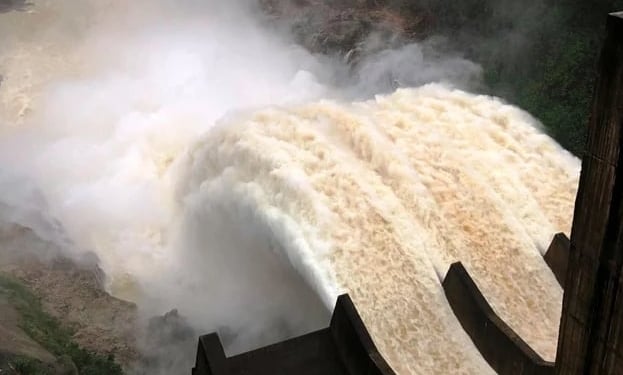
Water regulation of Ta Trach Lake plays an important role in preventing natural disasters and reducing flood risks for the downstream area of Hue City.
There were times when the People's Committee of Thua Thien Hue province and the Civil Defense Command issued immediate regulatory orders, forcing the operating force to immediately recalculate the incoming flow and discharge flow to advise on timely adjustments if there was a possibility of reducing the flood peak.
The coordination between Ta Trach, Huong Dien and Binh Dien reservoirs always plays a key role. Input parameters are continuously updated, thereby providing a synchronous regulation plan between the upper and lower reaches of the Huong River. "When operating in harmony, the reservoirs will create a clear flood reduction effect for Hue city. During the recent flood, the downstream localities highly appreciated the flood reduction effect of the reservoir system," Mr. Nguyen Quy An affirmed.
According to local assessments, the results achieved come from proactively monitoring the weather in real time, perfecting operational scenarios and maintaining continuous coordination between specialized units. Careful preparation before the flood season, especially the requirement to lower the water level to receive floods according to the correct procedure, has helped increase storage capacity and create room for regulation during heavy rains of unusual intensity.
The operation of reservoirs during the rainy season is always associated with many unpredictable risks, especially in the context of climate change causing unusual changes in weather patterns. However, the reality in Thua Thien Hue in recent times shows that when the inter-reservoir operation system is implemented consistently and flexibly, the flood reduction efficiency for downstream areas is always clearly demonstrated. This is also the basis for continuing to perfect operating procedures, enhancing forecasting capacity and expanding the application of science and technology in water resource management in the Central region in the coming years.
Source: https://nongnghiepmoitruong.vn/van-hanh-ho-dap-linh-hoat-cat-lu-cho-vung-ha-du-d787445.html

![[Photo] Parade to celebrate the 50th anniversary of Laos' National Day](/_next/image?url=https%3A%2F%2Fvphoto.vietnam.vn%2Fthumb%2F1200x675%2Fvietnam%2Fresource%2FIMAGE%2F2025%2F12%2F02%2F1764691918289_ndo_br_0-jpg.webp&w=3840&q=75)
![[Photo] Worshiping the Tuyet Son statue - a nearly 400-year-old treasure at Keo Pagoda](/_next/image?url=https%3A%2F%2Fvphoto.vietnam.vn%2Fthumb%2F1200x675%2Fvietnam%2Fresource%2FIMAGE%2F2025%2F12%2F02%2F1764679323086_ndo_br_tempimageomw0hi-4884-jpg.webp&w=3840&q=75)




















































































Comment (0)