

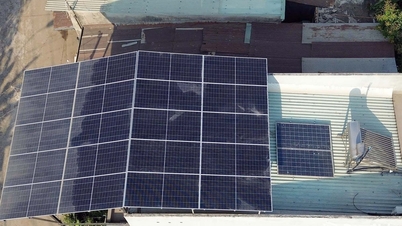
However, current solar energy harvesting technology has not yet fully exploited the potential of sunlight, so recent research from scientists at Korea University has received much attention.

Light-gathering efficiency is a major factor in determining the electricity output from solar panels.
PHOTO: REUTERS
Published in the journal ACS Applied Materials & Interfaces , the research team discovered a new material capable of absorbing most wavelengths in the solar spectrum, thereby significantly enhancing the amount of light that solar energy technologies can harvest. They developed "superspheres," or gold nanospheres, that can absorb wavelengths inaccessible to current photovoltaic materials.
Although silver and gold nanoparticles are known for their potential to harvest solar energy, they can only absorb a small fraction of the solar spectrum. The research team decided to improve this technology by using self-assembling gold superspheres, which consist of gold nanoparticles clustered together to form small spheres. By adjusting the diameter of the superspheres, they expanded their light-absorbing capacity.
Impressive solar light absorption efficiency.
To test the effectiveness of the superspheres, the research team used computer simulations to optimize the design and estimate performance. The results showed that the superspheres could absorb up to 90% of solar wavelengths. In practical tests, when a solution containing the superspheres was applied to a thermoelectric generator and illuminated with an LED solar energy simulator, the average solar energy absorption reached 89%, while the absorption rate of individual gold nanoparticles was only 45%.
Seungwoo Lee, one of the scientists involved in the research, said: "Our plasmonic superspheres provide a simple pathway to harness the entire solar spectrum. This coating technology can significantly reduce the barrier to high-efficiency solar thermal and photothermal systems in practical energy applications."
If these superspheres are widely applied in solar panel manufacturing, they could bring significant savings to communities and households using solar energy, while also helping to reduce air pollution. This development opens up prospects for a cleaner and more sustainable energy future.
However, whether these superspheres will become a new material for solar panels remains an unanswered question.
Source: https://thanhnien.vn/vat-lieu-moi-tao-dot-pha-hieu-suat-pin-mat-troi-185260428110516658.htm















![[GALLERY] Witnessing the first landing of an Italian F-35B fighter jet on a highway.](https://vphoto.vietnam.vn/thumb/402x226/vietnam/resource/IMAGE/2026/05/24/1779625960562_f-35b-della-marina-militare-2-jpg.webp)




















































































Comment (0)