

Bacteria are tiny living organisms—millions of them could fit on the head of a pin—yet they are found almost everywhere on Earth. From the deep ocean floor and scorching volcanic craters to the Antarctic ice sheets and even the human body, bacteria have existed and thrived for billions of years, even before dinosaurs appeared.
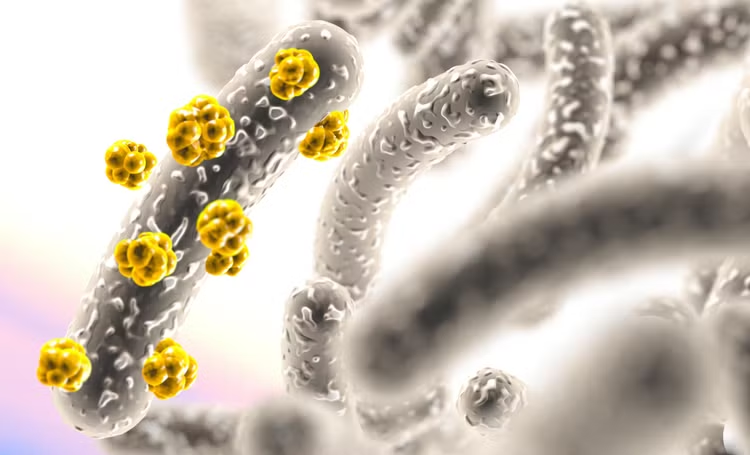
Photo: Wikimedia Commons.
Many people often think of bacteria as synonymous with disease, but in reality, the vast majority of bacteria are completely harmless, and even extremely essential for life. Trillions of bacteria live symbiotically in the human body, especially in the gut. They help digest food, synthesize vitamins, and support the immune system's effective functioning. Some scientists even suggest that the human body is more of a "mobile ecosystem" than an independent entity.
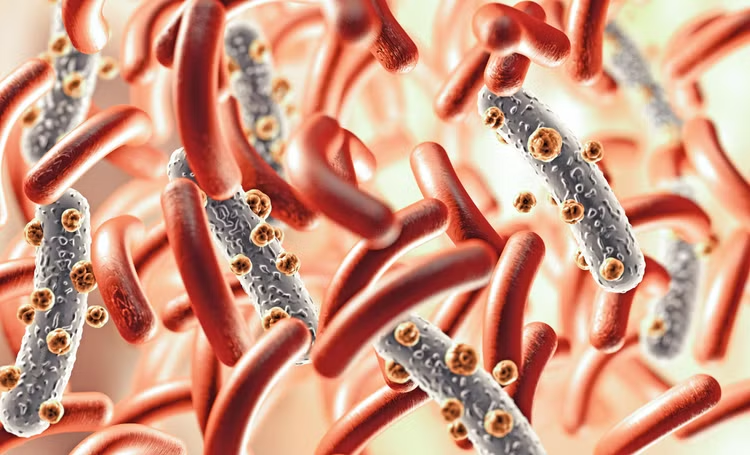
Photo: Wikimedia Commons.
Bacteria have an extremely simple structure but an incredible ability to adapt. They reproduce so rapidly that a single cell can produce millions of offspring in just a few hours if conditions are favorable. It is this high rate of evolution that makes bacteria susceptible to developing antibiotic resistance—one of the biggest challenges of modern medicine.
Interestingly, bacteria have also played a crucial role in the planet's history. Ancient cyanobacteria once produced oxygen through photosynthesis, helping to transform the primitive atmosphere into a suitable environment for complex organisms to thrive. In other words, without bacteria, humans probably wouldn't have existed.
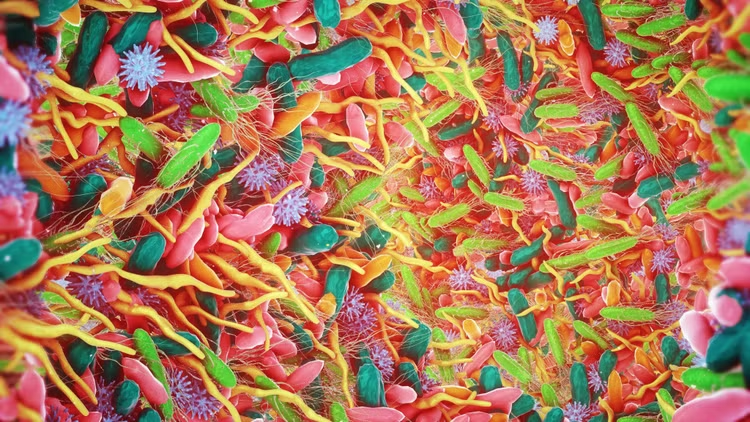
Photo: Wikimedia Commons.
In daily life, people utilize bacteria in many ways. Yogurt, cheese, kimchi, soy sauce, and pickled vegetables all involve the fermentation process of bacteria. In biotechnology, bacteria are also used to produce insulin, treat pollution, and conduct genetic research.
Some bacteria possess almost "supernatural" survival abilities. Some can withstand extremely acidic environments, others can live in water near boiling point, and some bacteria can even survive in space for short periods. Therefore, when searching for extraterrestrial life, many scientists believe that the first life forms humans might discover will most likely resemble bacteria rather than complex organisms.
Despite their small size and invisibility, bacteria are silently controlling many processes in the natural world . They decompose dead organisms, recycle nutrients, maintain ecosystems, and even influence human health and well-being through the gut microbiome. It could be said that Earth is not primarily a "human planet," but rather a planet of microorganisms, led by bacteria.
Source: https://khoahocdoisong.vn/vi-khuan-sinh-vat-thong-tri-thuc-su-cua-trai-dat-post2149100834.html






![[GALLERY] Witnessing the first landing of an Italian F-35B fighter jet on a highway.](https://vphoto.vietnam.vn/thumb/402x226/vietnam/resource/IMAGE/2026/05/24/1779625960562_f-35b-della-marina-militare-2-jpg.webp)








![[GALLERY] Elon Musk shocks with the statement that people may not need to go to work.](https://vphoto.vietnam.vn/thumb/402x226/vietnam/resource/IMAGE/2026/05/24/1779625359765_el-png.webp)






































































Comment (0)