

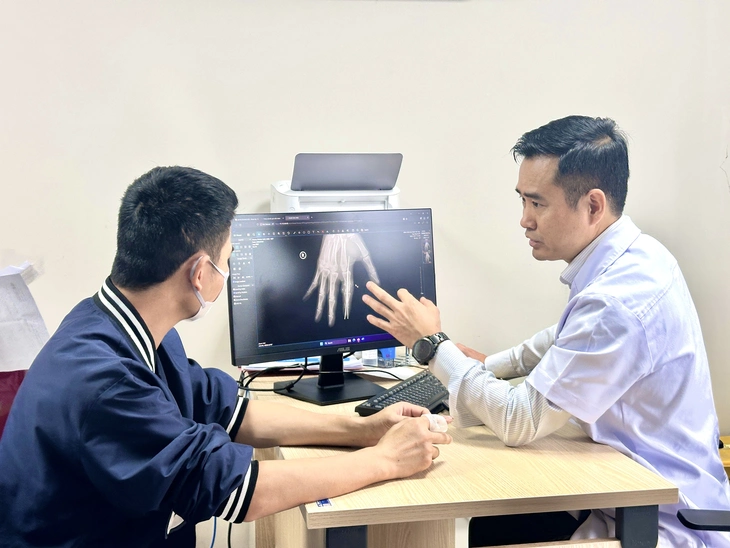
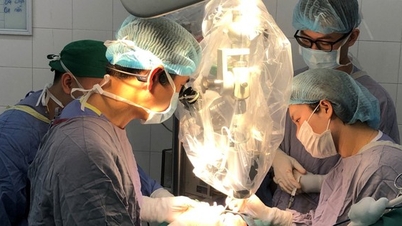
Doctor Vu Trung Truc, Viet Duc Friendship Hospital, examines a patient after surgery - Photo: BVCC
Severed finger from sea to land
At the time of the accident, Mr. D. (38 years old) was repairing equipment when storm No. 12 made landfall, causing the ship to rock violently.
Fortunately, the crew on board quickly provided first aid and preserved the severed limb in a thermos, brought him ashore and took him to the nearest medical facility in the Central region.
In the emergency situation, after receiving first aid from medical staff, Mr. D. wanted to have his severed limb reattached, so he and his family decided to take the earliest flight from Da Nang to Hanoi early the next morning to Viet Duc Friendship Hospital. The total time of anemia was up to 25 hours.
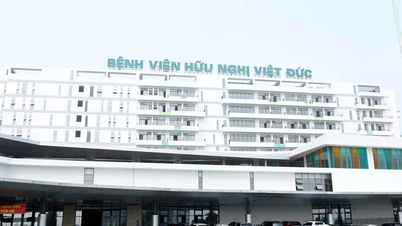
At Viet Duc Friendship Hospital, experts evaluated the severed limb and noted: the severed limb had been properly treated and preserved, the finger joints were still soft, and the tissue structure was well preserved.
The hospital immediately held a multidisciplinary consultation to come up with an optimal treatment strategy and decided to perform microsurgery to reattach the patient's finger.
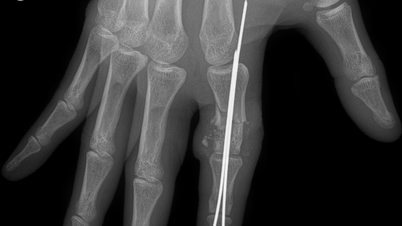
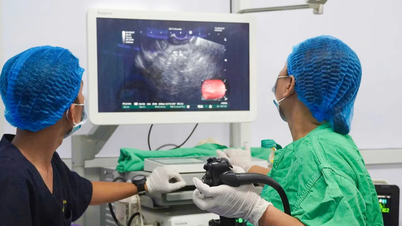
In the operating room, the emergency surgical team was deployed with multidisciplinary coordination. Two surgical teams were deployed in parallel, one team cleaned and prepared the severed finger, the other team prepared the stump. The finger bone was positioned and fixed with a specialized needle to create a stable axis, the tendon and ligament system was restored.
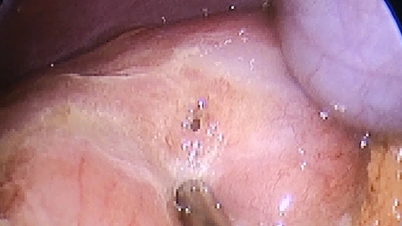
In particular, nerves and tiny blood vessels of only about 0.8 - 1mm are restored with high precision under a surgical microscope with special tools to ensure the restoration of blood circulation to the severed part.
This is a technique that requires the highest level of sophistication, because if just one blood vessel connection is not open, blood cannot nourish the fingertip and the limb will become necrotic.
Prolonged anemia, rare successful transplant
The ideal time to reattach a severed limb is 6 hours from the time of the injury until doctors restore circulation to the severed limb.
In the case of record ischemia lasting 25 hours, from the amount of blood perfusion to the temperature of the finger, control of the risk of vasospasm and monitoring of postoperative peripheral circulation to ensure complete recovery of the finger.
Doctor Vu Trung Truc - Deputy Head of the Department of Maxillofacial, Plastic and Aesthetic Surgery, Viet Duc Friendship Hospital, who directly performed the surgery - shared that this was an extremely special case.
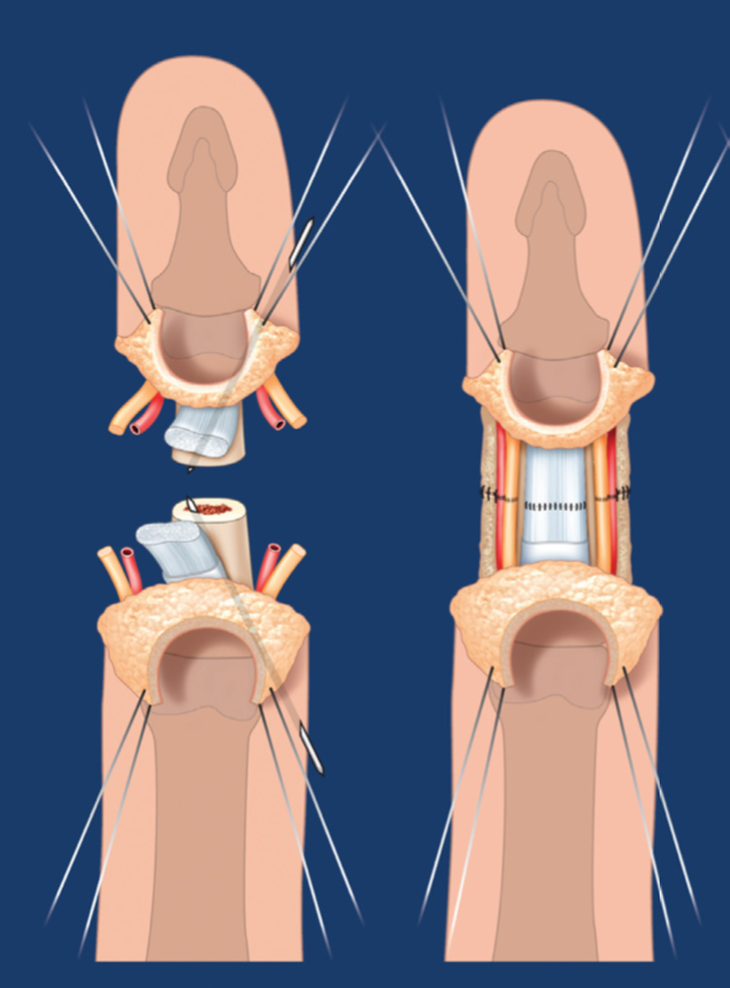
Blood vessels and nerves restored after microsurgery to reattach fingers - Photo: BVCC
In limb reattachment, prolonged ischemia is often a major obstacle. Before surgery, the patient and the severed body part must be evaluated by an experienced multidisciplinary team.
In this case, thanks to the proper preservation of the severed limb at the scene, the finger joint did not stiffen due to being kept at the right temperature.
Another factor is that the finger structure (including bones, skin, nerves, and blood vessels) is more resistant to ischemia than the more muscular limb, so a finger that has been ischemic for 25 hours can still be reattached.
After surgery, the wound has healed, the finger is pink and completely alive, the patient can have the stitches removed and the fixing needle removed. The patient is undergoing rehabilitation exercises to regain the mobility and feeling of the finger.
How to preserve severed limbs
Experts recommend that people need to equip themselves with proper first aid knowledge, because this is the deciding factor in the ability to save a limb:
- Do not wash or soak the severed limb in any solution. In case the severed limb is in a dirty environment with many foreign objects, it can be washed under clean running water, preferably purified drinking water or boiled and cooled water.
- Wrap the limb with clean gauze/towel, put it in a plastic bag and tie it tightly (avoid direct contact with ice).
- Place the bag containing the limb in another bag containing ice.
- Keep the limb in a clean, temperature-controlled environment and transport it as quickly as possible.
- Take the victim to the nearest medical facility for treatment and further instructions.
- Do not arbitrarily handle, do not use medicine or disinfectant chemicals on the severed limb.
Experts emphasize that proper first aid increases the chance of saving a severed limb.
Being equipped with first aid knowledge, calmly handling and preserving the situation right at the scene significantly increases the success rate of surgery, helps restore function and aesthetics, and reduces the risk of disability for accident victims.
Source: https://tuoitre.vn/vi-phau-thuat-noi-thanh-cong-ngon-tay-cua-thuy-thu-tau-vien-duong-bi-dut-roi-sau-25-gio-20251209084408018.htm



![[Photo] Urgently help people soon have a place to live and stabilize their lives](/_next/image?url=https%3A%2F%2Fvphoto.vietnam.vn%2Fthumb%2F1200x675%2Fvietnam%2Fresource%2FIMAGE%2F2025%2F12%2F09%2F1765248230297_c-jpg.webp&w=3840&q=75)












































![[Photo] General Secretary To Lam works with the Standing Committees of the 14th Party Congress Subcommittees](https://vphoto.vietnam.vn/thumb/402x226/vietnam/resource/IMAGE/2025/12/09/1765265023554_image.jpeg)























Comment (0)