

Institutional reforms, accelerating competitiveness.
Moody's upgraded Vietnam's outlook from "Stable" to "Positive," reaffirming its national credit rating at Ba2. The organization assessed that institutional quality and governance are clearly improving through accelerated administrative, legal, and public sector reforms since the end of 2024. Simultaneously, the competitiveness of the Vietnamese economy continues to be strengthened through increased digitalization, infrastructure investment, improved human resource quality, and capital market development. Risks from US trade protectionist measures have decreased compared to previous forecasts. Meanwhile, Vietnam maintains positive economic growth and stable foreign direct investment (FDI) inflows, further solidifying its position in the global supply chain.

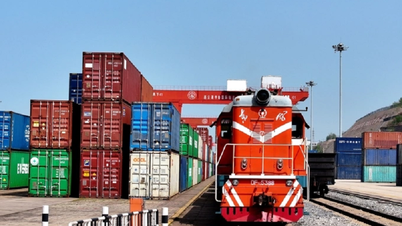
Vietnam's unwavering commitment to high, substantive, and sustainable growth is a highly valued factor in the eyes of international investors.
PHOTO: NHAT THINH
Vietnam's fiscal position continues to be a strong point thanks to low and stable government debt, robust debt repayment capacity, reduced reliance on foreign capital mobilization, which helps reduce foreign exchange risk and increase resilience to external risks.
Moody's also assessed that Vietnam has the ability to withstand shocks in energy prices, transportation costs, and inflationary pressures due to geopolitical developments, thanks to its solid growth foundation, strong external economic buffer, low foreign exchange risk, and diversified energy and export structure.
Economist, National Assembly representative, Associate Professor Dr. Tran Hoang Ngan commented: First, it is necessary to recognize that improving Vietnam's national credit rating is an inevitable trend because in recent years, Vietnam has made many breakthroughs such as reorganizing administrative agencies and decentralizing power to localities. Notably, in 2025, the National Assembly and the Government enacted many laws and resolutions to remove many institutional bottlenecks, free up resources, and create a more competitive business environment. Significantly, for many consecutive years, Vietnam has maintained high growth while keeping macroeconomic stability, controlling inflation, and reducing public debt. International organizations all assess that Vietnam has made many changes in administrative procedure reform, market transparency through digital transformation, and strong investment in infrastructure. Even the establishment of an International Finance Center in Vietnam is a move towards greater openness and integration.
Dr. Nguyen Van Dien, Head of the Department of Political Economy at the Regional Political Academy II, also believes that within the Asia-Pacific (APAC) region, Vietnam is still considered by the business community and investors as the safest, most secure, and most stable environment. Moody's adjustment of Vietnam's credit outlook from "Stable" to "Positive" is an inevitable result, as we are converging on all four strategic pillars.
First is the institutional pillar. Over the past period, Vietnam has demonstrated perseverance in its goal of institutional reform. Along with this, the legal system is increasingly being perfected, especially the Land Law, Housing Law, and Real Estate Business Law. These are key areas for infrastructure development, while also reflecting a transparent and efficient business environment, enhancing investor confidence.
The second pillar is the effective transformation of the national governance model, especially in the public administration sector. Alongside this, Vietnam has maintained macroeconomic stability amidst global fluctuations. This is also a crucial factor in the context of a turbulent global economy due to geopolitical conflicts in the Middle East. Vietnam has not been swept away by the vortex of instability; on the contrary, we have transformed major external fluctuations into opportunities to hone our macroeconomic governance capabilities, maintain stable indicators, and affirm the resilience and self-reliance of our economy against any external shocks. Thanks to these three factors, Vietnam has recently become a focal point attracting major technology companies. The figure of 20-30 billion USD in FDI attracted each year is proof that Vietnam is ready for industries requiring the highest levels of technology and intellectual content. This is also the fourth pillar that helps improve Vietnam's credibility on the international stage.
"A vote of confidence" for investors
It's noteworthy that Moody's isn't just looking at GDP growth rate, but also at "the ability to sustain long-term growth with lower risk." This is where Vietnam is making a difference. From an institutional perspective, Vietnam has recently undergone some fundamental and structural reforms, rather than localized ones. Moody's highly appreciates the restructuring of the public administration, the reduction of intermediate layers, and the acceleration of approval processes for public investment projects as well as FDI projects. Compared to Thailand or Malaysia, Vietnam currently has an advantage in terms of reform momentum and growth potential.
Another crucial point is the "confidence in governance capacity" narrative. Credit rating agencies now look not only at current data but also at the ability to respond to future shocks. Another point to note is that Vietnam is gradually shifting from a "low-cost" model to a "stability + reform + high growth" model. This is what prompted Moody's to change its perspective. Overall, Moody's upgrade of the outlook to "Positive" can be seen as a very important "vote of confidence" for international investment funds.
Associate Professor Dr. Nguyen Huu Huan , Vice Chairman of the Executive Board of the Ho Chi Minh City International Finance Center.
Increased national financial credibility benefits the economy.
Upgrading the national credit rating to "Positive" will bring many benefits to the economy. According to Associate Professor Tran Hoang Ngan, the biggest and most obvious benefit is that it will give Vietnam more opportunities to raise capital in the international market. Furthermore, the higher the national credit rating, the lower the cost of borrowing (lower interest rates). Meanwhile, with a "Positive" rating, Vietnam will find it easier to borrow foreign capital at lower interest rates. Conversely, the lower the credit rating, the higher the interest rate. If the credit rating is too low, it will be difficult or even impossible to borrow foreign capital. For example, a country with a "Negative" rating will attract almost no investors or international organizations willing to lend to it. Combined with the official upgrade of the stock market from a frontier market to a secondary emerging market starting in September, this will open up even more opportunities for Vietnam to attract FDI capital. This is a positive sign for the Vietnamese economy, especially in the context where Vietnam needs to boost infrastructure investment to contribute to high economic growth, and therefore needs to mobilize many domestic and foreign capital sources.

Upgrading the country's credit outlook will open up many opportunities for Vietnam to raise international capital at a lower cost.
PHOTO: NGOC THANG
Sharing the same view, Associate Professor Dr. Nguyen Huu Huan, Vice Chairman of the Ho Chi Minh City International Finance Center, assessed: The upgrade of Vietnam's national credit outlook by Moody's is of great significance in the current context, because this is not simply a technical assessment by a credit rating agency, but is essentially a "signal of confidence" for the entire economy. Importantly, the outlook reflects the expectations of global financial institutions about Vietnam's future in the medium and long term. In other words, Moody's is sending a message that Vietnam has the potential to significantly improve its national credit quality in the near future.
Specifically, the first and most direct impact is on Vietnam's cost of capital. In international finance, a country's credit rating is almost the "base cost" of the entire economy. When the outlook is upgraded to "Positive," international investors will assess Vietnam's national risk lower than before. This allows the government to issue international bonds at lower interest rates, while simultaneously reducing the cost of capital mobilization for Vietnamese banks and businesses in the international market. It is noteworthy that this impact is not limited to the public sector. Banks and businesses themselves will also benefit indirectly because the "country risk premium" will decrease. This is an extremely important factor in the context of Vietnam needing a very large amount of capital for its double-digit growth target and the estimated investment needs for development in the 2026-2030 period exceeding US$1.5 trillion.
The second impact is on FDI flows. In fact, many large investment funds worldwide, especially pension funds, insurance funds, or long-term investment institutions, often have "internal regulations" – only investing in countries with stable or positive credit outlooks. Therefore, an upgraded outlook will help expand the "investor pool" that can consider investing in Vietnam. Another important impact on the domestic financial market is that confidence in the domestic currency, bond market, and stock market will be more positive. This helps strengthen expectations of exchange rate stability, reduce pressure on capital outflows, and support the process of upgrading the Vietnamese stock market in the future.
"I believe the biggest impact of the 'Positive' outlook upgrade lies in the long-term strategic aspect. Vietnam is entering a new phase of development with the goal of high growth, building an international financial center, upgrading the production value chain, and attracting high-quality capital flows. During that phase, 'national financial credibility' will become an intangible but extremely important asset. A country with a positive credit outlook will have a significant advantage in negotiating with international financial institutions, attracting multinational corporations, developing financial centers, and building large-scale capital markets. This is also an important foundation for Vietnam to gradually move closer to its goal of upgrading its national credit rating in the future," Mr. Nguyen Huu Huan stated.
Continue reforming the financial market institutions and structures.
Moody's also noted the risks to the banking system, the real estate market, and existing institutional shortcomings, despite significant improvements, as factors hindering Vietnam's potential credit rating upgrade.
Associate Professor Tran Hoang Ngan noted that the fact that this organization still maintains Vietnam's national credit rating at Ba2 indicates that concerns remain. In the coming time, the Government needs to focus on restructuring the financial system to reduce the economy's dependence on the banking system for capital. Currently, bank capital accounts for up to 145% of GDP, while the stock market (including stocks and corporate bonds) accounts for about 85% of GDP; plus government bonds account for about 20% of GDP, meaning the banking system still bears the burden of providing capital to the economy. This poses potential risks. At the same time, developing the financial market also helps businesses proactively raise capital, reduce the cost of using capital, and boost investment. Simultaneously, Vietnam continues to implement its planned programs such as administrative procedure reform, digital transformation, and removing institutional bottlenecks. As a result, Vietnam's national credit rating could be upgraded from Ba2 to a higher level, and the country and businesses would have more opportunities to raise international capital at lower costs.
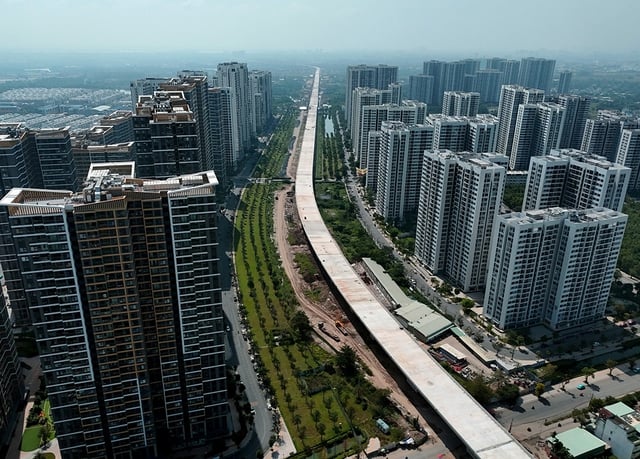
Vietnam's upgraded national credit rating will create more opportunities to raise international capital at lower costs (Pictured: Ho Chi Minh City's Ring Road 3 project).
PHOTO: NGOC DUONG
Despite expressing high expectations, Mr. Nguyen Huu Huan also cautioned that this is only the beginning, not the destination. Moody's is not upgrading Vietnam immediately, but is placing it in a position where it is likely to be upgraded. If reforms slow down or risks such as bad debt, real estate, budget pressures, or the quality of corporate governance are not properly addressed, this outlook could be completely revised. Therefore, to move from Ba2 to Ba1 or even closer to the "investment grade" group, Vietnam needs to do many big things. This includes transforming institutional reforms into measurable results. Vietnam needs to demonstrate that these reforms help shorten project approval times, reduce compliance costs, increase policy predictability, and limit the "top-down" bottleneck. Next, macroeconomic stability must be maintained as a "national credit anchor." Simultaneously, it is necessary to continue controlling inflation, stabilizing the exchange rate, and keeping public debt and debt repayment obligations within safe limits. Risks in the banking system, corporate bonds, and real estate must be managed effectively. An economy that wants to be rated higher must have a deeper, more transparent financial system with less contagion risk.
Another task is to upgrade the capital market and improve access to international capital. When the capital market is stronger, the economy will become less dependent on banks, the cost of capital will decrease, and the country's credit rating will improve. Finally, the quality of growth must be improved. "To be upgraded from Ba2 to Ba1, Vietnam not only needs high growth, but also needs to demonstrate that this growth is more stable, more transparent, less risky, and based on a better institutional foundation. The 'positive outlook' is an open door, but to step through it, Vietnam must continue substantive reforms, especially in three bottlenecks: institutional implementation, the financial system, and the quality of growth," emphasized Associate Professor Dr. Nguyen Huu Huan.
Vietnam establishes a distinct position on the international stage.
Within the next one to two years, Vietnam will not only upgrade its credit rating to a higher level, aiming for Ba1, but also establish a completely different position on the international stage. Vietnam's roadmap is on the right track, aligned with global trends; we also have an active government and the decisive involvement of the National Assembly through specific resolutions; institutional bottlenecks are being rapidly removed. Vietnam only needs to continue implementing core solutions including: financial transparency – strengthening the banking system through bad debt control and independent auditing according to international standards; reforming the enterprise system – implementing Resolution 79 to restructure state-owned enterprises, creating leading companies capable of guiding in the 4.0 era; and continuing to stabilize the macroeconomy, maintain public debt management, and control budget deficits.
Dr. Nguyen Van Dien , Head of the Department of Political Economy, Regional Political Academy II
Source: https://thanhnien.vn/viet-nam-duoc-nang-hang-tin-nhiem-185260509204509612.htm




































































































Comment (0)