

 |
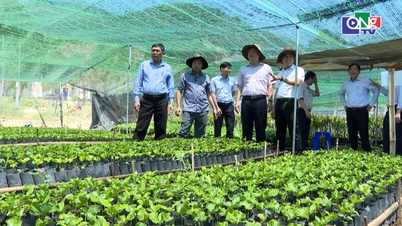
| The bank is supporting people in Hamlet 2, Dak Lua Commune, in developing their production. |
Enduring capital contributes to the development of the island.
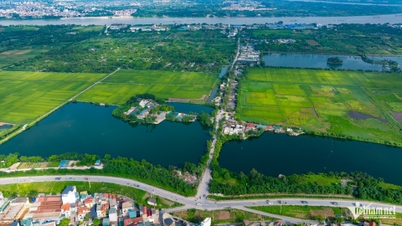
Visiting My Hoa Hung island commune these days, our first impression is no longer that of an isolated island, but rather a clearly different pace of life compared to 15-20 years ago. From the O Moi ferry terminal, concrete roads stretch through the hamlets, new rural flower-lined roads follow one another, and electricity and clean water have reached even the residential areas once known for their "three lacks and four shortages."
According to local officials and residents, the island's dynamism is largely due to policy-based credit. For many years, capital from the Social Policy Bank of An Giang province has consistently reached every farming household, addressing small but practical needs, thereby creating livelihoods and developing production.
Mr. Nguyen Minh Tuan (Six Tuan), Head of the Farmers' Association in My Thanh hamlet, said that Pho Ba islet was formerly a separate island, home to about 400 households who mainly lived by fishing, gardening, and hired labor. Life was precarious, and the people were always worried about erosion.
"But since connecting with revolving bank credit, almost every family has access to capital, from clean water and job creation to housing. People are using the capital effectively. Especially since electricity and clean water have been available, many households have boldly raised fish in cages and planted perennial trees, increasing their income 4-5 times compared to before," Mr. Tuan shared.
Not only has policy-based credit in My Hoa Hung helped people escape poverty, but it has also fostered larger-scale business models focusing on specialty crops of this riverine delta region. In My An 2 hamlet, Mr. Ho Quoc Tuan – Tuan "the cherry" – is a prime example. Concerned about the frequently flooded alluvial land and the low yield of rice cultivation, he sought out the Tam Phao cherry variety from Soc Trang and brought it back to try planting it. Starting with a few dozen trees, he independently researched techniques, learned how to care for them, and gradually expanded his operation as he accumulated capital.
Anh Tuan recounted that in 2011, a major flood swept away his orchard. During that difficult time, the Social Policy Bank continued to provide capital to help him raise the embankment and rebuild his orchard. Since then, he has not only planted trees but also expanded his eco-tourism area, processed products such as cherry wine and syrup, and is gradually working towards OCOP (One Commune One Product) certification.
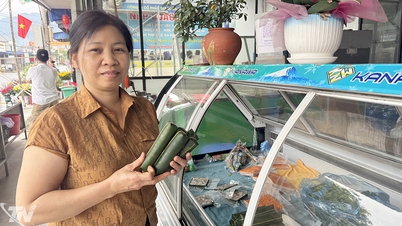
The story of Tuan "the cherry" is not unique. Walking through the hamlets from My An and My Thanh to My Long, one can see bank credit flowing into very specific livelihoods. In My Long 2 hamlet, Ms. Nguyen Thi Thai Huyen started with a family-scale chili sauce production, then borrowed from the bank to invest in machinery, expand production, and standardize the process. To date, the product has been recognized as a 3-star OCOP product, becoming one of the local specialties.
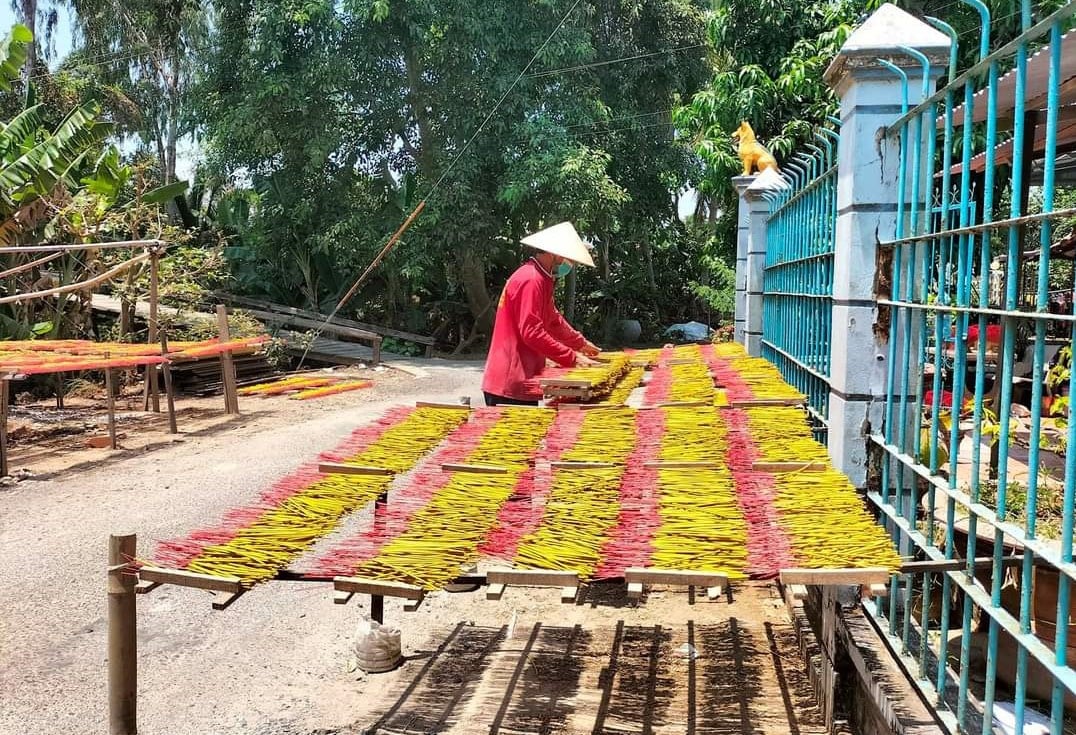
In other villages, traditional occupations such as incense making, ornamental flower cultivation, and chili farming have existed for generations, but previously were mostly done on a small scale. Now, thanks to policy-based credit, many households have boldly invested more systematically and joined cooperatives to improve productivity and output.
According to Ms. Pham Thi Thuy Huynh, an official of the Vietnam Fatherland Front in My Hoa Hung commune, the policy credit capital flowing into each household and circulating over many years has created a synergistic boost for the entire commune. As a result, traditional incense-making and ornamental flower-growing villages in Ong Ho islet have developed quite strongly; many families not only preserve their crafts but also open up spaces for tourists to visit and experience.
According to the commune's leaders, in early April 2026, My Hoa Hung was recognized as an island commune of An Giang province. This is not only an administrative change, but also opens up additional support mechanisms for the people and officials living and working there.
"This is an important condition for the locality to better develop its existing potential and strengths, from horticultural economy to ecotourism. Regarding policy-based credit, becoming an island commune will help preferential loan programs spread more widely and penetrate deeper into specific livelihood models," a representative of the commune stated.
 |
| Credit funding has helped millions of households improve their livelihoods and rise to prosperity. |
Livelihoods in flood-prone areas
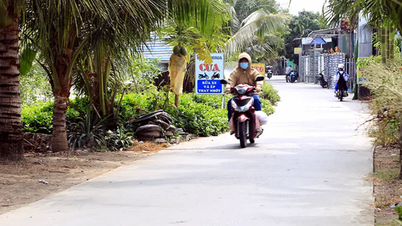
Leaving the islet in the middle of the Hau River, the story of bank credit continues in Dak Lua commune (Dong Nai province), where poverty stems not only from a lack of capital but also from the harsh natural conditions of the upstream forest edge of the Dong Nai River – an area that for many years was considered a "flood epicenter," with difficult roads, a long rainy season, and a scattered population in many small clusters along the forest edge. In this context, bank credit does not appear as a sudden "boost," but enters life slowly and closely, starting with the most basic needs. In many hamlets, the question is not "what crops to plant, what livestock to raise," but how to have a house foundation high enough to avoid flooding every rainy season.
Mr. Nguyen Thanh Nam, a resident of Hamlet 4, still clearly remembers the years when his family lived in a low-lying area. Every time it rained, water would flood their house, disrupting daily life and making long-term production almost impossible. “Back then, we only worried about flooding, not about doing anything big. Only when we received loans to raise the house foundation and rebuild the livestock sheds did life gradually stabilize,” Mr. Nam confided. From helping people settle down, policy-based credit in Dak Lua continues to deeply impact the livelihoods of individual farming households. With bank loans of tens of millions of dong, many households have started raising breeding cattle, planting fruit trees, and improving their neglected gardens. Each year, a little bit accumulates into a stable source of income – not quickly, but surely.
The story of Ms. Dinh Thi Hanh is a clear example. In the early 2000s, her family struggled, having to work as laborers and rely on freshwater fish and crabs from the forest for their livelihood, resulting in an unstable income. When the Women's Union supported her with a loan from the Social Policy Bank to raise cattle and buffalo, she began rebuilding her life from the very first animals. There was no sudden leap forward; each year the herd increased by a few animals, combined with other work to generate income. After nearly 10 years, the herd of cattle and buffalo had grown to several dozen, transforming a struggling household into one with a comfortable standard of living. Similarly, many other households started with small loans, then gradually expanded their livestock farming, combining it with other sources of income such as cashew shelling, labor, and small-scale trading to stabilize their lives. The common thread is that no one "changed their lives" instantly, but they all had a clearer roadmap, instead of depending on the luck of the weather and market as before.
According to Mr. Nguyen The Vinh, Director of the Tan Phu Branch of the Vietnam Bank for Social Policies, by the end of the first quarter of 2026, the total outstanding loans of policy credit programs in the commune reached nearly 47.6 billion VND, with more than 800 households having outstanding loans, an increase of about 9% compared to the beginning of the year. In the first three months of this year alone, more than 90 poor households and policy beneficiaries received loans totaling over 6.2 billion VND, directly contributing to poverty reduction, job creation, and social security in the locality.
According to Mr. Vinh, what is noteworthy is not only the scale of capital, but also the way it is organized and implemented. The entire loan balance is entrusted through socio-political organizations, with a network of savings and loan groups covering all hamlets, ensuring that the capital flows directly to each household and each specific situation. “In an area like Dak Lua, without a system of loan groups, it would be very difficult to manage and effectively utilize the capital. These groups serve as both a bridge and a place where people support each other in production,” Mr. Vinh explained.
Furthermore, maintaining a savings plan through loan groups, with monthly deposits of just a few tens of thousands of dong, has created an important financial habit for people in remote areas. While not a large sum, these small amounts accumulate into a substantial sum, helping households be more proactive in repaying their debts and laying the foundation for continued borrowing in subsequent cycles. This also ensures that the capital flow remains uninterrupted, circulating continuously over many years.
In recent years, as transportation and irrigation infrastructure have gradually improved, policy-based credit has become more effective. From focusing on small-scale livestock farming, many households have boldly shifted to higher-value models such as growing durian and green pomelo, combined with breeding cattle to create a dual income stream. Some households have also utilized their garden space for intercropping, diversifying products and reducing risks from market fluctuations and weather conditions.
From specific stories in My Hoa Hung island commune to the capital flowing into the forest edge of Nam Cat Tien, it is clear that policy credit is not just a source of support, but has become an integral part of rural development. The capital doesn't follow large-scale projects, but permeates every home, every garden, every small livelihood, adapting to specific circumstances to address the most practical needs of the people.
Therefore, the changes brought about by policy credit do not happen suddenly, but are persistent and continuous, starting with seemingly small things: raising the foundation of a house, raising a herd of cattle, improving an orchard, preserving a craft, or producing a new product. When these small changes are extended over time, they create a new face for many rural areas, where people not only overcome immediate difficulties but also gain a foundation to continue on the path of long-term livelihood.
Source: https://thoibaonganhang.vn/von-ngan-hang-thay-ao-nhung-vung-que-181399.html
























![[LIVE] CLOSING CEREMONY AND AWARD PRESENTATION OF THE 2026 DIGITAL TRANSFORMATION COMPETITION IN THE BANKING INDUSTRY](https://vphoto.vietnam.vn/thumb/402x226/vietnam/resource/IMAGE/2026/05/23/1779502316786_chatgpt-image-08-13-30-22-thg-5-202620260522081352.png)





























































Comment (0)