

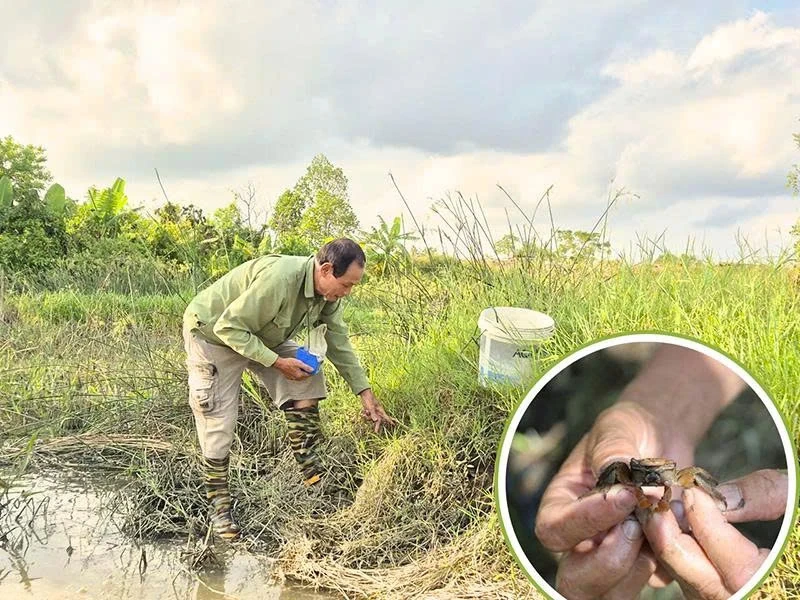
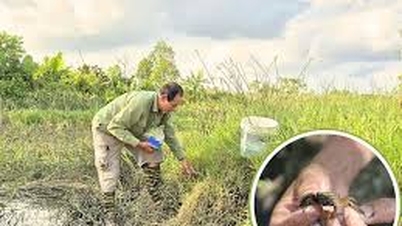
Mr. Diep shows how to lure crabs to make nests.
One chilly morning, we followed Mr. Diep along the ditches around the fields, his 2.5-hectare farm. What made us excited was that he revealed to us how to see with our own eyes the images of the clams entering and leaving their nests. We had to be very careful, because if we heard the slightest sound from footsteps or the grass and trees shaking slightly, they would quickly crawl down to their holes.
Mr. Diep said: "There are many clams here, but to catch them, you have to set traps and be an experienced person." Pointing to the vast field that he hired, Mr. Diep said that this whole area used to be abandoned fields, barren land that could not grow rice. In 2016, after retiring, he rented it back with the purpose of making a comprehensive farm. At first, he tried all kinds of models, from raising cows, pigs, ducks, to growing fruit trees... but the barren, low-lying land was not suitable.
After much thought, there was even a time when Mr. Diep gave up and did not invest anything because of the pressure. However, it was during that time that he had valuable observations and experiences. He realized that his farm was located close to the Yen River estuary, the water level rose and fell regularly, the clams appeared in large numbers, reproduced quickly, and produced a local specialty, clam sauce, so he asked himself: "Why don't we develop a model from the animals that are produced in the fields, and are popular with the people?"
When talking about the idea, everyone in his family advised him to rest and recuperate after many years of work. No one believed that raising clams would become a business. As for the neighbors, many people could not help but shake their heads at his decision. They thought that "raising clams" was just a joke, because clams have always lived naturally along the river, so who would catch them to raise, and then fail like the previous models. Some people even advised him "not to waste time and money", but he had decided to do it, so he sought out people who were knowledgeable about clam raising techniques to learn.
Mr. Diep shared: “The clams adapt to the environment with grass, moss, prefer early morning and live very well. They reproduce by themselves, no need to raise them industrially.” To start the model, he hired an excavator to dig “trenches” around the field, both to lead water and to create a natural environment for the clams to live and nest. He also planted sedge along the banks to preserve the soil and create hiding places. Not long after, in addition to the clams he released, the natural clams also competed to come and make nests.
According to Mr. Diep, raising clams does not require much investment, just the initial cost of renting an excavator to create a favorable environment for the clams, then there is almost no need to invest much in breeds or food. Clams reproduce by themselves, the main food source is moss and plankton left behind when the tide rises and falls. Every month, he hires people to clean the ditches, ensuring natural water circulation. Otherwise, clams live according to their instincts.
The clam harvest season lasts from March to July every year. He excitedly said: “Catching clams is also fun! We use 1.5 liter plastic bottles, cut in half, place them along the ditch bank and sprinkle some crushed roasted rice as bait. Just a moment later, the clams smell the aroma and crawl into the trap. Every morning, walking along the ditch bank, seeing the trap full of clams is fun.” Thanks to the model, each year his family collects about 3 tons of clams, selling them for about 80,000 VND/kg, bringing in an income of more than 200 million VND. Mr. Diep also shared his plan to expand the model, registering to build an OCOP product to bring Trung Chinh clam sauce to the market.
Head of the Economic Department of Trung Chinh Commune, Tran Van Thang, assessed that Mr. Diep's clam farming model is a creative direction, taking advantage of the low-lying fields, moist soil and abundant water resources, turning clams that were thought to only meet the meals of each family into a livelihood model for income, helping to change the way of thinking of people in low-lying areas.
Article and photos: Dinh Giang
Source: https://baothanhhoa.vn/vua-cay-noi-dong-trung-271174.htm



![[Photo] Urgently help people soon have a place to live and stabilize their lives](/_next/image?url=https%3A%2F%2Fvphoto.vietnam.vn%2Fthumb%2F1200x675%2Fvietnam%2Fresource%2FIMAGE%2F2025%2F12%2F09%2F1765248230297_c-jpg.webp&w=3840&q=75)











![[OCOP REVIEW] - Linh Phuong underground sticky rice wine - the quintessence of heaven and earth, preserved through every drop](https://vphoto.vietnam.vn/thumb/402x226/vietnam/resource/IMAGE/2025/12/09/1765265919130_review-ocop-ruo-w1200t0-di2549d205d2125644t11280l1-vang-va-mau-cam8.webp)



























![[Photo] General Secretary To Lam works with the Standing Committees of the 14th Party Congress Subcommittees](https://vphoto.vietnam.vn/thumb/402x226/vietnam/resource/IMAGE/2025/12/09/1765265023554_image.jpeg)




















Comment (0)