

Located on Celio Hill - one of the seven historic hills of Rome, this is an important religious building and attractive destination for tourists.
|
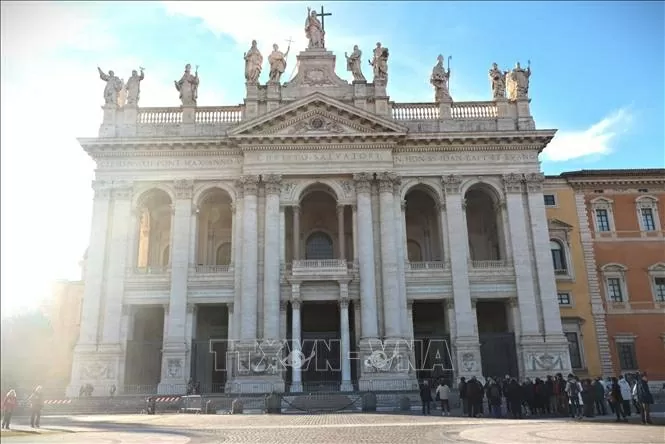
Facade architecture of the Basilica of St. John Lateran. |
During the 10 centuries from IV to 14, the Basilica of St. John Lateran, as well as the building next to it, was the center of the Church of Rome, the headquarters and symbol of the Hierarchy.
Chapels, monasteries, inns and hotels were established around this center as the "heart" of Church life at that time, much like the Vatican today.
The facade of the Basilica of St. John Lateran dates from the 18th century and is very well proportioned, considered the most magnificent of all the basilica facades in Rome.
Florentine architect Alessandro Galilei designed this facade in 1735 at the request of Pope Clement XII. It is all marble and fits well with the square in front.
On the roof of the facade, in the middle is a statue of Christ the Savior, on both sides are statues of St. John the Baptist holding the Cross and St. John the Apostle holding the chalice. On both sides are 12 saints, Doctors of the Latin and Eastern Churches, each statue 7m high, symbolizing the unity of the teachings of the Christian Church. There are 15 statues in total.
In the middle of the facade of the Basilica is the main balcony, where the Popes usually give their blessings to the people during the Holy Year. It was also here that Cardinal Gaspani, in the name of Pope Pius XI, signed the Lateran Treaty with Italy, establishing the Vatican State in 1929, re-establishing the legal and territorial independence of the Holy See. From then on, the Pope solemnly accepted this place as his Cathedral, as Bishop of Rome.
In the main hall of the Church there are 30 columns made of yellow marble, on both sides are statues of the 12 Apostles (about 6m high) sculpted by Pope Clemente IX (1700-1721). Above are reliefs recounting the stories of the Old and New Testaments.
The wooden Basilica was started by the architect Pirri Ligorio under the orders of Pope Pius IV (1559-1565). The project was completed under Pope Pius V (1566-1572).
In the transept of the Basilica, near the right entrance, there is a great organ with 2,000 pipes, supported by two large columns of yellow marble decorated with gilded wood. It is one of the most important organs in Italy and was designed by the architect Luca Blasi in 1599.
In particular, during the Holy Year 2025, the Basilica of St. John Lateran will have one of its five holy doors opened. The enduring beauty of the heritage has witnessed and preserved historical marks over the centuries that anyone who has the opportunity to visit Rome wishes to admire.
Father Carlo emphasized: "The Basilica of St. John Lateran is the only church in the world with the highest title of 'Archistle Basilica' - above all other basilicas, including St. Peter's Basilica in the Vatican.
The site is home to many of the Catholic Church's most important relics, those of Christ, Saint Peter and Saint Paul."
The Basilica of St. John Lateran - the first church of the Catholic Church and the cathedral of the Diocese of Rome - not only has historical and religious value, but also architectural and artistic value throughout its more than 17 centuries of existence. This is a great work, bearing a strong historical mark and contributing to the ancient love song that has resonated through thousands of years of history of the city of Rome. |
(according to VNA)
Source: https://baoquocte.vn/vuong-cung-thanh-duong-thanh-john-lateran-di-san-ton-giao-hon-1700-nam-o-italy-336161.html



























![[Photo] National Assembly Chairman Tran Thanh Man attends the VinFuture 2025 Award Ceremony](/_next/image?url=https%3A%2F%2Fvphoto.vietnam.vn%2Fthumb%2F1200x675%2Fvietnam%2Fresource%2FIMAGE%2F2025%2F12%2F05%2F1764951162416_2628509768338816493-6995-jpg.webp&w=3840&q=75)






























































Comment (0)