


Application of technology
Amidst the harsh heat of the dry season, cassava fields in Tan Hoi commune, Tay Ninh province, a key raw material area with over 3,400 hectares, are witnessing a landmark change. Instead of the sound of diesel-powered water pumps, a quietly operating solar power system is now becoming the "soul" of the modern irrigation system.
Previously, energy costs were a constant burden for farmers. Mr. Duong Thanh Phuong, in charge of the Tan Hoi Commune Agricultural Extension Station, shared: Each hectare of cassava costs between 1 and 1.5 million VND in electricity per month. With a concentrated irrigation cycle of about 4 months, the cost can reach 7-10 million VND/hectare. When fuel prices fluctuate, farmers often face a harsh trade-off between reducing irrigation water and accepting losses. To overcome this bottleneck, solar power models integrated with modern pumping technology have been introduced into cassava fields. Initially, a system cost nearly 40 million VND for 5 hectares, but now, thanks to "localization" and simplification of equipment, the cost is only about 12 million VND for each system with 2-4 solar panels.
Speaking about practical effectiveness, Mr. Bui Cong Ngoc, a cassava farmer in Tan Hoi commune, excitedly said that with reduced cost pressures, farmers are more confident in adopting new technologies. The integration of frequency converters into the pumps makes the equipment compact and easy to use. With a payback period of only about 2-3 seasons, this is a very viable option.

The combination of solar power and drip irrigation systems not only reduces costs but also increases productivity by approximately 20%. This method helps the soil retain its looseness, reduces weeds, and allows for the direct application of fertilizers and pesticides to the root zone, minimizing waste of agricultural supplies.
Besides the cost issue, the cassava industry in Tay Ninh is facing a greater challenge: land degradation. After years of extensive farming and chemical abuse, the soil structure has been broken down, acidified, and its fertility gradually lost. The SATREPS project, funded by Japan, has opened up a "rejuvenation experiment" for cassava in Vietnam in general and Tay Ninh in particular.
The focus of this solution is to bring circular farming into the field through five core principles: minimizing soil disturbance, maintaining cover, keeping roots alive, promoting biodiversity, and integrating livestock farming.
Mr. Takuro Shinano, Head of the SATREPS project team, emphasized: Regenerative farming techniques are a suitable approach, especially for areas in Vietnam where land is experiencing declining soil health. This is key to restoring soil ecosystems, reducing reliance on chemical inputs, and enhancing long-term profitability.
In Tan Hoi commune, the pilot model is helping farmers shift their mindset from exploitation to resource restoration. Modern equipment such as drones (UAVs), sensor systems, and artificial intelligence (AI) have been applied to monitor the health of cassava fields. People can now diagnose cassava mosaic disease through images on their phones and track carbon accumulation through carbon logbooks.
Mr. Dao The Anh, Deputy Director of the Vietnam Academy of Agricultural Sciences , assessed: Restructuring the cassava industry is an urgent requirement. The SATREPS project not only brings technology but also forms synchronized technical packages, from disease-resistant varieties to smart production processes, helping cassava no longer be a source of environmental pressure but become a link in the circular agricultural ecosystem.
Towards Net Zero

A more long-term vision for cassava cultivation in Tay Ninh is to participate more deeply in the renewable energy value chain, especially in ethanol production. In the context of energy security and global emission reduction requirements, cassava has become a strategic raw material due to its high starch content. To realize this goal, breeding science plays a crucial role. New cassava varieties such as HAC-10, with a starch content of 29-31% and superior resistance to cassava mosaic disease, are expected to create a breakthrough.
Dr. Truong Vinh Hai, Deputy Director in charge of the Southern Institute of Agricultural Science and Technology, affirmed: Cassava can absolutely become a major green fuel source in the roadmap to replace fossil fuels. With the readily available raw materials in Tay Ninh, it can optimize ethanol conversion efficiency, surpassing many other crops.
However, a gap still exists between research and business needs. To bridge this gap, a research ordering model has been proposed. Mr. Tran Quoc Dung Trung, Director of the Hung Loc Agricultural Experimental Research Center, said: Developing disease-resistant cassava varieties not only protects production but also ensures a stable supply for the biofuel industry. The center is strongly shifting towards controlled breeding to create superior varieties that are well adapted to local soil conditions.
From a state management perspective, Mr. Nguyen Dinh Xuan, Deputy Director of the Department of Agriculture and Environment of Tay Ninh province, believes that the research-ordering approach helps businesses proactively secure raw materials, provides scientists with stable resources, and ensures sustainable output for farmers through linkage contracts. This is a necessary direction to overcome the fragmented and undirected production situation.
Mr. Xuan also emphasized that developing ethanol from cassava is a dual strategy: both increasing the value of agricultural products and helping the cassava industry contribute to reducing millions of tons of CO2 annually through the carbon credit market.

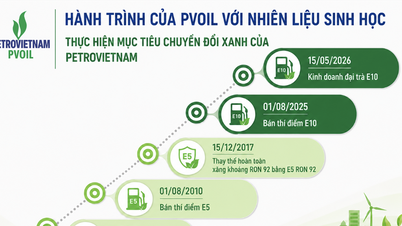
The transformation of Tay Ninh's cassava industry is not only about economic efficiency but also linked to the government's commitment to achieving net zero emissions by 2050. Expanding the use of E5 and E10 biofuels derived from cassava will help form a closed carbon cycle.
Associate Professor Dr. Nguyen Hong Quan, Director of the Institute for Circular Economy Development Research, analyzed: Developing biofuel from cassava not only contributes to ensuring national energy security but is also an important solution to realize the Net Zero commitment. The convergence of breeding science, processing technology, and circular economy models will transform cassava into a pillar of modern agriculture.
Although the road ahead still presents many challenges in terms of administrative procedures and infrastructure, the positive signs from cassava farming in Tay Ninh indicate a new opportunity is opening up. Once barriers are removed, technology is localized, and the collaboration of the "four stakeholders" (farmers, businesses, scientists, and the government) is strengthened, Tay Ninh cassava will truly become a green gold, bringing sustainable prosperity to farmers and making a significant contribution to the country's green economy.
Source: https://baotintuc.vn/kinh-te/xanh-hoa-chuoi-gia-tri-cay-san-20260515085518069.htm




























































































Comment (0)