

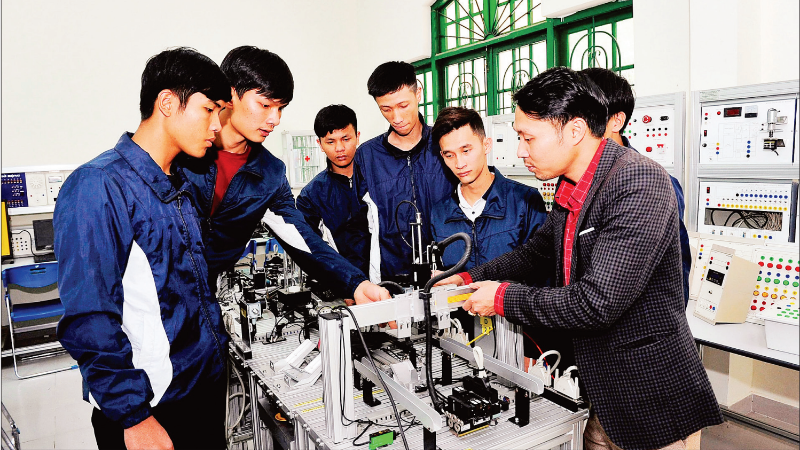
Applying AI in vocational education is not only a trend, but also an urgent requirement to improve the efficiency of management, training and enrollment; at the same time, ensuring technological autonomy and competitiveness in the labor market. According to Master Le Viet Cuong, College of Electronics and Refrigeration (Hanoi), AI currently has a profound impact on all fields, especially vocational education, where human resources are trained to directly serve production, services and technological innovation.
The application of AI in vocational education not only helps improve the quality of teaching and learning, but also develops digital capacity and adaptive skills for staff, lecturers and students. AI helps lecturers save time preparing lessons, students learn according to their individual abilities, and schools have more data to improve training programs.
However, according to Mr. Cuong, the rate of AI application in vocational education is still very low, less than 10% of establishments regularly deploying it. The main reasons come from the lack of a team that understands technology and data; facilities and information technology infrastructure are not synchronized; lack of legal corridors and mechanisms to encourage cooperation between businesses and vocational schools; along with concerns about the security of learning data and technology investment costs...
Currently, many vocational training institutions have organized pilot implementations of AI applications in management and training; teaching assistant systems, chatbots (virtual assistants) to support students, and provide quick learning feedback.
According to Mr. Nguyen Thanh Hung, former Deputy Director of International Relations Department ( Government Office )
In fact, AI helps automate processes, analyze big data and personalize learning experiences, thereby improving training efficiency. Technology not only supports teaching and management but also serves practical simulation, career guidance and smart recruitment.
According to Mr. Nguyen Thanh Hung, former Deputy Director of the Department of International Relations (Government Office), many vocational training institutions have piloted the application of AI in management and training; teaching assistant systems, chatbots (virtual assistants) to support students, and quick learning feedback. Some institutions have simulated vocational skills, for example, step-by-step instructions in assembling and repairing equipment using AR/VR (virtual reality and augmented reality technology) combined with AI...
However, the application of AI in vocational education still faces many challenges, from infrastructure and resources to implementation capacity. Many training institutions still lack synchronous equipment, and training programs for lecturers and managers on AI are limited, making the ability to apply technology a bottleneck. Vocational education emphasizes direct practical skills, while AI is mainly associated with digital learning and simulation, so integrating technology without reducing the quality of practice is a difficult problem.
The application of AI in education in general and vocational education in particular is an inevitable trend, contributing to improving the effectiveness of management, teaching and learning, while serving the comprehensive digital transformation process of the education sector. To exploit it effectively, it is necessary to overcome barriers in infrastructure, human capacity, training methods and ensure responsible use.
According to Mr. Le Viet Anh, Department of Quality Management (Ministry of Education and Training), the country has more than 1,800 vocational training institutions, including nearly 400 colleges. Currently, the Ministry of Education and Training is continuing to perfect the vocational competency framework, considering digital competency and technology application skills as important criteria for evaluating learners.
On the other hand, Dr. Nguyen Van Nghi, former Vice Principal of the School of Science and Technology Management, Ministry of Science and Technology, emphasized that applying AI in vocational education is an important requirement to meet the national human resource development strategy. However, in reality, only about 30% of vocational education institutions have digital standard labs. Therefore, Vietnam needs to build an AI ecosystem in vocational education, synchronizing from institutions, data, simulation infrastructure to teacher capacity and business-school cooperation, thereby shortening the gap between policy and practice.
From now until 2035, Vietnam's labor structure will shift strongly towards high-skilled needs, making the vocational education development strategy especially important.
Despite its great potential, Vietnam’s vocational education still has gaps in technology infrastructure, simulation, teacher capacity and data standardization. Therefore, building an AI ecosystem requires close coordination between macro policies and micro actions such as piloting models and training staff.
From now until 2035, Vietnam's labor structure will shift strongly towards high-skilled needs, making the vocational education development strategy especially important. Experts say that training institutions need to have a clear digital transformation roadmap; determine AI application goals; invest in infrastructure; train lecturers and managers and build a culture of responsible technology use; AI must be used as a support tool, not replace the central role of teachers and learners. At the same time, it is necessary to set up KPIs to measure effectiveness and evaluate the impact of AI on training quality, output skills and employment rates.
In addition, barriers in infrastructure, human resources, training methods and data security need to continue to be removed. Perfecting policies, increasing investment and training digital human resources are conditions for AI to be applied in the right direction, serving the goal of sustainable development.
Source: https://nhandan.vn/xay-dung-he-sinh-thai-ai-trong-giao-duc-nghe-nghiep-post928517.html






















![[Photo] National Assembly Chairman Tran Thanh Man attends the VinFuture 2025 Award Ceremony](/_next/image?url=https%3A%2F%2Fvphoto.vietnam.vn%2Fthumb%2F1200x675%2Fvietnam%2Fresource%2FIMAGE%2F2025%2F12%2F05%2F1764951162416_2628509768338816493-6995-jpg.webp&w=3840&q=75)
































































Comment (0)