


Give cities more decision-making power.
Vice Chairman of the Ho Chi Minh City People's Committee Nguyen Manh Cuong shared that the draft Law on Special Cities was developed based on a summary of the practical implementation of the city's special mechanisms and policies over the past period. With the spirit of "local decision, local action, local responsibility," the draft aims to build a superior legal framework for a megacity in the new development phase. The draft law consists of 9 chapters and 45 articles, focusing on 4 key areas, including many large-scale policies with far-reaching impacts and unprecedented in practice.
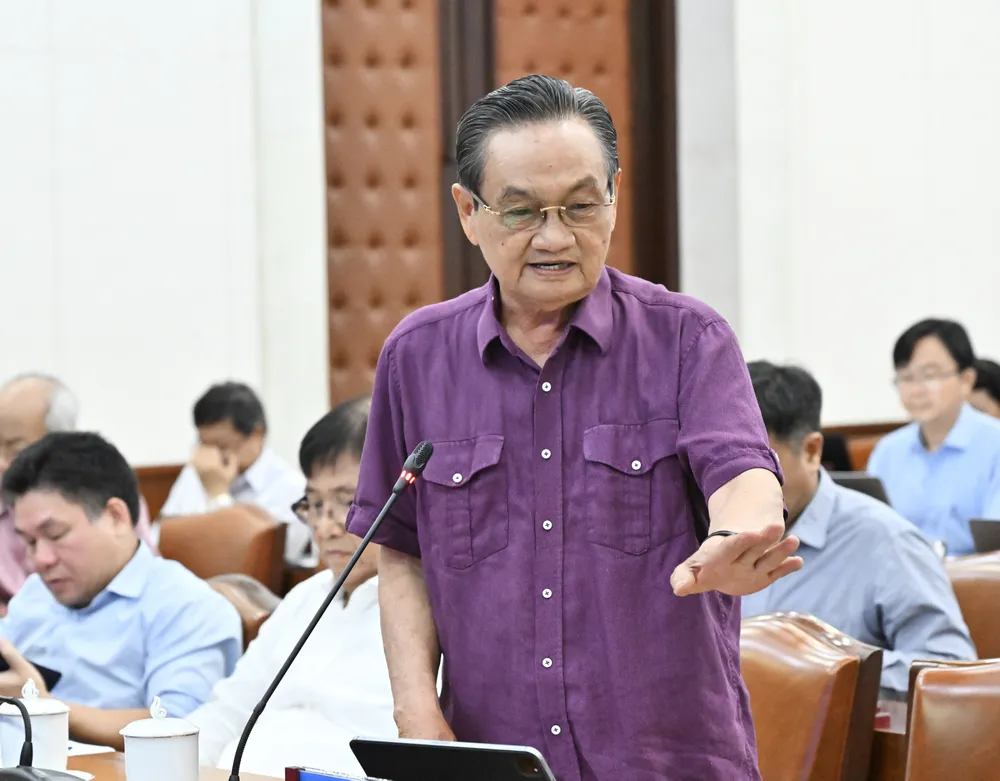
Contributing to the discussion, Dr. Tran Du Lich , a member of the National Financial and Monetary Policy Advisory Council, suggested that the Law on Special Cities would provide a stable and long-term legal framework for the city. He proposed that the law should focus on addressing core issues, including: granting the city government the authority to decide on the organization, arrangement, and effective exploitation of state-owned enterprises and public assets; and allowing the city government to issue local government bonds.
At the same time, it is necessary to give the city more room to enact policies; and to clearly define regulations for local budgets. In particular, Ho Chi Minh City needs to be more proactive with regard to local budget revenues; the City People's Council must have the right to make decisions and bear the highest responsibility, while the Central Government plays a supervisory and post-audit role.
Dr. Tran Du Lich also argued that the city is "asking for mechanisms, not money," and therefore needs to be empowered to generate revenue and proactively invest in development. He proposed granting more decision-making power regarding organizational structure, staffing, and civil service regulations to the two levels of local government; and increasing the authority of department directors and the chairman of the city's People's Committee to reduce unnecessary meetings and bureaucratic procedures.
From a regional perspective, many experts suggest redefining the scope of the "Ho Chi Minh City metropolitan area" to be more realistic. Associate Professor Dr. Thai Thi Tuyet Dung from the Vietnam National University Ho Chi Minh City suggested that the metropolitan area should include Ho Chi Minh City and adjacent localities, and that a "Regional Coordination Council" mechanism should be added to address current coordination bottlenecks. Sharing this view, Associate Professor Dr. Phung Chi Sy, Director of the Center for Environmental Technology, proposed that the regional scope should only include Ho Chi Minh City and adjacent or connected localities in the Dong Nai River basin such as Tay Ninh, Dong Nai, and Lam Dong to better address infrastructure, flood control, and environmental issues.
According to Nguyen Thi Hong Hanh, Director of the Ho Chi Minh City Department of Justice, the draft Law on Special Cities has 9 chapters, including: General provisions; Government organization, civil service regime and promulgation of legal documents; Urban planning, construction, development and urban order and safety; Economic, cultural and social development; Scientific and technological development, innovation and digital transformation; Resources for the development of special cities; Regional development linkages and environmental protection; Supervision, inspection and accountability; and Implementation provisions.
This is a draft law on decentralization, with thorough and maximum decentralization implemented in all areas (except for 4 areas where decentralization is not applied). The decentralization follows the principle: powers of the National Assembly are proposed to be delegated to the People's Councils; powers of the Government are delegated to the People's Committees; and powers of the Prime Minister are delegated to the Chairmen of the People's Committees. The drafting committee proposed including nearly 300 powers in the draft law, specifically delegating over 140 powers to the People's Councils, over 130 powers to the People's Committees, and over 20 powers to the Chairmen of the People's Committees.
Removing planning bottlenecks
Architect Ngo Viet Nam Son argues that the new draft law mentions free trade zones and TOD (Transit-Oriented Development), but it is insufficient to create new development drivers for Ho Chi Minh City. He proposes including five specific urban models in the law: free trade zones, financial centers, TOD cities, airport cities, and knowledge cities.
Architect Ngo Viet Nam Son also analyzed that, with the airport city model, Ho Chi Minh City does not yet have sufficient authority to comprehensively intervene in the area surrounding Tan Son Nhat Airport. If legalized, the city would be more proactive in planning the area affected by both Tan Son Nhat International Airport and the surrounding area of Long Thanh International Airport. Meanwhile, the knowledge city model will connect university cities, high-tech zones, and innovation centers to form new growth poles. Architect Ngo Viet Nam Son noted that if only commercial value is exploited without considering social welfare, low-income earners will be pushed away from public transportation routes. Therefore, he proposed allocating 20%-30% of the land around TOD projects for social housing or housing for workers to rent.
Meanwhile, Associate Professor Dr. Thai Thi Tuyet Dung argued that the draft law currently does not give adequate attention to the fields of education and healthcare, despite these being prominent strengths of Ho Chi Minh City. According to her, the city needs a financial mechanism for universities and tertiary hospitals located within its boundaries; and also needs to supplement policies to attract foreign experts and scientists in key areas.
Faced with the pressure of a shortage of high schools, Associate Professor Dr. Thai Thi Tuyet Dung proposed allowing the establishment of high schools within the campuses of large universities such as the Vietnam National University Ho Chi Minh City, to utilize available resources and address the educational needs of the people. Associate Professor Dr. Thai Thi Tuyet Dung also suggested that the regulations on exemption from criminal liability should be carefully considered to ensure consistency with the Criminal Code; the Law on Special Urban Areas should only stipulate exemption from administrative or civil liability.
Dr. Pham Thai Son, Vietnamese-German University: Developing a framework for monitoring and evaluating planning.
The draft addresses urban management extensively, and I believe it needs a clearly defined quantitative and qualitative framework for monitoring and evaluating planning. This framework would replace the inefficient and unregulated annual administrative reporting method, enabling the government to accurately grasp the actual impact of planning. Furthermore, in terms of spatial organization, the draft should include a mechanism for inter-ward and inter-commune planning. Establishing a legal framework for inter-commune regional planning would address bottlenecks in shared infrastructure after mergers and promote effective regional governance solutions.
Dr. Nguyen Thi Thien Tri, Ho Chi Minh City University of Law: Careful consideration of land reclamation.
One issue that directly impacts the psychology and lives of urban residents is the regulation expanding the scope of land acquisition, which needs to be considered with utmost caution. The draft regulation stipulates that, in addition to the cases of land acquisition under the Land Law, Ho Chi Minh City can also acquire land in other cases as prescribed by this law. This is an extremely sensitive issue.
This law lacks groundbreaking provisions regarding the practical rights of urban residents, and expanding the authority for land expropriation to local governments could easily provoke negative public reaction. To ensure consistency, coherence, and public safety, the draft should not arbitrarily add separate cases for land expropriation for cities, but should consistently adhere to the general provisions of the current Land Law.
Dr. Nguyen Thi Hau, Vice President and General Secretary of the Ho Chi Minh City Historical Science Association: Protecting urban heritage and memory.
The draft Law on Special Urban Areas needs stronger mechanisms to protect heritage, historical landscapes, and community cultural spaces, as these are the very soul that creates the identity of Ho Chi Minh City. The draft still lacks regulations on assessing the socio-cultural impact of urban renovation projects, central area reconstruction, or large-scale TOD (Transit-Oriented Development) projects.
In fact, many cities around the world have paid the price for dense urban development that has disrupted original communities and commercialized heritage. Therefore, the law needs a strong legal framework to preserve urban memory, establish heritage preservation funds, and apply strict penalties for acts of heritage damage. Lost heritage is lost forever; it cannot be addressed with just an apology.
Source: https://www.sggp.org.vn/xay-dung-khung-phap-ly-vuot-troi-cho-sieu-do-thi-post853993.html
























































































Comment (0)