

Lack of well-trained human resources
In recent enrollment seasons, some cultural and artistic training majors, especially traditional arts with specific characteristics such as tuong, cai luong... have fallen into a state of student shortage. Sharing with the media, Dr. People's Artist Trieu Trung Kien - Director of the Vietnam Cai Luong Theater said that at art talent training schools such as Hanoi University of Theatre and Cinema, Ho Chi Minh City University of Theatre and Cinema for many years now, there have been no candidates applying for classes of actors, musicians of tuong and cai luong.
According to statistics, as of 2021, the total number of human resources in the Culture, Sports and Tourism sector nationwide is 899,950 people, of which the field of culture and arts: 19,751 people; the field of physical education and sports: 10,199 people; the field of tourism: 870,000 people, of which 18,907 people serve in all three fields of culture and arts, physical education, sports and tourism.
Currently, the cultural industry includes 10 fields according to Decision No. 2486/QD-TTg approving the Strategy for the development of Vietnam's cultural industries to 2030, with a vision to 2045, including: cinema, performing arts, fine arts - photography - exhibitions, advertising, architecture, fashion , design, electronic game software, handicrafts, cultural tourism... All of these fields are based on creativity, talent, knowledge and technology. Therefore, human resources are the decisive factor for the industry's competitiveness.
In Vietnam, the development of the cultural industry is taking place, but is still slow compared to its potential. One of the reasons is the lack of high-quality human resources. According to statistics from the National Tourism Administration, the Vietnamese tourism industry is lacking about 30-40% of experienced workers compared to actual needs. With the development of technology, science and engineering, many new cultural industries have been "born" such as games, creative design, and art management, but they continue to face a serious shortage of human resources.
Notably, in the film industry, one of the fields with great contributions and strong spreading ability, the number of well-trained directors, screenwriters, and visual effects engineers is still low. Every year, Vietnamese screenwriters are still in short supply, not enough to meet the market demand with hundreds of film projects, web-drama, advertising and multimedia content. This puts many producers in a passive position, even having to hire foreign screenwriters, resulting in uneven product quality.
In practice, countries with developed cultural industries pay special attention to human resource training. South Korea is a typical example. Since the late 1990s, South Korea has invested billions of dollars in training human resources for the entertainment, arts, and digital content technology industries. Thanks to that, they have built a huge creative force, contributing to bringing music, movies, video games, and fashion to the world. In 2023, the value of South Korea's cultural content exports will reach tens of billions of dollars, a large part of which comes from a team of professionally trained human resources.
Not only lacking in quantity, Vietnam's human resources also face many limitations in digital skills, the ability to apply new technologies such as AI in content creation, 3D modeling, film effects, game engines, etc. This leads to many Vietnamese businesses having good ideas but not enough human resources to implement them, or having to hire foreign experts at high costs.
For example, the animation market in Vietnam is relatively “gloomy” compared to international friends. Although animation is bringing huge profits to the film industry, it requires highly qualified human resources in terms of technology, storytelling and aesthetic sense. This is a problem that educational institutions in art schools in Vietnam have not yet fully met.
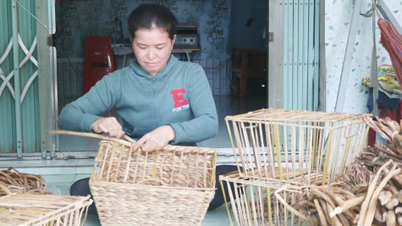
Another challenge is limited management thinking. In many areas such as cultural tourism, heritage promotion, and fashion, Vietnam has many unique products but lacks a brand development strategy, resulting in low added value. For example, traditional craft villages can create sophisticated handicrafts, but lack a creative design team to modernize the products or a marketing team to bring the products to the international market.
Obviously, for the cultural industry to make a breakthrough, high-quality human resources must be one step ahead. This is the foundation for creating added value, increasing competitiveness and contributing to making Vietnam a strong creative nation.
Developing high-quality human resources to serve the cultural industry
Decision 2486/QD-TTg approving the Strategy for the development of Vietnam's cultural industries to 2030, with a vision to 2045, shows the potential for developing high-quality human resources for the cultural industry. As for placing high human resource needs as the focus of development, the Strategy clearly states that "developing high-quality human resources" is one of the key solutions. That is, for the cultural industry to develop, it is necessary to have a team with appropriate qualifications, knowledge, and skills;

Expanding the cultural industry, creating diverse career opportunities. For example, industries such as cinema, fine arts, creative design, game software, advertising, media, cultural tourism are all included in the cultural industry. This requires a diverse human resource, not only traditional artists, but also technical experts, marketing, management, information technology... promoting multidisciplinary, multi-skilled training;
Encourage education and training associated with practice, technology and creativity. Because cultural industrial products require creativity, technology, copyright and meet market needs, training should not stop at "academics" but must combine practice, digital skills and creativity suitable to practical requirements. The strategy encourages the application of creativity, technology, culture and commerce, so the training program needs to be adjusted towards professionalism and multi-skills. Create an environment and cultural ecosystem where human resources can practice and develop. The development of creative centers, cultural industrial clusters, art spaces, cultural distribution and export centers is part of the strategy. Thanks to that, human resources have a real playground, opportunities to experience creativity and learn necessary to form high-quality human resources.
In addition, the cultural industry emphasizes technology, intellectual property rights and international competition, so investment in facilities, digital infrastructure and creative tools will be essential as a foundation for training modern human resources with the capacity to meet the requirements of the times.
Although the Strategy for the Development of Vietnam's Cultural Industries to 2030, with a Vision to 2045, opens up great opportunities for the development of high-quality human resources. However, to realize that goal, there are still many challenges for the cultural industry. For example, the demand for high-quality human resources is increasing rapidly but the supply has not met, while the training program is still heavy on theory and slow to innovate according to practical requirements. There is a lack of lecturers who are knowledgeable in new fields such as creative technology, digital media or copyright management. Many training facilities are also limited in digital infrastructure and modern equipment. In addition, the cultural industry has difficulty attracting talent because the remuneration policy is not really competitive.
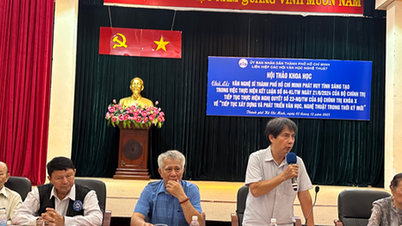
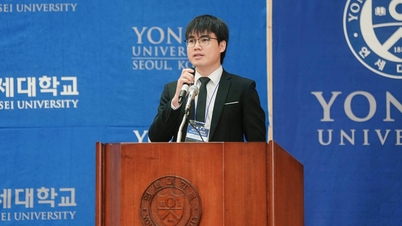
Dr. Mai Thi Thuy Huong, Deputy Director of the Vietnam Institute of Culture, Arts, Sports and Tourism, in her speech at the Scientific Conference towards the 14th National Party Congress, deeply analyzed the new points in the Draft Documents of the Congress, especially the orientation of human resource development in the cultural sector in the new era. First of all, it is necessary to fundamentally innovate training and fostering work in a professional, flexible and practical direction, overcoming the situation of heavy theory but lack of skills. Building a professional competency framework and shifting the focus from "learning to know" to "learning to do, learning to create" is a key requirement.
Second, developing digital human resources in the cultural sector becomes a pillar of the era, with skills such as data thinking, multimedia communication, digital copyright management and AI application. Training facilities need to invest in digital infrastructure to form a generation of digital artists. Third, there needs to be a policy to attract and treat cultural talents specifically to motivate creativity.
Finally, building a creative ecosystem including art spaces, creative centers, open museums or digital theaters will create an environment for cultural human resources to practice, connect and develop sustainably.
Source: https://baophapluat.vn/xay-dung-nguon-nhan-luc-tinh-hoa-cho-cong-nghiep-van-hoa.html




















![[Photo] National Assembly Chairman Tran Thanh Man attends the VinFuture 2025 Award Ceremony](/_next/image?url=https%3A%2F%2Fvphoto.vietnam.vn%2Fthumb%2F1200x675%2Fvietnam%2Fresource%2FIMAGE%2F2025%2F12%2F05%2F1764951162416_2628509768338816493-6995-jpg.webp&w=3840&q=75)
















































Comment (0)