

Many teachers and administrators believe that this document is necessary in the context of the education sector promoting digital transformation; at the same time, they propose to add a number of regulations so that electronic textbooks can truly become standard, safe and convenient digital learning materials for both teachers and students.
Platform for digital learning environment
“Issuing a Circular regulating standards and procedures for converting electronic textbooks is very necessary in the current context.” Emphasizing this, Mr. Pham Van Gieng - Vice Principal of Pedagogical Secondary and High School ( Hanoi Pedagogical University 2) said that digital transformation in education is no longer a slogan but has become an inevitable trend. When we move towards an open education system where learners can study anywhere, anytime, electronic textbooks must have clear standards.
In fact, there are many digital textbooks on the Internet, but some documents are inconsistent or inconsistent with official textbooks, easily causing information confusion. A unified legal document will help ensure the reliability, accuracy and quality orientation of this digitization.
Studying the draft Circular, Mr. Pham Van Gieng commented that this is a quite comprehensive document, updating many new elements. The notable point is that not only does it require keeping the content of printed books, the draft also mentions an interface that is friendly to students' eyes, ensuring multi-platform access, with interactive features, searching, highlighting, taking notes; especially the ability to integrate with learning management systems, AI, VR...
This shows that the thinking of building electronic textbooks has gone beyond the scope of “converting PDF format”, towards a truly digital learning environment. The appraisal process through a council of technology experts and teachers is also a point of progress, because digital educational products without practical experience will hardly be effective.
Sharing the same view, Mr. Nguyen Van Hung - Principal of Minh Dai High School ( Phu Tho ) affirmed the necessity of issuing regulations on standards and procedures for converting electronic textbooks; from there, teachers and students will have standard data, convenient to exploit in the teaching and learning process.
Mr. Hung said that schools are currently actively innovating and strongly implementing digital transformation in education and consider this one of the key tasks of the school year. Therefore, the conversion of printed textbooks to digital format, which can be read, listened to and viewed on electronic devices, is something that schools are looking forward to.
“The draft Circular has clearly stipulated the content, standards and process of converting printed textbooks into electronic textbooks. In particular, digital formats and the ability to read, listen and see on electronic media are added, multimedia integration and interactive features are very practical contents.
In my opinion, to facilitate teaching, it is necessary to convert both teacher's books and subject-related reference materials into digital format, and integrate multimedia components and virtual experiments. This will help teachers exploit more easily and effectively support teaching preparation work," Mr. Nguyen Van Hung shared.
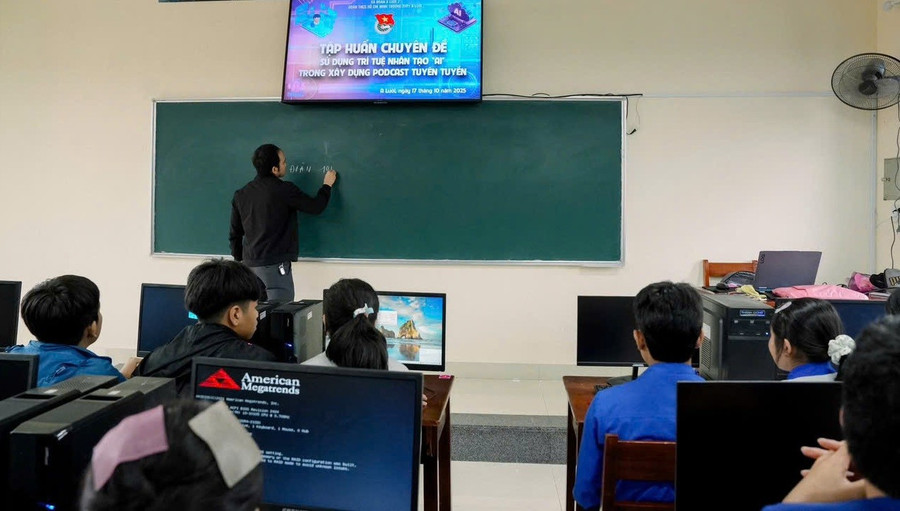
As a Physics teacher at a high school in the mountainous region, Ms. Pham Nguyen Trang Ngan - A Luoi High School (Hue City) said that the issuance of regulations on standards and procedures for converting electronic textbooks is extremely necessary.
According to her, the education sector needs a unified legal framework to ensure that electronic textbooks are built according to standards, are safe, have consistent content, data security and copyright; and avoid situations where each place does things differently or where illegal content appears, affecting students.
This regulation also contributes to ensuring fairness in access to digital learning materials by clearly stipulating interface optimization, multi-platform usability and offline support, suitable for students in both favorable and disadvantaged areas.
Ms. Pham Nguyen Trang Ngan highly appreciated the draft Circular for clearly stating the standards on content, technology, features, security and the process of evaluating electronic textbooks. These regulations are quite strict, systematic, and consistent with modern educational trends; especially the requirements of not inserting advertisements, protecting personal data privacy, ensuring that electronic textbooks match the content of printed textbooks and have features to support learners.
Suggested content to be improved
However, Ms. Trang Ngan also found that the draft still focuses too much on technical factors and does not emphasize enough the challenges of infrastructure, equipment and access conditions for digital learning for students in mountainous areas; at the same time, it does not clarify the responsibility of training and supporting teachers so that electronic textbooks can be used effectively.
“I propose to add regulations on optimizing the capacity of electronic textbooks and their performance, ensuring they run well on low-configuration devices, which is very important for students in mountainous areas. I also hope that the Circular will have additional provisions to encourage or support equipment, transmission lines, and digital capacity training for teachers and students in disadvantaged areas.
In addition, there should be guidelines on the duration of device use to ensure health, as well as clear orientation on combining printed textbooks and electronic textbooks in the initial stage so that the transition process takes place smoothly, reducing pressure on teachers and students," Ms. Pham Nguyen Trang Ngan suggested.
According to Mr. Pham Van Gieng, the draft needs to clarify the exploitation mechanism and usage costs: Are electronic textbooks free or subject to fees? If a third party exploits part of the content and collects money, how will it be handled? In addition, the responsibility for updating, maintaining and providing technical support should also be specifically regulated to avoid the situation of approval but unsustainable operation.
Mr. Nguyen Van Hung proposed that the Drafting Committee consider adding more regulations related to the exploitation of electronic textbooks, such as: School management content; teachers and students exploit electronic textbooks through which accounts (identification codes on industry databases, citizen identification cards, etc.). If there are these regulations, schools will easily monitor the frequency of use, and at the same time evaluate students' self-study as well as the level of exploitation of teachers and students.
Giving detailed comments on the draft, Mr. Nguyen Minh Dao - Principal of Lam Kinh High School (Thanh Hoa) said that it is necessary to add requirements on the ability to integrate with digital education platforms. In the context that the whole industry is deploying national digital learning materials..., electronic textbooks need to ensure that they allow synchronization of students' learning data; thereby, truly becoming part of the digital transformation ecosystem.
The regulation also needs to supplement provisions on pedagogical standards and interaction levels (minimum interaction level; information threshold appropriate for each level of education; requirements on color, sound, avoiding cognitive overload, etc.). The pedagogical nature of electronic textbooks is a core element, but the draft has not yet clarified it.
Security, intellectual property rights and access control issues also need to be clarified. Electronic textbooks are very susceptible to unauthorized sharing. Therefore, the draft should add content on account-based access authorization; copyright infringement warnings, and requirements for data encryption during storage and transmission. This protects the copyright and reputation of the publisher.
“Finally, the draft should add a requirement for pilot evaluation with teachers and students. Before official approval, e-textbooks need to be tested in practice to check ease of use, measure learning effectiveness and record feedback from teachers and students. This will help the books to be more realistic,” said Mr. Nguyen Minh Dao.
At Lam Kinh High School, after discussion within the core team, Mr. Nguyen Minh Dao said that the school's collective agreed: The draft basically meets the requirements of digital transformation, but needs to be more flexible to keep up with the development of technology.
Technology changes very quickly, so the technical regulations in the Circular should be open, allowing for periodic updates or the issuance of appendices to avoid obsolescence. Thus, the draft has shown a certain degree of flexibility, but still needs to expand the “open space” to promote innovation.
Source: https://giaoducthoidai.vn/xay-dung-tieu-chuan-sach-giao-khoa-dien-tu-co-so-cho-hoc-lieu-so-post759808.html





![[Photo] Urgently help people soon have a place to live and stabilize their lives](/_next/image?url=https%3A%2F%2Fvphoto.vietnam.vn%2Fthumb%2F1200x675%2Fvietnam%2Fresource%2FIMAGE%2F2025%2F12%2F09%2F1765248230297_c-jpg.webp&w=3840&q=75)



















































![[Photo] General Secretary To Lam works with the Standing Committees of the 14th Party Congress Subcommittees](https://vphoto.vietnam.vn/thumb/402x226/vietnam/resource/IMAGE/2025/12/09/1765265023554_image.jpeg)



























Comment (0)