

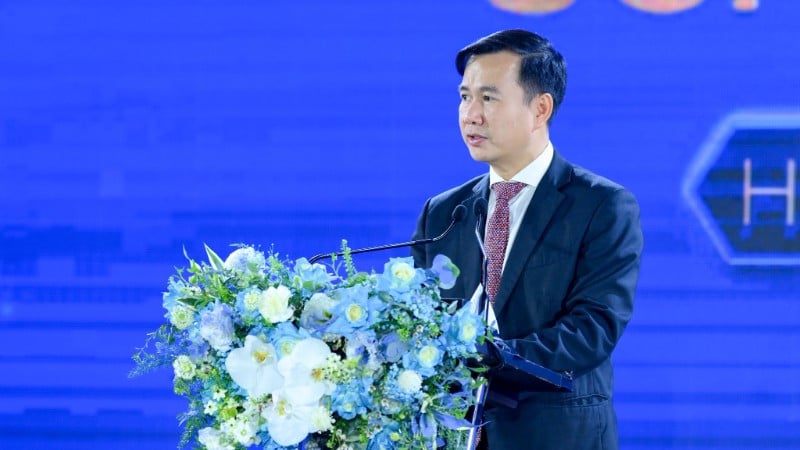
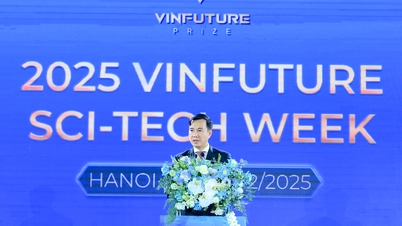
The panel discussion “AI for Humanity: AI Ethics and Safety in the New Era” took place on the afternoon of December 2, within the framework of the VinFuture 2025 Science and Technology Week, bringing together scientists, politicians and inventors to discuss responsible AI development, towards humanistic values. Deputy Minister of Science and Technology Bui The Duy attended and delivered a speech.
Vietnam has all the conditions to go fast and strong in the AI era.
Speaking at the seminar, Deputy Minister Bui The Duy said that Vietnam issued its first AI Strategy in 2021. Given the remarkable development of AI, by the end of this year, Vietnam will announce an updated AI Strategy and AI Law. This is not only a legal framework but also a declaration of national vision, identifying that AI must become Vietnam's intellectual infrastructure, contributing to social welfare, sustainable development and enhancing national competitiveness.
According to the Deputy Minister, Vietnam is building a national AI supercomputing center, an open data ecosystem and a Vietnamese AI infrastructure towards autonomy, while at the same time implementing comprehensive AI at a rapid pace, making AI a universal "intelligent assistant" for all people to improve social productivity and expand access to knowledge, a step forward that previously only high-ranking leaders had access to.
"Vietnam is determined to develop AI technology according to the open philosophy: open standards, open data, open source code. "Open" is the way to receive global knowledge, master technology, develop Make in Vietnam and contribute back to humanity. "Open" is also a condition to ensure safety and transparency in AI applications," the Deputy Minister emphasized.
Accordingly, Vietnam will promote the application of AI in industries and state agencies, and the National Technology Innovation Fund will allocate 30-40% of support resources, including AI vouchers for small and medium-sized enterprises, so that the Vietnamese market can truly become the cradle of strong AI enterprises.
Vietnam is both a large market and a place where new AI products are formed. With 11 strategic technology groups, computing infrastructure, rich data, Make in Vietnam digital enterprises and an ambitious startup-research community, the Deputy Minister affirmed that Vietnam has all the conditions to move quickly and strongly in the AI era.
Sharing about ethics in AI, Deputy Minister Bui The Duy affirmed that Vietnam develops AI in a fast-safe-humane direction, in which AI supports humans but humans are still the subjects who make the final decision.
"In the coming time, Vietnam will issue a National AI Ethics Code, AI Strategy and AI Law with key viewpoints: risk-based management; ensuring transparency and accountability; putting people at the center; encouraging domestic AI development; developing AI as a driving force for rapid and sustainable growth; and protecting national digital sovereignty based on AI data, infrastructure and technology.
Vietnam's AI path is defined by the word "And": global and local; cooperation and autonomy; technology and application; elite and mass; open data and protected data. AI development must be based on four pillars: institutions-infrastructure-human resources-AI culture, connected and complementary to each other," said the Deputy Minister.
Sharing with international experts, Deputy Minister Bui The Duy affirmed: AI is a historic opportunity for Vietnam to break through and become a developed country with high income. After decades of construction and development, Vietnam has become the 32nd largest economy in the world and has all the conditions to enter the AI era, improve labor productivity, achieve double-digit growth, strengthen governance capacity and protect the country.
Fairness and ethics in the use of AI
Artificial intelligence (AI) is transforming modern life, from education and healthcare to communication and governance. Rapid advances in AI offer growth opportunities, but also pose global ethical and safety challenges. Issues of fairness, responsibility and public trust are now at the heart of international dialogue to ensure AI is used for the common good.
Through keynotes, guided videos, and open discussions, the panel explores how to apply ethical frameworks in practice, maintain transparency and human oversight in AI, and promote international cooperation to strengthen global AI governance.
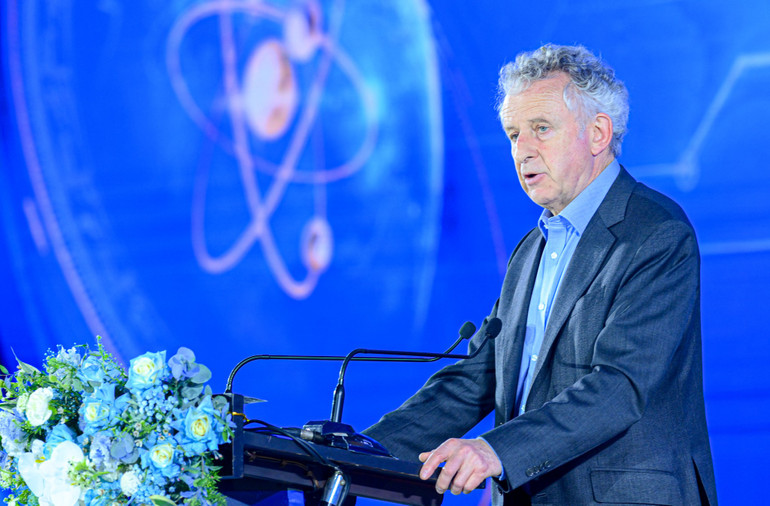
At the seminar, Professor Yoshua Bengio - co-winner of the 2018 Turing Award, warned that large-scale models, if not properly controlled, can self-optimize in a way that causes humans to lose control over the technology they create.
Professor Geoffrey Hinton – “father of AI” and winner of the 2024 Nobel Prize in Physics – emphasized that ethical and safety risks are no longer hypothetical but have become real issues.
According to Associate Professor Luu Anh Tuan, Executive Director of the Center for Artificial Intelligence Research, VinUni University, as a latecomer, Vietnam has the opportunity to take advantage of the latest technology in the world. Vietnam must build a clean data warehouse, covering the fields of culture, history, health, Vietnam's own context, ethnic minority dialects... In addition, there needs to be an ethical mechanism to avoid misinformation and fake news.
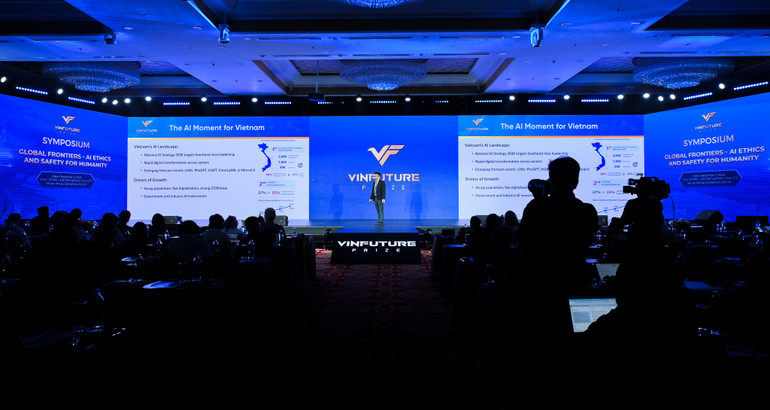
Associate Professor Luu Anh Tuan emphasized that Vietnam needs to ensure AI sovereignty, follow the open source direction and the Government must have clear guidelines on this issue. In addition, there needs to be a national AI ethics framework, detailed guidelines on the deployment of large language models, and an independent agency to verify and monitor, rather than leaving this model completely autonomous.
The discussion concluded by affirming the VinFuture Foundation's mission of promoting science and technology to serve humanity responsibly, calling for joint action to build a smart technological future that protects human dignity, promotes trust and a safer world.
Deputy Minister Bui The Duy affirmed that AI can only truly serve humanity when it is developed on an ethical, transparent, verifiable and responsible basis. This requires that from the technical design stage to the legal framework, everything must be geared towards protecting people and strengthening social trust.
"The international lessons shared today clearly show that responsible innovation can only be achieved through a multi-disciplinary approach, public engagement and collaboration between academia, industry and the state. This is also an experience that Vietnam can learn from to perfect its AI ecosystem. Opinions during the roundtable discussion suggested that Vietnam has a great opportunity to become an emerging bright spot in the region for responsible AI," said the Deputy Minister.
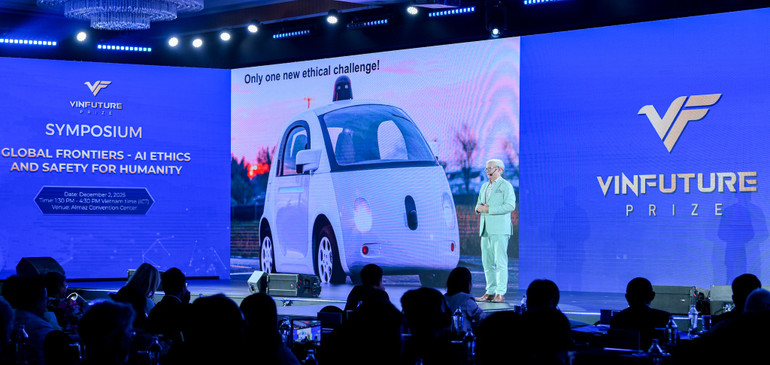
From this scientific seminar, the Deputy Minister said that Vietnam needs to promote education and develop AI talents, from popularizing AI knowledge to the people to in-depth training of experts; promote multi-disciplinary cooperation, bringing together scientists, experts, engineers, doctors, lecturers and policymakers to participate in designing, testing and monitoring AI systems; strengthen international cooperation, learn governance models from leading countries and contribute to global efforts on safe and humane AI.
The Ministry of Science and Technology is committed to always working with scientists, experts, businesses and domestic and international partners to build and develop a safe, humane and humane artificial intelligence ecosystem.
Vietnam will continue to actively participate in international forums and coordinate with VinFuture Foundation to bring its voice to major discussions on the future of AI.
Source: https://nhandan.vn/xay-dung-trung-tam-sieu-tinh-toan-ai-quoc-gia-dua-ai-tro-thanh-tro-ly-tri-tue-pho-cap-cho-nguoi-dan-post927397.html

![[Photo] Parade to celebrate the 50th anniversary of Laos' National Day](/_next/image?url=https%3A%2F%2Fvphoto.vietnam.vn%2Fthumb%2F1200x675%2Fvietnam%2Fresource%2FIMAGE%2F2025%2F12%2F02%2F1764691918289_ndo_br_0-jpg.webp&w=3840&q=75)
![[Photo] Worshiping the Tuyet Son statue - a nearly 400-year-old treasure at Keo Pagoda](/_next/image?url=https%3A%2F%2Fvphoto.vietnam.vn%2Fthumb%2F1200x675%2Fvietnam%2Fresource%2FIMAGE%2F2025%2F12%2F02%2F1764679323086_ndo_br_tempimageomw0hi-4884-jpg.webp&w=3840&q=75)












![[Photo] Parade to celebrate the 50th anniversary of Laos' National Day](https://vphoto.vietnam.vn/thumb/402x226/vietnam/resource/IMAGE/2025/12/02/1764691918289_ndo_br_0-jpg.webp)
![[Video] Urgently preparing for the inauguration and groundbreaking ceremony of projects to welcome the 14th National Party Congress](https://vphoto.vietnam.vn/thumb/402x226/vietnam/resource/IMAGE/2025/12/02/1764691316170_dung00-16-00-06still005-jpg.webp)
















































Comment (0)