

Ancient traces on the land of songs
Kẻ Đòi has long been known by the familiar name: Xóm Hát (Singing Village). No one remembers exactly when that name originated, only that through generations, singing has become an integral part of this rural area. In Kẻ Đòi, it seems that in every household there is someone who knows how to sing traditional opera, loves folk songs, plays traditional musical instruments, or participates in the performing arts group. That's why the folk song goes: "At night, I lie down and listen to the drums of Kẻ Đòi / Listen to the bells of Kẻ Hạc, listen to the whistles of Kẻ Lau."
According to Mr. Hoang Thanh Mai, former Head of the Culture Department of Bo Trach district (formerly), this area bears many unique cultural traces. “The locals here recount that during Nguyen Hue's march north, the Tay Son army once stopped in this region. It's possible that soldiers with roots in Binh Dinh (formerly) brought the art of Tuong Boi opera to Ke Doi. Over time, this art form was adopted, preserved, and has remained here to this day,” Mr. Mai stated.
 |
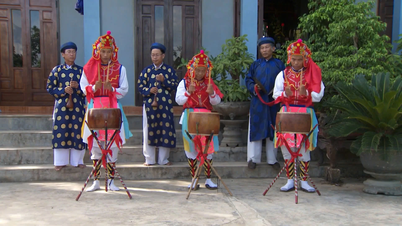
| The younger generation of the Dong Trach Commune Folk Music and Singing Club is continuing the traditions of their homeland - Photo: DH |
While this hypothesis lacks sufficient historical evidence to fully confirm it, in the cultural life of the people of Kẻ Đòi, traditional Vietnamese opera (tuồng bội) has truly become an integral part of their culture. Elderly villagers recount that, in the past, during festivals or periods of agricultural leisure, the entire village would gather around the communal courtyard to watch the performances. The sounds of drums, the two-stringed fiddle, and clappers echoed through the quiet countryside night. The performers knew every scene and movement by heart, and the audience knew the lyrics by heart.
Mr. Tran Minh Ho (90 years old), one of the elders with in-depth knowledge of traditional Vietnamese opera in Ke Doi, slowly recounted that the most prosperous period for the village's opera was before the August Revolution and during the years of resistance against the American invasion. Despite the fierce bombing and shelling of the war, the singing in this small village never ceased.
“Those were tough days, but everyone loved singing. At night, people would use two empty bullet casings as lamp stands, lighting them with oil to provide light for the performers. Whenever they heard the sound of American planes, the whole village would immediately turn off their lights and fall silent. When the planes passed, the lights would be turned back on, and the theater would be brightly lit again with the sounds of drums and singing…,” Mr. Ho recalled.
The song that passed through the war.
In the memories of many, Hat Hamlet is also a place of heartfelt camaraderie during the fierce years of war. In 1965, when the American invaders attacked North Vietnam, many families in the coastal area of Ly Hoa had to evacuate to Phu Trach. The people of Ke Doi sheltered and cared for their relatives as if they were family, sharing every cassava root and can of rice amidst the bombing. Even in those difficult times, the sound of singing still resonated powerfully. Those were the nights when the villagers gathered around oil lamps to listen to the performing arts group sing folk songs. It was the lullaby of mothers in the evacuation area. It was the singing that drowned out the sound of bombs and bullets, giving people hope to live.
Some people still vividly remember the song sung by an old mother in the village of Hát as she bid farewell to her relatives returning to their old homes after years of evacuation: "You return home, remembering your lonely friend/Remembering the mat you spread, remembering the place where you slept…". Therefore, the singing in Kẻ Đòi is not just art. It is also about human connection, the memory of a time of hardship but also of deep affection.
Returning to Dong Duyet 1 today, it's hard to recognize the small hamlet of yesteryear. The narrow dirt roads have been replaced by wide concrete roads. Spacious houses have sprung up side by side. The new rural landscape is changing this area every day. But the most precious thing is that the people here still maintain their love for traditional folk songs, and their eyes still shine brightly, despite having gone through many difficulties and storms. There are families that have followed the singing profession for generations. For example, the family of Mr. Nguyen Duy Sung has four children and one grandchild pursuing professional singing careers.
From a small village, many sons and daughters of Kẻ Đòi have stepped onto the big stage, becoming actors, artists, and cultural and artistic activists. But wherever they go, they still carry with them the distinctive folk singing style of their homeland.
Established in the 1990s, the Dong Trach commune folk music and singing club originated from the Ke Doi singing village. Through the changes of time and overcoming difficulties, the club has persevered and thrived to this day.
Ms. Pham Thi Hong Phuong, the club's chairperson, said that the club currently has 29 members, the oldest of whom is 92 years old but still actively participates in activities and performances. For many years, the club has not only maintained regular activities but also directly taught folk music and singing to students in the area, and participated in many local cultural programs. "The encouraging thing is that more and more students are interested in folk music, actively joining clubs and receiving direct guidance from artisans. From there, they gradually develop a love for their homeland's culture, contributing to preserving this heritage through transmission," Ms. Phuong shared.
Who remembers, who forgets?
Ms. Pham Thi Hong Phuong recounted the stories of the once-famous opera singers of Ke Doi with a look of deep regret. In her memory, Mr. Pham Hoat remained one of the "keepers of the soul" of the opera village with all his dedication and passion for the craft. In those days, he didn't wait for young people to come and learn to sing; instead, he quietly sought out successors. Whenever he heard of someone in the village with a bright voice, who could hum folk songs, or simply loved watching opera performances, he would go to their house to persuade their family to let them learn.
After working in the fields, as night fell over the small village, the old man would gather the children in his yard, patiently teaching them each song, each rhythm, each stroke of the beard, each eye movement, each gesture in traditional opera. Those lessons had no lesson plans, no brightly lit stage, only the rhythmic drumming in the night and the passionate devotion of people who loved art to the very end.
From those simple training sessions, some later became professional actors, while others simply kept their voices for the village festivals each season. But for them, the memories of the nights spent learning to sing with Mr. Pham Hoat remain an unforgettable part of their lives. Ms. Phuong said that what the old artisans worried about most wasn't poverty, but the day when the sound of the traditional opera drums would no longer echo in Ke Doi. "The elders used to say, 'If the sound of the opera drums is lost, the village of Hat will lose its soul…'," she said, her voice choked with emotion.
Then she fell silent for a long time as she spoke of old artisans like Mr. Pham Hoat, Mr. Nguyen Duy Sung… all of whom have now passed away. “Our generation has only preserved a part of the songs. As for the performance skills, the demeanor, and the gestures of the traditional opera that our ancestors once displayed, no one can do it like before anymore,” Ms. Phuong recounted.
That lingering sense of unease still permeates every evening's cultural and artistic activities in Hat Hamlet. As the older generation of artisans gradually departs, the villagers increasingly realize that preserving a folk melody is difficult, but preserving the essence of traditional Vietnamese opera is even more challenging. Therefore, for the people of Ke Doi today, preserving traditional art is not just about conserving a form of folk culture, but also about preserving the identity of their homeland.
Dieu Huong
Source: https://baoquangtri.vn/dat-va-nguoi-quang-tri/202605/xom-hat-ke-doi-ai-nho-ai-quen-6484918/













































































Comment (0)