

This sector combines creativity, technology, and business, simultaneously preserving and exploiting commercial value, contributing to the economy , enriching the spiritual life of the public, and strengthening the nation's soft power.
In general, the cultural industries usually include core sectors such as film and music . television , publishing , video games , fashion design , performing arts , and Cultural tourism. Some countries also include handicrafts, sports, and advertising. Some countries even include ethnic cuisine and traditional medicine. The extent to which cultural industries are grouped together or separated depends on whether they are included as a whole.
In 2014, Vietnam officially identified the task of developing the cultural industries alongside building and perfecting the cultural market. Resolution 33-NQ/TW and the Strategy for the Development of Cultural Industries (2016) for the first time provided specific strategic orientations, clearly defining objectives, areas, and solutions for development (up to 2020, with a vision to 2030). The 13th National Party Congress emphasized promoting the development of cultural industries, considering it one of the strategic breakthroughs for sustainable national development. Particularly noteworthy are recent documents (the 2nd Strategy (2025) on the development of cultural industries up to 2030, with a vision to 2045, Resolution No. 80-NQ/TW (2026)) on the development of Vietnamese culture, and the documents of the 14th Party Congress (2026). The Party and State have positioned the strategy for the development of cultural industries at a higher level. The cultural and artistic industries (CTE) are defined as the epitome of the combination of content creation with technology and digital transformation with cross-border markets. They are an endogenous, dynamic driving force and a regulatory system for sustainable development, with the potential to contribute significantly to GDP and exports, compete internationally, protect and promote national cultural identity, expand integration, and strengthen the nation's soft power. The State is committed to investing at least 2% of the budget in CTE sectors, while continuing to improve laws, mechanisms, and policies to encourage and promote the development of CTE to a new level. Although the Party and State's policy in Vietnam started later than in developed countries, it is now updated and implemented in line with global trends.
Globally, the contribution of the cultural industries to GDP is approximately 4%, with developed countries typically ranging from 4% to 7% depending on the statistical scope and the size of each country's economy. The UK and South Korea have reached 9%. In terms of added value, the US leads, reaching over $1.2 trillion in 2024, followed by China at nearly $1 trillion, Japan at $280 billion, the UK at $180 billion, Germany at $160 billion, Italy at $150 billion, France at $125 billion, and South Korea at $120 billion. The export value of cultural industry products is nearly $2 trillion, with 70% coming from the top 10 countries. China and the US export hundreds of billions of dollars annually, while other countries export tens of billions. The key cultural industries with well-known brands in the US are film, music, television, entertainment software, and multimedia. China's strengths lie in cinema (especially historical and martial arts films), handicrafts, toys, cultural tourism, and video games; Japan's in comics, animation, and video games; South Korea's in music (K-Pop) and television dramas; and developed European countries in fashion, cosmetics, and sports.
Within ASEAN, Singapore and Thailand are considered to have the most developed cultural industries. Singapore's strengths lie in its role as an international innovation center, performing arts, and global-scale event and exhibition organization; Thailand excels in film, music, fashion, and cultural tourism (promoting national culinary identity and traditional medicine); Indonesia in handicrafts , music, and video games; the Philippines in animation, music, and performing arts; and Malaysia in animation, video games, local cuisine, and cultural tourism. The proportion of cultural industries in these countries ranges from 5-7%. The general global trend is to develop cultural industries into a leading "non-polluting" sector, making significant contributions to GDP and exports, promoting digital transformation, expanding borderless markets in cyberspace, building national and international brands, promoting local identity, and competing through soft power.
The cultural and artistic industries in Vietnam are defined by 10 sectors: Film; Fine Arts, Photography and Exhibitions; Performing Arts; Software and Entertainment Games; Advertising; Handicrafts; Cultural Tourism; Creative Design; Television and Radio; and Publishing. In the period 2025-2030, Vietnam will focus on developing six key sectors: Film, Performing Arts, Software and Entertainment Games, Advertising, Handicrafts, and Cultural Tourism.
By 2025, Vietnam's cultural industry is expected to reach nearly US$20 billion, accounting for 4.2% of GDP (with a GDP of US$476 billion), placing it in the middle-income group globally and the upper-middle income group within ASEAN. The target is to achieve 7% (by 2030, equivalent to US$56 billion) and 9% (by 2045, equivalent to US$135 billion). Exports of cultural industry products are projected to grow by an average of 7% (by 2030) and 9% (by 2045). There are also 5 to 10 national cultural industry brands (by 2030). Vietnam aims to become a developed cultural industry nation in Asia, ranking in the top 3 in ASEAN and top 30 globally in terms of Soft Power Index and export value of cultural industry products.
The revenue targets for each industry (equivalent to USD) by 2030 are determined (from highest to lowest): (1) Software and entertainment games 50 billion; (2) Cultural tourism 31 billion; (3) Handicrafts 6 billion; (4) Advertising 3.2 billion; (5) Creative design 2 billion; (6) Television and radio 1.3 billion; (7) Cinema 500 million; (8) Performing arts 430 million; (9) Fine arts, photography and exhibitions 124 million; (Publishing has no specific revenue target). Structure: Software and entertainment games account for 53%, Cultural tourism accounts for 33%, other industries account for 14%. The main development direction is to combine content creation with technology and the market, with the digital cultural industry accounting for a dominant proportion of over 80%.
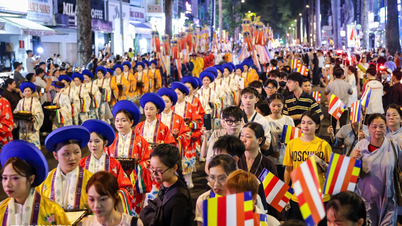
Major cities generally possess a full range of cultural industries as part of the national strategy, with infrastructure, markets, leading in added value and exports of cultural products, and a significantly higher contribution to GRDP compared to the national average. Hanoi (UNESCO Creative City) focuses on creative design, heritage, and art, with cultural industries contributing approximately 5.3% to GRDP in 2025, targeting 9% (2030) and 12% (2045). Ho Chi Minh City (Leading Cultural Industry Center) contributes 5.7% to GRDP (2025), targeting 7.2% (2030) and 9% (2045). The highest contributions come from key sectors such as film, games, performing arts, and cultural tourism. Da Nang (Central Heritage & Creative Center). The focus is on cultural tourism, digital industry, and gaming. It aims to contribute 5.8% to GRDP (2025), with targets of over 10% (2030) and 13% (2045). Hue (Heritage & Festival City): Focus on developing the night economy, live art, cuisine, and the ao dai (traditional Vietnamese dress) capital, linked to the heritage of the ancient capital. It has already contributed 4.5% to GRDP, with targets of 7% (2030) and 12% (2045). In general, in cities, entertainment, cultural tourism, and advertising sectors account for over 85% of the city's GRDP contribution, while other sectors contribute 15%.
Other localities have more limited infrastructure, especially markets, and focus primarily on developing cultural tourism, festivals, performing arts, and handicrafts. Very few cultural industries directly engage in commercial activities; their focus is mainly on activities such as filmmaking, visiting historical sites and museums, entertainment at tourist areas and attractions, and the sale of handicrafts and souvenirs. Cultural tourism is the mainstay, but it generates little direct revenue, mainly contributing to attracting tourists and extending their stay, thereby increasing revenue from accommodation, food, and shopping. Festivals, including large ones, sometimes sell tickets (like the Hung Temple Festival), while others do not, such as the Moc Chau Ethnic Culture Festival in Son La, but they still indirectly contribute to revenue from other services. Other cultural activities, including sports, are mostly service-oriented, not ticketed, and generate little revenue from other services (food, accommodation, shopping). In mountainous provinces, only professional cinemas are commercial establishments, while mobile film screening teams provide services. Professional performing arts activities are also primarily for public service. Some community art troupes perform for visiting groups and receive remuneration, but it is not substantial. Non-commercial cultural activities, which are public service activities, are usually not counted as revenue but still contribute a portion of the costs to the provinces' GRDP. Generally, cultural tourism accounts for an overwhelming proportion (over 80%) of the cultural sector's contribution to GRDP in the provinces, with other sectors accounting for only 20%.
In the future, digital transformation will help expand the market in cyberspace, not limited by geographical boundaries, but encompassing national and global markets, especially through online platforms such as YouTube, Spotify, Netflix, Amazon Kindle, TikTok, etc. Local cultural identity tends to be emphasized, aligning with consumer tastes. Thus, localities, especially mountainous provinces and ethnic minority regions, become an advantage. Not only in developed cities and provinces, but even in mountainous provinces like Son La, there are increasingly more individual channels producing and broadcasting content introducing the culture of ethnic groups (festivals, weddings, funerals, beauty contests, ethnic dances and songs, landscapes, villages, ethnic cuisine, traditional crafts, handicrafts, OCOP products, tourist destinations, homestays, experiential activities...). There are even channels guiding people in practicing health exercises and dancing at home... Publishing and broadcasting on the internet directly generates advertising revenue and contributes to promoting the sale of local products and attracting tourists to the area. The global advertising value is projected to reach US$1.2 trillion by 2025, with digital and social media advertising accounting for 80%, and print media only 20%. In addition, these individual broadcasting channels also attract considerable support and assistance from organizations and individuals both domestically and internationally. Locally, the former Vinh Long Provincial Television Station, which does not use state budget funds and even pays taxes to the state, is among the top 1,000 leading enterprises (nearly 1,000 billion VND/year). This is also due to its successful development of the online market, generating income from copyrights and advertising (the YouTube channel alone earns 4 million USD annually, equivalent to over 105 billion VND). The key issue is that developing the online market for cultural and artistic products must go hand in hand with improving management capacity, statistics, copyright protection, and child protection.
Developing statistical criteria for evaluating cultural industries is also a key issue. Since 2016, the Cultural Industry Development Strategy has addressed the need to research and develop statistical criteria for evaluating the revenue and added value of cultural industries. However, to date, annual statistics at the national and provincial levels on cultural industries still follow traditional indicators, limiting them to arts and entertainment industries, which account for only a very small percentage of GDP/GRDP. The majority are still mixed in with other sectors (handicrafts are under the Industry sector, entertainment for tourism is under the Tourism sector, broadcasting is under the Information and Communication sector...). In 2024, the ratio of the arts and entertainment sector to other cultural industries in the GDP/GRDP structure showed a significant disparity, with a ratio of 1/3-7 (Nationwide 0.63/4.2; Hanoi 0.75/5.3; Ho Chi Minh City 0.93/5.7; Da Nang 1.75/5.8...). Other localities have only included statistics on the arts and entertainment sector and have not yet calculated the other cultural industries, but the disparity is likely to be very large. Most localities base their targets on national indicators for cultural industry development: developed cities and provinces aim for higher than the national average; average provinces aim for the same as the national average; and less developed provinces aim for lower than the national average. Provinces limited to the arts and entertainment sector according to current statistics have very low targets. For example, in the Northern Midlands and Mountains region, Dien Bien province aims for cultural industries to account for 5% of GRDP (2030) and 7% of GRDP (2045). Meanwhile, Son La province only aims for 0.7% and 0.9%, although currently Son La's contribution rate from the arts and entertainment industry is higher than Dien Bien's (0.49 compared to 0.36). Given this situation, some localities (Hanoi City, Hue City) are proactively researching a system of statistical indicators to evaluate cultural industries. When calculating the full 10 cultural industries, it is necessary to subtract the portions that have long been mixed in with other industries. Therefore, the most standard approach is to have a set of indicators applied at the national and provincial levels nationwide, consistent with the statistical indicators for other industries.
Phan Duc Ngu
Source: https://sonla.dcs.vn/tin-tuc-su-kien/noi-dung/xu-huong-cong-nghiep-van-hoa-7923.html
























































































Comment (0)