

Rich, poor, and imprisoned—all because of the land.
In a sweltering rented room under the intense heat of early May, Mrs. Nguyen Thi Kim Buu (Hamlet 1, Song Trau Commune, Trang Bom District, Dong Nai Province) is preparing "new" documents to continue her complaint regarding her family's 11,000 m² plot of land, which was confiscated for the Bau Xeo Industrial Park nearly two decades ago. At 70 years old, Mrs. Kim Buu is the second generation to pursue this complaint. Her mother, Mrs. Le Thi Lam, passed away five years ago, not long after the family's land was forcibly confiscated at the end of 2018. Mrs. Kim Buu is not the only complainant. Approximately 50 households here, across generations, also disagree with the Dong Nai government's decision to confiscate their land and hand it over to the Bau Xeo Industrial Park investor.
On January 12, 2004, the Chairman of the People's Committee of Dong Nai province signed Decision 101/QD-CT-UBND to reclaim over 440 hectares of land in the communes of Song Trau, Tay Hoa, Doi 61, and Trang Bom town, and "temporarily assign the entire reclaimed land area" to Tin Nghia Company, Dong Nai Rubber Company, and their members to carry out compensation, land clearance, and investment procedures for the construction of Bau Xeo Industrial Park. In February 2004, Tin Nghia Company and Dong Nai Rubber Company contributed capital to establish Thong Nhat Joint Stock Company as the investor of Bau Xeo Industrial Park.
The source of the complaint also stems from this. Ms. Kim Buu's family and other households whose land was confiscated argue that Decision 101 of the Chairman of the People's Committee of Dong Nai province in 2004, issued before any decision from the Prime Minister regarding the establishment of the Bau Xeo Industrial Park, was "outside the authority." Their land and houses were also not within the approved planning boundaries, so the land confiscation for handover to the industrial park investor lacked legal basis. Therefore, the people refused to comply with the confiscation and have been filing complaints since 2004. In 2018, the People's Committee of Trang Bom district issued a notice to organize the forced land confiscation. Ms. Kim Buu and the other households argue that the Trang Bom district People's Committee's forced land confiscation based on Decision 101 was not in accordance with the law, and have continued to file complaints until now.
"They only compensated us 25,000 VND/m2 and 15 million VND as resettlement money, totaling over 700 million VND for 11,000 m2 of houses and gardens. How are we supposed to live after our land is confiscated?" said Mrs. Kim Buu. For many years, the 70-year-old woman, representing her seven siblings, has been living in a friend's rented room while pursuing her ongoing lawsuit, which she doesn't know when it will end...
Families with multiple generations filing land-related complaints, like Mrs. Kim Buu in the Bau Xeo Industrial Park, are not uncommon. Monthly reports on citizen petitions by the National Assembly never fail to mention large groups of petitioners who have escalated their cases from local to central levels, seeking justice. Most of them are citizens pursuing land-related disputes, like Mrs. Kim Buu and the residents of Trang Bom District. The figure of over 70% of land-related complaints, as announced by authorities, is an average statistic over many years.
Nearly four decades of national reform have created many dollar billionaires, most of whom amassed their wealth through real estate. However, these nearly 40 years of national renewal have also created a sense of injustice among generations of people who feel wronged by the fact that ancestral land is being confiscated at low prices and then handed over to businesses to build industrial parks, shopping centers, and high-rise buildings, which are then sold at high prices. Agricultural land is confiscated at 1 million VND/m², then rezoned as residential land, subdivided, and sold by businesses as high-rises at 50 million VND/m². Dr. Nguyen Si Dung, former Deputy Head of the National Assembly Office, stated that this 49 million VND increase is due to land expropriation, zoning changes, and land allocation decisions, which constitute land rent differential.
The actual land value difference is much larger than the example Mr. Nguyen Si Dung cited. Many residents of Thu Thiem (Thu Duc City, Ho Chi Minh City) had their land confiscated at a price of 18 million VND/m2, but just a few years later, when they returned to the project being built on their land, they were told by staff that apartment prices had risen to 350 million VND/m2 and were already sold out. A survey by the Vietnam Real Estate Association showed that the difference in land prices before and after a project reached up to 700 times in some areas, and at least 50 times. This enormous profit is offensive, infuriating, and a source of injustice. People lose their homes, land, and jobs because of socio-economic development projects for the national and public interest, but they themselves do not benefit from the value these projects bring. Compensation and resettlement money do not help them have a better life after their land is confiscated. Socio-economic development projects are underway, but the people remain poorer. Land acquisition and site clearance have therefore become a source of fear for many residents and the root cause of prolonged grievances and complaints.
In his opening remarks at the 5th Central Committee Meeting of the 13th Party Congress in May 2022, when the Party Central Committee reviewed the resolution on land policy, General Secretary Nguyen Phu Trong stated: "Many people have become rich because of land, but there are also many who have become poor because of land, even imprisoned because of land, losing even father-son and brotherly relationships because of land...". Land conflicts are increasing alongside the country's transformation and development.
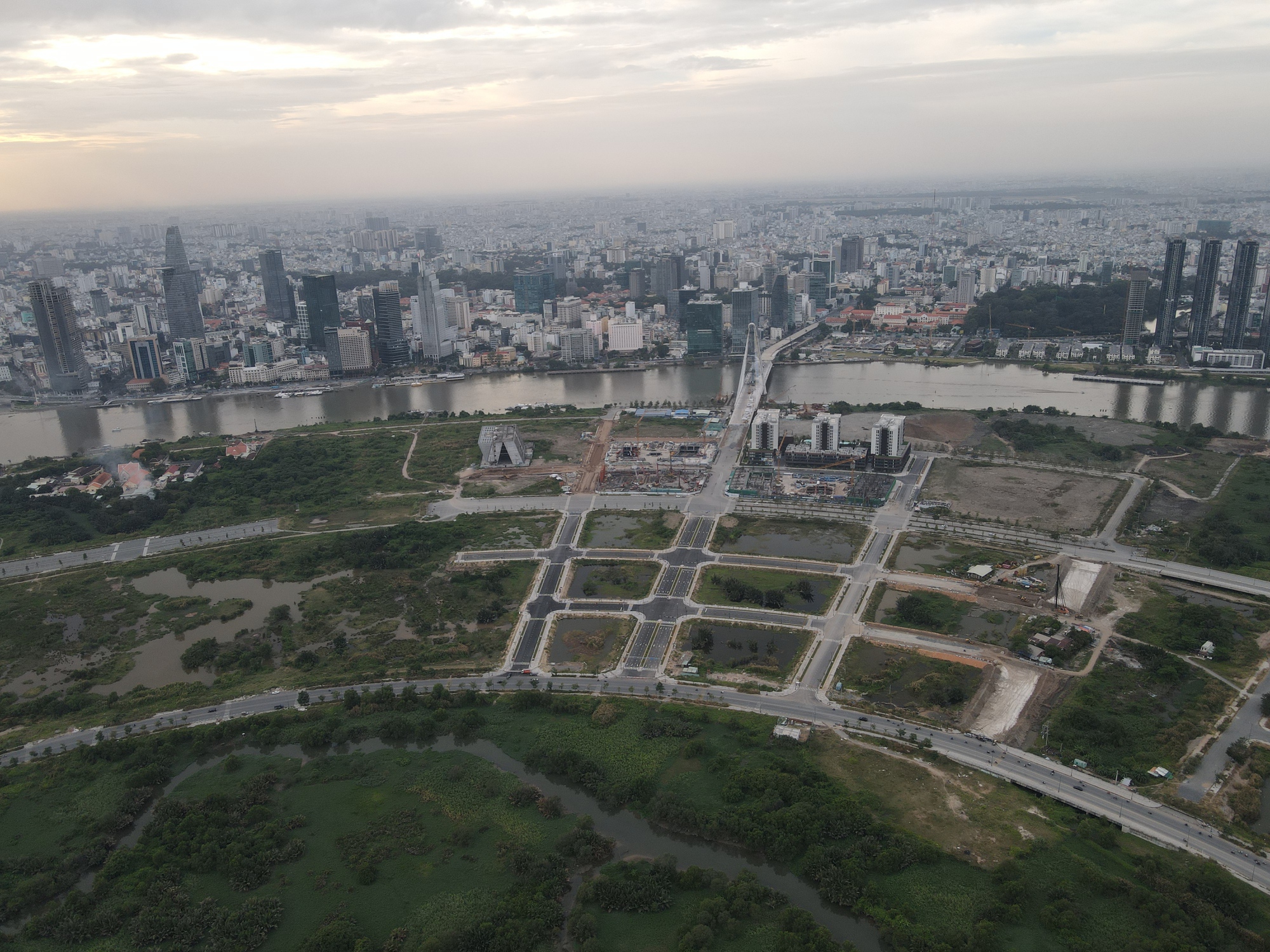
Over 70% of all land-related lawsuits nationwide.
THE ROOT CAUSES OF LAND CONFLICTS
If the people aren't the ones benefiting from the differential land rent generated by land acquisition projects, then who is? The most obvious answer is the businesses – those who were allocated the acquired land at low prices and then sold it at very high prices. But on many forums, businesses claim they are being unfairly accused and slandered.
According to the Constitution, Party resolutions, and the current Land Law, land is owned by the entire people, with the State acting as the representative owner and managing it uniformly. Exercising its right as the representative owner, the State determines the purpose of land use through land use planning and plans, and permits changes in land use. The decision to use a plot of land for urban development instead of keeping it as agricultural land (and only the State is permitted to do this) has created differential land rent.
According to Dr. Nguyen Van Dinh, a legal expert in investment and real estate, when businesses implement real estate projects, in addition to advancing money for state compensation and land clearance, they must also pay additional fees based on the land price determined by the state. In the surplus method used to value land for most land acquisition and conversion projects, the land price is calculated so that the business receives 15% of the added value after the investment project is completed, known as profit. The remaining 85% of the land rent difference must be paid into the state budget through land use fees. "Theoretically, 85% of the surplus value is the land use fee that the investor must pay to the state, which is integrated into the budget to be used for public purposes nationwide according to the State Budget Law, serving public investment," Dr. Dinh said.
However, what Mr. Dinh said is only "theory." The practical picture of regulating differential land rent is very different, involving many complex processes and procedures with numerous loopholes for corruption and malpractice. Businesses find many ways to maximize profits. Meanwhile, the state has probably never managed to integrate 85% of the added value into the budget. In most major land-related cases from north to south over the years, provincial and city governments, through various means, have allocated land to businesses at low prices, resulting in state revenue losses from the differential land rent. These losses range from tens of billions to thousands of billions of dong.
Dr. Nguyen Si Dung, former Deputy Head of the National Assembly Office
In a major case brought to trial recently, former Chairman of the People's Committee of Binh Thuan province, Nguyen Ngoc Hai, signed a document on February 23, 2017, approving the allocation of three plots of land totaling over 92,600 m2, located on both sides of Road 706B (in Phu Hai Ward, Phan Thiet City), to Tan Viet Phat Company without auction, at a price of 1.2 million VND/m2, the starting price for an auction as per a 2013 decision. Subsequent investigations revealed that allocating land at 1.2 million VND/m2 was illegal because, according to the Land Law, land use fees and land lease fees must be determined based on the land price at the time the state agency allocates or leases the land. According to authorities, the allocation of these three plots of land at such a low price to the company by former Binh Thuan provincial leaders resulted in a loss of over 45 billion VND for the state.
Similarly, on December 27, 2012, former Secretary of the Binh Duong Provincial Party Committee Tran Van Nam, then Vice Chairman of the Provincial People's Committee, signed decisions agreeing to apply the land price of 51,914 VND/m2 as stipulated in the 2006 decision of the Binh Duong Provincial People's Committee to calculate land use fees for two land plots of 43 hectares and 145 hectares when converting land use purposes and allocating land to the Binh Duong Production - Import-Export Corporation. According to the verdict, the determination of low land prices by defendant Tran Van Nam and his accomplices, which violated regulations, resulted in a loss of over 761 billion VND for the state.
In many similar cases of selling off prime land at low prices in Khanh Hoa, Da Nang, or Ho Chi Minh City, the defendants, who are leaders of these provinces and cities, all claim they did not profit from or engage in corruption when allocating land at low prices to businesses. Authorities have also failed to prove this. No bags of cash were found on their balconies. No illicit funds were found in safes or bank accounts of the suspects. Nor were any shady relationships brought to light. No one understands what "greased" the entire advisory and decision-making system when officials were aware that allocating land at low prices was wrong. Yet, the amount of money lost is growing steadily.
"For a long time, the entire system has been driven by the pursuit of differential land rent. This is the root cause of injustice and land conflicts," Dr. Nguyen Si Dung summarized. To reduce conflicts, Dr. Dung said that the issue of regulating differential land rent must be resolved, so that a portion of this added value is used to help those whose land is expropriated to have new housing that is equal to or better than their old homes, as stated in the Party's resolution. "If there is differential land rent, it shouldn't fall into the pockets of businesses or officials with the power to change land use purposes or adjust planning. There needs to be a way to redistribute the differential land rent fairly," Dr. Dung said.
Source link
![[Image] National Assembly discusses the implementation of the socio-economic development plan.](https://vphoto.vietnam.vn/thumb/1200x675/vietnam/resource/IMAGE/2026/04/20/1776696707422_ndo_br_img-20260420-185419-jpg.webp)
![[Photo] General Secretary and President To Lam meets with National Assembly delegates from ethnic minorities.](https://vphoto.vietnam.vn/thumb/1200x675/vietnam/resource/IMAGE/2026/04/20/1776696701056_a1-bnd-8331-3342-jpg.webp)






















































































Comment (0)