

The Transport Newspaper had an interview with Mr. Dinh Cao Thang, Head of the Finance Department, Vietnam Road Administration, regarding this proposal.

4 methods of management and exploitation
The Road Law, effective from January 1, 2025, allows for toll collection on state-invested expressways. What measures is the Vietnam Road Administration currently implementing to realize this regulation?
The implementation of toll collection will only be carried out after the expressways have ensured the necessary infrastructure and resources for implementation.
To implement toll collection, the agency assigned to manage the highway infrastructure assets must develop an asset exploitation plan and submit it to the competent authority for approval.
The timing of toll collection and the list of expressways where tolls will be implemented will be specifically determined in the decision approving the project.
Along with the process of drafting the toll collection decree, the Vietnam Road Administration is developing a plan for asset exploitation in accordance with Decree No. 44/2024 for submission to the Ministry of Transport for approval.
During the operation process, the Vietnam Road Administration will collect statistics and monitor the growth rate of vehicle traffic, and propose improvements to the legal framework to provide a basis for implementing other forms of highway management and operation such as transferring toll collection rights, transferring operating rights, business-management concessions (O&M contracts), or other more advantageous methods based on a project approved by the Government .
Mr. Dinh Cao Thang
Currently, there are many methods for managing and operating expressways. What are those methods, sir?
According to regulations, there are currently four methods for exploiting transportation infrastructure assets: the asset management agency directly organizes the exploitation of road transportation infrastructure assets; transferring the right to collect tolls; leasing the right to exploit road transportation infrastructure assets (O&M); transferring the right to exploit for a limited period; and other methods (if any) according to a plan approved by the Government.
Highways funded by the state budget are public assets, classified as infrastructure assets, owned by the State with the State acting as the representative owner, and are toll-collecting assets.
Of the methods you just mentioned, which one is the most feasible?
The method of leasing the right to operate road infrastructure assets is inappropriate because leasing the right to operate does not apply to road infrastructure assets that are subject to road usage fees.
Transferring exploitation rights for a limited period is also inappropriate, as this is linked to investment in upgrading and expanding existing assets according to projects approved by competent authorities.
Thus, among the forms of exploiting financial resources from public assets, there are two methods of exploiting state-invested, owned, managed, and operated expressways under new construction investment projects (excluding upgrading and expansion projects), with organized toll collection and under the authority of the Ministry of Transport to approve the asset exploitation plan: The asset management agency directly organizes the exploitation of road infrastructure assets and transfers the right to collect tolls.
The Law on Investment under the Public-Private Partnership (PPP) method includes provisions on the O&M contract form. Under this form, the investor or PPP project enterprise is granted the right to operate and manage part or all of the existing infrastructure and systems for a specified period.
The state's revenue collection will be flexible and transparent.
Could you elaborate on the advantages and disadvantages of these methods?
The advantage of having the asset management agency directly organize the exploitation is that it aligns with the functions and responsibilities of the agencies currently entrusted with managing and exploiting the assets.
This method can be implemented immediately, without creating additional organizations or personnel; the process of managing and exploiting assets is continuous and uninterrupted.
At the same time, this will ensure a steady annual revenue stream for budget contributions; the budget revenue over the years will be relatively stable; it is basically consistent with current legal documents and does not require many additions.
The government will be flexible in adjusting fee levels to suit the socio -economic development policies of each period; transparent in revenue collection, accurately reflecting the annual growth rate of vehicles and the actual traffic volume due to the application of non-stop toll collection technology.

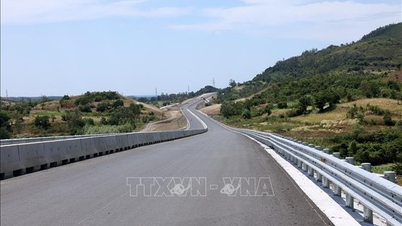
Toll collection will only be implemented after state-invested expressways have ensured the necessary infrastructure and resources for implementation (In the photo: North-South Expressway section from Mai Son to National Highway 45). Photo: Ta Hai.
However, this method has the disadvantage that the State budget does not have an immediate source of funding; instead, the revenue will be maintained and supplemented gradually each year.
The advantage of transferring toll collection rights is that it attracts social resources to invest in road infrastructure. The State budget immediately receives a corresponding revenue source according to the toll collection concession contract.
However, according to regulations, the transfer of toll collection rights is carried out through an auction. The starting price is determined based on traffic volume calculations.
For newly opened expressways, traffic volume and growth rate calculations are only estimates, and the traffic distribution ratios after toll collection are implemented do not fully account for other objective factors (such as natural disasters, epidemics, etc.), leading to errors in determining the transfer value of asset exploitation rights or conflicts of interest and obligations between the State and investors.
The O&M contract method has the advantage of implementing the policy of socialization, mobilizing external resources to participate in the operation and maintenance of transportation infrastructure.
The state's investment capital is also recovered quickly, the state receives a large sum of money in a short period of time, and the number of implementing agencies is reduced.
However, it has the disadvantage that the cost of the State receiving the funds early is the cost of raising capital and the profit that must be paid to the investor implementing the O&M concession.
This expense will reduce the amount of fees collected for the State budget, and to ensure the financial viability of the project contract, the fees may have to be increased.
The government also lacks flexibility in adjusting fees to suit different periods. Furthermore, investors can only be selected for sections of the route that are expected to have high traffic volume.
Which method should I choose?
So, which option was proposed, sir?
The Vietnam Road Administration proposes a method for exploiting highway infrastructure assets in accordance with the Law on Asset Management and Use, and this falls under the authority of the Ministry of Transport to approve the Project.
Specifically, the method involves "the agency assigned to manage road transport infrastructure assets directly organizing the operation." The implementation period for this operation method is approximately 5-8 years (the full operating cycle of the equipment).
Therefore, the Vietnam Road Administration, as the agency entrusted with asset management, will directly organize the management, maintenance, and toll collection for expressway sections invested in, owned, managed, and operated by the State in accordance with the law.
The toll collection will be implemented on a service leasing basis, with the State investing in the infrastructure and hiring a service provider to operate it. The nationwide operation of the automated toll collection system provides a favorable condition for selecting a service provider.
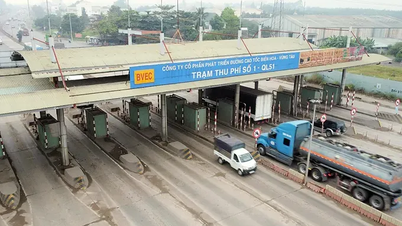
The organization of highway toll collection will be through toll stations, applying a model with "multi-lane free-flow ETC input (no barriers), single-lane ETC output (with barriers)", through the selection and bidding of toll collection service providers.
So, when is the fee collection expected to be implemented, sir?
It is expected to begin in May 2025, after the highways have completed the construction of essential infrastructure such as rest stops and ITS systems. Monitoring and management of funds will be assigned to the road management zones.
Thank you, sir!
Source: https://www.baogiaothong.vn/ai-se-thu-phi-cao-toc-dau-tu-bang-ngan-sach-19224093023164922.htm






























![[Photo] “Red Journey” 2026: Vietnamese Youth Continue Building the Bridge of Friendship Between Vietnam and China](https://vphoto.vietnam.vn/thumb/1200x675/vietnam/resource/IMAGE/2026/04/20/1776629730866_4055880775670638308-9618-4200-jpg.webp)





























































Comment (0)