

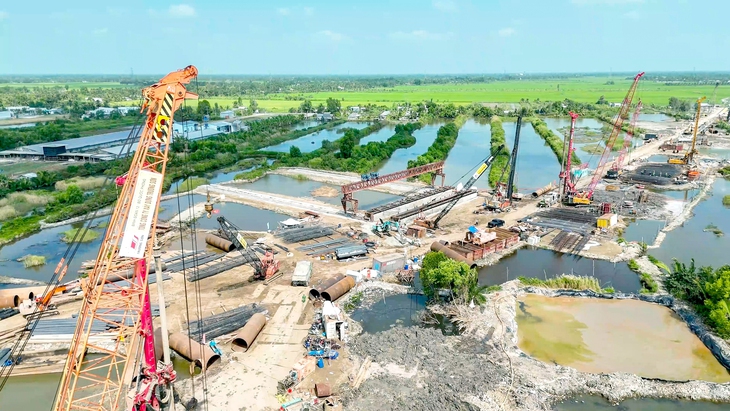
The Ca Mau - Dat Mui expressway is gradually taking shape, creating a connecting axis that will help agricultural products from the Mekong Delta reach international gateways from Hon Khoai port - Photo: THANH HUYEN
On the massive highway construction sites, machinery is bustling with activity; at airports, steel frames and terminal roofs are gradually taking shape; and at the harbors, ships and boats come and go in a constant stream.
Interregional infrastructure is opening up a new growth axis for the Mekong Delta, so it seems there is a concrete answer to the question "Does it have roads yet?".
Therefore, the question that needs to be asked right now is how localities and businesses will utilize the new transportation infrastructure to move faster and get ahead on the path of development.
Ca Mau: Marine economy as the driving force, expressways as the "lever"
From Ca Mau at the southernmost tip of the country, through An Giang to Dong Thap, each locality is redefining its development strategy based on the strong investment in transportation infrastructure, seaports, and airports by the central government.
With an area of over 7,942 km², a population of over 2.6 million people, a coastline of 310 km, and a sea area of over 120,000 km², Ca Mau possesses rare natural conditions. Its three sides bordered by the sea are not only a geographical advantage but also a potential "reserve" for the marine economy, renewable energy, and logistics.
Once the highway is fully completed and the seaport is finished, Ca Mau will no longer be the "end of the map," but will become the starting point of new trade corridors leading to the open sea.
Mr. Nguyen Ho Hai, Secretary of the Ca Mau Provincial Party Committee, stated that the provincial Party Committee has identified four strategic pillars for breakthroughs in the coming period. The first focus is on completing connecting transportation infrastructure, especially expressways, airports, and seaports; and developing a comprehensive digital infrastructure to attract investment into economic zones, industrial parks, and clusters with competitive advantages.
Based on that foundation, Ca Mau aims to develop the marine economy as the main driving force for growth. Wind power, solar power, green hydrogen, LNG power... are positioned as key sectors, aiming for energy self-sufficiency and electricity exports.
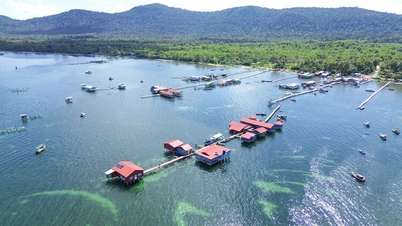
Seaports, especially Hon Khoai port, are expected to become an important link in the logistics chain, reducing dependence on transshipment ports outside the region.
Furthermore, the province continues to elevate high-tech, clean agriculture with two pillars: shrimp and rice; building a large-scale shrimp industry value chain, sustainably exploiting the economy under the mangrove canopy, and expanding the ecological rice-shrimp model. Tourism is also oriented towards development based on the province's natural advantages, history, and local cultural identity.
To realize this strategy, Ca Mau has identified public investment as the driving force, activating social investment and promoting public-private partnerships. Transportation infrastructure is being developed along dynamic economic corridors, connecting road, waterway, air, and seaport routes, targeting key economic, tourism, and historical-cultural sites.
Simultaneously, administrative reforms are being implemented to improve the investment environment and attract strategic investors in the fields of renewable energy, marine economy, and logistics; a proposal is being made to the central government to allow piloting of special mechanisms to remove "bottlenecks" related to land and site clearance.
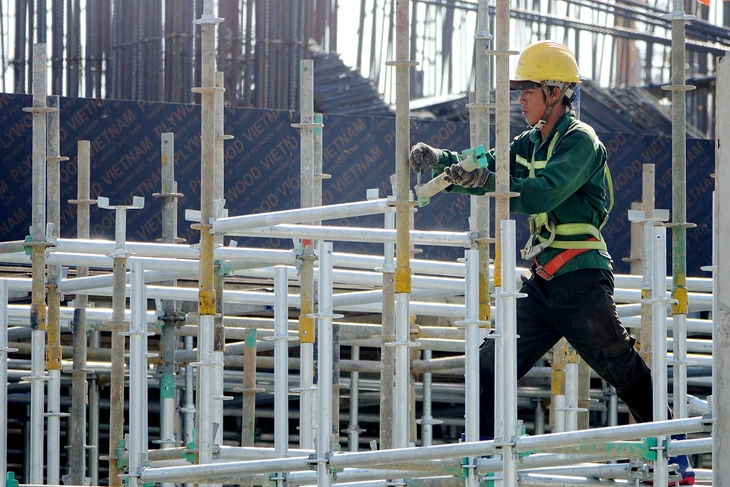
The Phu Quoc International Airport expansion project is being carried out urgently by the construction unit and workers - Photo: CHI CONG
An Giang: Towards the ASEAN Gateway
In the Southwest, An Giang is also making the most of the opportunities arising from the wave of infrastructure investment.
Mr. Ngo Cong Thuc, Vice Chairman of the People's Committee of An Giang province, said that in recent years, the province has received significant investment from the Government in key transportation projects, from expressways to airport systems. This is an important condition for attracting investment and promoting socio-economic development.
According to Mr. Thuc, developing transportation and technical infrastructure is a key requirement to meet the new development orientation. Besides the projects currently underway, An Giang continues to propose investment in the Ha Tien - Rach Gia - Bac Lieu (now Ca Mau) expressway. The project is currently being planned and promoted by the central government and the Ministry of Construction during this term.
"The formation of expressways not only creates momentum for development in An Giang province but also contributes to connecting the entire Mekong Delta region, expanding the region's trade gateway with ASEAN countries," Mr. Thuc affirmed.
Along with the highway system, the province is reviewing and adjusting the Rach Gia Airport planning according to 4C standards, meeting the operational requirements in the new phase. Notably, An Giang has unique conditions as it possesses three airports: Phu Quoc, Rach Gia, and Tho Chu. This advantage opens up great opportunities in the development of the marine economy, tourism, and logistics.
Regarding resources, the province has agreed on the principle of preparing counterpart funds for key projects, prioritizing the allocation of local budget funds alongside central government funds. Land clearance work is also organized systematically, drawing lessons from projects such as the Chau Doc - Can Tho - Soc Trang expressway.
With its gradually improving network of highways, airports, and seaports, An Giang aims to become an important trade gateway for the ASEAN region – a place where goods, tourists, and capital can flow quickly between Vietnam and its neighbors.
In addition, the Phu Quoc Special Economic Zone has chosen to thrive through international tourism. Mr. Tran Minh Khoa, Chairman of the People's Committee of the Phu Quoc Special Economic Zone, stated that Phu Quoc has experienced rapid and significant development. Infrastructure, including transportation, seaports, and Phu Quoc International Airport, has been systematically invested in, facilitating convenient domestic and international connections.
In 2025, Phu Quoc is expected to welcome over 8.1 million tourists, including more than 1.8 million international visitors, generating revenue of approximately 44,000 billion VND. The target for 2026 is around 10 million tourists, with approximately 2.2 million international visitors and revenue reaching 50,000 billion VND.
To achieve this goal, in addition to improving the quality of tourism services and products, the locality is focusing on building the APEC Convention Center, expanding the DT.975 road, and especially the Phu Quoc airport expansion project to serve the Asia-Pacific Economic Cooperation Forum in 2027.
"Phu Quoc Airport is identified as the gateway, the 'face' and a decisive factor in the development of tourism on the island. When the expansion is completed, the airport will not only welcome APEC 2027 but also create a boost for the island to attract more international flights, sharing the tourist burden with neighboring regions," Mr. Khoa said.

Mr. Ngo Cong Thuc - Vice Chairman of the People's Committee of An Giang province (second from the left) - at an inspection of the Chau Doc - Can Tho - Soc Trang expressway during the Lunar New Year of the Horse - Photo: BUU DAU
Dong Thap: A corridor for development and aspiration for breakthroughs.
With an area of nearly 6,000 km² and a population of over 4.2 million people, the development space of Dong Thap province is no longer confined to inland fields but stretches from the border with Cambodia - the headwaters of the Tien River - to connections leading to the East Sea.
The combination of border economy and maritime-oriented thinking has given Dong Thap rare development potential, allowing the province to closely connect from the southwestern border to the southern key economic region.
Within the overall regional picture, Dong Thap is also clearly defining its development corridors for the next five years (2026-2030). Accordingly, Dong Thap province has identified five key economic corridors, including:
The central corridor (expressway, National Highway 1) prioritizes high-tech industries, regional logistics, and modern urban areas; developing My Tho and Cao Lanh into service and trade centers.
The Eastern Coastal Corridor (strategic maritime economic axis) prioritizes coastal economic zones, seaports, wind power, resort tourism, and climate change-adaptive coastal cities.
The corridor along the Tien River is developing based on its riverine advantages; prioritizing ecotourism, high-tech agriculture, processing of 15 agricultural and aquatic products, and waterway logistics; connecting the urban chain of Hong Ngu - Cao Lan - Sa Dec - Cai Be - My Tho - Go Cong.
The Dong Thap Muoi inland corridor (National Highways N1, N2, and N30) prioritizes large-scale commercial agriculture, specialized farming areas, and processing centers; and the development of ecological, circular, and climate change-adaptive agriculture.
The corridor along the Hau River is developing multimodal logistics, processing, and shipbuilding industries.
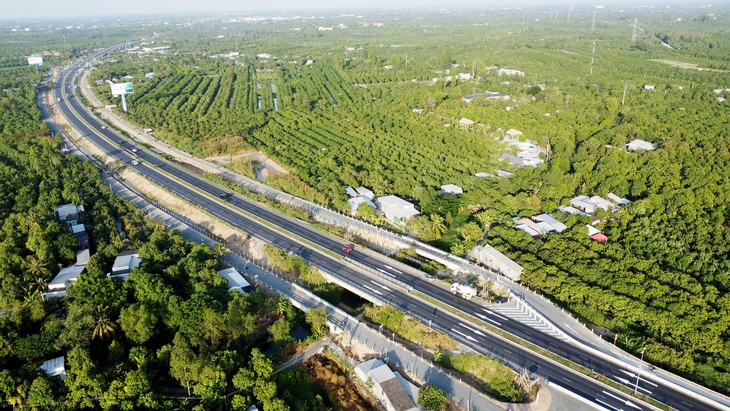
Dong Thap province has identified its development corridor, with the My Tho - Cao Lan axis receiving significant investment to become two bustling service and commercial centers, acting as a "nucleus" to spread momentum throughout the province. - Photo: MAU TRUONG
Infrastructure is key to solving the long-standing traffic congestion problem.
From a business perspective, Mr. Ho Quoc Luc, Chairman of the Board of Directors of Sao Ta Food Joint Stock Company, believes that the strong investment in transportation infrastructure and ports in the Mekong Delta is a very positive sign.
"Good transportation infrastructure speeds up the flow of goods, thereby reducing costs and risks. The Mekong Delta is the capital of shrimp, fish, rice, and fruit. When seafood is transported quickly, its quality is better preserved," Mr. Luc commented.
He also emphasized that if there were deep-water ports and container ships right in the region, rice, fruits, shrimp, and fish would no longer have to incur high transportation costs to the Ho Chi Minh City port cluster. When logistics costs decrease, the competitiveness of agricultural products from the Mekong Delta in the international market will increase significantly.
This isn't just the story of one business, but a shared problem for the entire region. For a long time, the Mekong Delta has been considered the "rice and shrimp granary" of the country, but high logistics costs are eroding this advantage. Infrastructure is the key to solving this problem.
A series of multi-billion dollar projects "open the way" for the Mekong Delta.
In recent years, the Mekong Delta has entered its most rapid infrastructure development phase ever, gradually eliminating traffic bottlenecks and expanding development opportunities for the entire region.
Complete the eastern highway axis.
A significant boost was the Trung Luong - My Thuan expressway, over 50km long and with a total investment of 12,000 billion VND, which was put into operation at the end of April 2022. This four-lane expressway, with a design speed of 80km/h, has put an end to the long-standing traffic congestion on National Highway 1, especially during holidays and Tet (Lunar New Year).
Following that, the My Thuan 2 bridge, along with its approach roads at both ends, spanning 6.6km and featuring 6 lanes, with a total investment of over 5,000 billion VND, was started in February 2020 and put into operation at the end of 2023.
The project is being built approximately 350m upstream from the old My Thuan Bridge, with its starting point connecting to the Trung Luong - My Thuan Expressway and its end point connecting to the My Thuan - Can Tho Expressway.
The bridge's commissioning has completed the expressway from Ho Chi Minh City to Can Tho, creating a seamless transportation network for the entire region and significantly reducing congestion on the old My Thuan bridge and National Highway 1.
The nearly 23km section of the My Thuan - Can Tho expressway also reached completion at the end of 2023, completing the eastern expressway axis. As a result, travel time from Ho Chi Minh City to Can Tho has been reduced to just over 2 hours, instead of about 3.5 hours as before.
In the South, the Can Tho - Ca Mau expressway project, nearly 110km long and costing nearly 27,500 billion VND, was put into operation at the end of 2025 and is currently completing auxiliary items and interchanges.
The newly opened road reduces travel time from Ca Mau to Ho Chi Minh City to approximately 3.5 to 4 hours, nearly halving the journey time compared to traveling via National Highway 1.
At the starting point of the route, the Can Tho 2 Bridge project is expected to commence in 2026 and be completed after 5 years, creating an additional span across the Hau River, ensuring continuous traffic flow on the North-South axis.

The Can Tho - Ca Mau expressway, now operational, connects a key section of the eastern expressway network from North to South, facilitating convenient trade and transportation of goods. - Photo: THANH HUYEN
Formation of the western axis and the horizontal axis
On the western axis, the Lo Te - Rach Soi expressway, over 51km long and costing more than 6,300 billion VND, opened to traffic in early 2021. This route shortens travel time from Can Tho to Kien Giang to about 50 minutes, while also enhancing international transport connectivity.
This expressway connects the Mekong Delta Central Connection project and the N2 route, forming a North-South axis in the West, providing seamless access from Dong Nai and Ho Chi Minh City to Can Tho, An Giang, and Ca Mau without having to go through National Highway 1.
In mid-2024, after three years of operation, the My Thuan Project Management Board (Ministry of Construction) began upgrading the route with a total investment of approximately 750 billion VND from the state budget. Currently, the road has met the standards of a complete expressway, ensuring safer and smoother traffic flow.
Meanwhile, the Chau Doc - Can Tho - Soc Trang expressway, over 188km long and with a total investment of nearly 45,000 billion VND, is gradually taking shape and is expected to be completed in its entirety by 2027. Once operational, this will be a vital transportation artery running through the central Mekong Delta, connecting the southwestern border gate with the Tran De seaport.
Strategic bridges spanning major rivers
Along with expressways, major river crossing bridges are also receiving significant investment. The Rach Mieu 2 Bridge (6,800 billion VND) is scheduled for completion in August 2025, helping to alleviate pressure on the existing Rach Mieu Bridge.
Meanwhile, the 15.1km-long Dai Ngai Bridge, costing 8,000 billion VND, will shorten the distance from Ca Mau to Ho Chi Minh City by approximately 80km when completed in 2028 compared to traveling on National Highway 1.
We need to find a balance between public and private narratives.
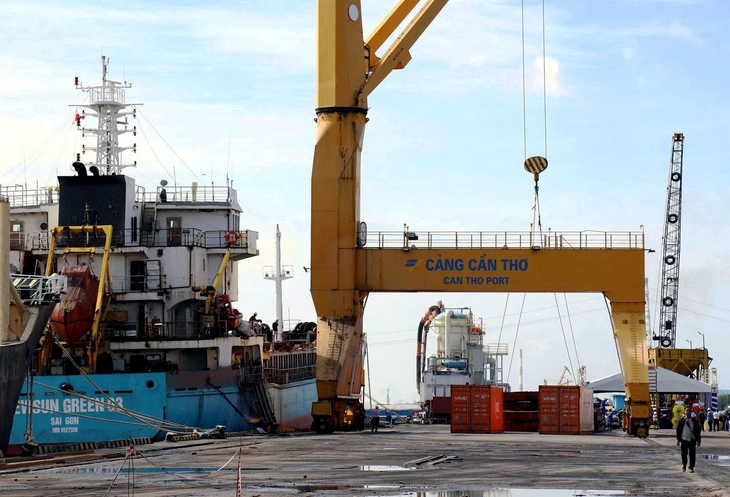
Cai Cui Port is a key port in Can Tho city for cargo transportation - Photo: CHI QUOC
Transportation infrastructure is eliminating the "geographical lag" of the Mekong Delta. As logistics costs decrease and transit times shorten, the competitiveness of agriculture, fisheries, and tourism is enhanced, opening new doors for development in the delta. However, infrastructure only becomes a growth driver when integrated into a strategy for reorganizing the economic space.
As a regional hub, Can Tho is orienting its development towards logistics, innovation, digital transformation, agricultural processing, and high-quality services, linked with ports, airports, and expressways, leveraging the advantages of new development space from Hau Giang and Soc Trang bordering the sea to form a seamless chain.
Located at the "heart" between the Tien and Hau rivers and the eastern coastal area, Vinh Long, after expanding to include Tra Vinh and Ben Tre, has the opportunity to leap forward through its marine economy, fruit processing industry, cold storage facilities, and agricultural product transshipment center.
Dong Thap, An Giang, and Ca Mau also harbor many plans and projects for the future. The common point is that these localities cannot simply rely on new roads and wait for capital to arrive automatically. Infrastructure needs to be properly integrated into the development of specific sectors and spatial planning; otherwise, it will only be a concrete road passing through missed opportunities.
New transportation infrastructure requires a forward-thinking approach to inter-provincial and inter-regional development. If each locality pursues its own model, the major risk is fragmentation and intra-regional competition.
Regional linkages must become substantive, instead of each province inviting small projects. There needs to be inter-provincial value chain planning: raw material areas - logistics centers - export ports. Only when investors see the big picture will they be willing to invest large and long-term capital.
The value chain of innovation, creativity, agriculture, logistics, processing, and export only forms when there is a rational division of roles. Areas serving as service centers, trade gateways, high-quality raw material sources, and marine economic development areas create a cohesive ecosystem, with the delta region sharing a common heartbeat.
Parallel to spatial planning is institutional reform. Roads have been opened, but if investment procedures are slow, planning is unstable, and land for production is not ready, investors will still be left out.
The benchmark for the 2026-2030 period will not only be the number of projects, but also the quality of governance, the level of transparency, and the government's ability to "work alongside" businesses.
More importantly, infrastructure forces the region to shift from a production-oriented mindset to a value-oriented one. When transportation is convenient, the advantage lies not in exporting raw materials but in deep processing, brand building, and participating in global supply chains with a higher standing.
Opportunities for development are already present on the transportation map. But growth will only appear on the economic map if localities dare to change their way of thinking and doing things.
Logistics centers need to be established quickly to reduce costs for farmers and businesses. Industrial zones linked to agricultural and aquatic product processing must be planned close to raw material sources. Inter-provincial tourism routes need attractive products to retain tourists, instead of just being short stops.
2026 will be a crucial test. If infrastructure is "awakened" with a clear development strategy, the Mekong Delta could enter a new growth cycle: not just a rice and fish granary, but a modern agricultural economic zone, with smart logistics and unique ecotourism.
As the Mekong Delta region gets closer to Ho Chi Minh City and the Southeast region, the spatial advantage leads to a significant reduction in logistics costs, which is reflected in the price of agricultural products. This difference creates "room" for investment in deep processing and brand building, instead of chasing after high production volume.
Similarly, tourists visiting the Mekong Delta are no longer deterred by long journeys, but they demand more enriching experiences and more attractive tourism products.
Connecting destinations between provinces will determine whether transportation infrastructure becomes an advantage and an attraction for tourism.
Source: https://tuoitre.vn/ai-vuot-len-tu-dat-chin-rong-20260228091026415.htm
![[Photo] National Assembly Chairman Tran Thanh Man attends the opening session of IPU-152](https://vphoto.vietnam.vn/thumb/1200x675/vietnam/resource/IMAGE/2026/04/16/1776277863731_ctqh5-jpg.webp)
![[Photo] The General Secretary, President and his wife meet with Vietnamese-Chinese friendship leaders.](https://vphoto.vietnam.vn/thumb/1200x675/vietnam/resource/IMAGE/2026/04/15/1776264829725_vna-potal-tong-bi-thu-chu-tich-nuoc-to-lam-gap-mat-nhan-sy-huu-nghi-viet-nam-trung-quoc-8703641-3130-jpg.webp)
![[Photo] My Son at night: A thousand-year-old heritage site amidst the Milky Way](https://vphoto.vietnam.vn/thumb/1200x675/vietnam/resource/IMAGE/2026/04/15/1776261039184_ndo_br_chon6-jpg.webp)

![[Photo] Mrs. Ngo Phuong Ly meets and exchanges views with Mrs. Peng Li Yuan](https://vphoto.vietnam.vn/thumb/1200x675/vietnam/resource/IMAGE/2026/04/16/1776277858080_phu-nhan-1-jpg.webp)















































Comment (0)