

During talks with Indian Prime Minister Narendra Modi in New Delhi on December 16, Sri Lankan President Anura Kumara Dissanayake affirmed that Colombo would not allow its territory to be used "in a way that is detrimental to India's interests."
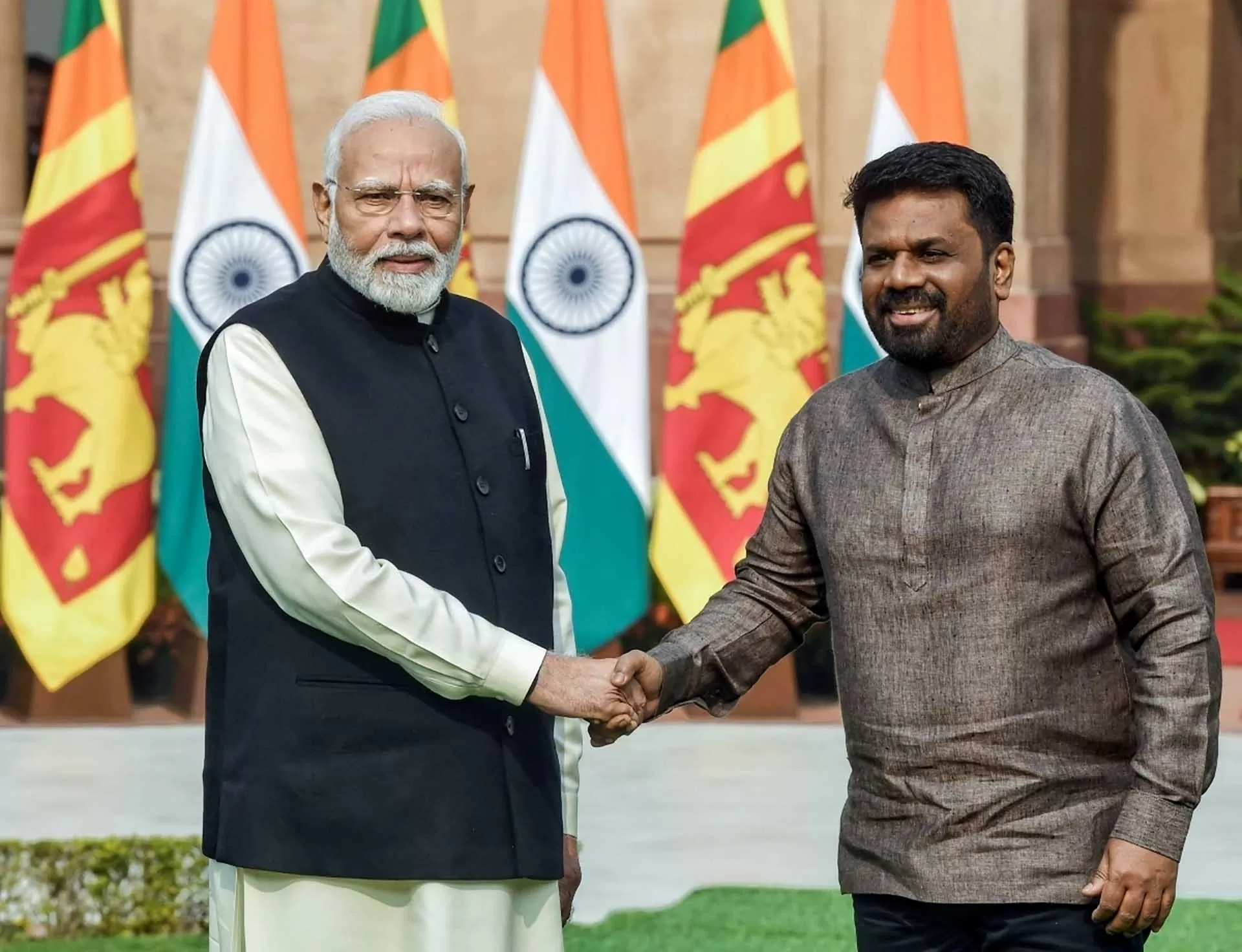 |
| Prime Minister Narendra Modi (left) and President Anura Kumara Dissanayake, on December 16 in New Delhi. (Source: PTI) |
Reaffirming commitment
The statement reiterates Dissanayake's campaign promise from September. At that time, Dissanayake, leader of the Marxist National People's Power Party (NPP), asserted, "We will not allow any country or organization to use Sri Lanka's airspace, land, or sea to threaten or endanger the national security of any country in the region, including India."
Besides a statement seemingly intended to “reassure” New Delhi amidst escalating great power competition in the region, President Dissanayake discussed a range of issues of mutual interest with his counterpart Droupadi Murmu, Prime Minister Narendra Modi, Foreign Minister S. Jaishankar, and National Security Advisor Ajit Doval…
Notably, in the joint statement issued during the visit, the leaders of both sides emphasized the challenges facing both countries in the region and reaffirmed their commitment to cooperation to combat traditional and non-traditional threats and ensure a free, open, safe, and secure Indian Ocean region. Prime Minister Modi and President Dianayake affirmed that cooperation between the two countries would be strengthened, especially in areas such as maritime security, counter-terrorism, cybersecurity, humanitarian assistance, and disaster relief.
Natural partner
The joint statement expressed that the relationship between India and Sri Lanka is a natural partnership, bolstered by deep cultural and civilizational ties, geographical proximity, and people-to-people connections. The two nations have adopted a shared vision for the future, and President Disanayake's visit will bring new growth and energy to bilateral relations.
To date, India has provided $5 billion in credit and grants to Sri Lanka. India's strong support has played a crucial role in Sri Lanka's economic recovery and humanitarian assistance following the severe economic crisis of 2022. New Delhi's financial guarantees facilitated the International Monetary Fund's (IMF) expansionary fund mechanism, providing much-needed support for Sri Lanka's debt restructuring efforts.
According to the joint statement, in the coming period, the two sides will establish grid connections and multi-purpose oil pipelines, accelerate the progress of the Sampur solar power plant project, supply LNG to Sri Lankan power plants, and soon complete the digital financial transaction project. They will also promote the implementation of projects such as restoring the railway signaling system, providing scholarships for university students, and training 1,500 Sri Lankan civil servants over the next five years. In addition, the two sides agreed to “ explore the possibility of signing a framework agreement on defense cooperation” to enhance cooperation through joint exercises, maritime surveillance, dialogue, and conducting relevant training programs.
For his part, the visitor from the South Asian island nation thanked India for helping Sri Lanka during the “unprecedented economic crisis” two years ago, and asked Prime Minister Modi to support Sri Lanka’s accession to BRICS. Conversely, Mr. Modi welcomed Colombo’s support for New Delhi’s candidacy for a non-permanent seat on the UN Security Council for the 2028-2029 term, and endorsed India’s “Neighbors First” policy and SAGAR vision (Security and Growth for All in the Region).
Resolving the past
As India's closest coastal neighbor in the Indian Ocean region, Sri Lanka's stability and prosperity are integral to the region's security and development. In this context, Mr. Dissanayake's visit and the results achieved promise to open a new chapter in the complex narrative of India-Sri Lanka relations, particularly for the Marxist political party Janatha Vimukthi Peramuna (JVP, People's Liberation Front), which leads the ruling NPP coalition.
In the 1980s, the JVP strongly opposed “Indian hegemony” and the India-brokered agreement between the Sri Lankan government and the Tamil Liberation Tigers. Even as this left-wing party reinvented itself, Dissanayake consistently sought to allay concerns about “anti-India” sentiment. By strengthening cooperation in the face of shared challenges and opportunities, the two South Asian nations are setting an example of constructive engagement on a broader scale. This dynamic partnership is not only transforming bilateral relations but also making a significant contribution to the stability and prosperity of the Indian Ocean region.
Therefore, by choosing India as the destination for his first three-day foreign trip since being elected President in September, Mr. Dissanayake continues to demonstrate his commitment and desire to deepen bilateral relations with New Delhi. With the direction of a “natural partnership” and the latest achievements of this visit, a new chapter in India-Sri Lanka relations in the coming years may be opened, especially in the context of increasingly fierce strategic competition in the region.
Source: https://baoquocte.vn/an-do-sri-lanka-lang-gieng-can-nhau-297942.html
![[Photo] A vibrant celebration of generations of Nhan Dan Newspaper staff](https://vphoto.vietnam.vn/thumb/1200x675/vietnam/resource/IMAGE/2026/03/11/1773228432744_cb-75-nam-7-7034-jpg.webp)








































Comment (0)