

MRS. NGUYEN THI BINH AND THE HISTORICAL WRITER
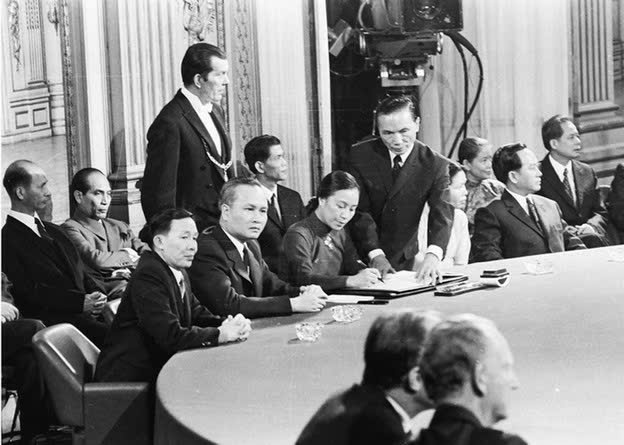
On January 27, 1973, in Paris, the "Agreement on Ending the War and Restoring Peace in Vietnam" (also known as the Paris Agreement) was signed. As the result of the most arduous and protracted diplomatic struggle in Vietnamese diplomatic history, with 202 public joint sessions and 24 private meetings over a period of 4 years and 9 months (from May 13, 1968 to January 27, 1973), it marked a crucial turning point in the Vietnamese people's struggle against the US and for national liberation.
Fifty-two years have passed, but when the name Nguyen Thi Binh, former Vice President, the first female Minister of Foreign Affairs of Vietnam, and head of the negotiating delegation of the Provisional Revolutionary Government of South Vietnam at the Paris Conference, is mentioned, the whole world admires and respects the unwavering will, flexibility, and keen insight of this outstanding female diplomat, a daughter of Quang Nam province.
Ms. Nguyen Thi Binh, whose real name was Nguyen Chau Sa, was born on May 26, 1927, in La Kham village, Dien Quang commune, Dien Ban district, Quang Nam province , into a family with a revolutionary tradition: her paternal grandfather was a soldier in the Can Vuong movement, fighting and sacrificing his life in his hometown; her maternal grandfather was the patriotic scholar Phan Chau Trinh. From a young age, she participated in patriotic movements and actively took part in demonstrations against French colonialism. After her imprisonment, she continued her activities and was appointed a member of the National Liberation Front of South Vietnam, in charge of foreign affairs.
In 1968, she served as Deputy Head of the National Liberation Front of South Vietnam's negotiating delegation at the Paris Conference. Her presence, as a female diplomat, attracted international attention and facilitated the negotiation process. She was subsequently appointed Minister of Foreign Affairs of the Provisional Revolutionary Government of the Republic of South Vietnam and Head of the Provisional Revolutionary Government's Delegation at the Paris Conference. Her role at the Paris Conference was described as challenging, requiring skill, steadfastness, and flexibility in negotiating with the powerful United States.
Ms. Nguyen Thi Binh achieved many successes in negotiations, making a significant contribution to the signing of the 1973 Paris Agreement. After the war, she continued to dedicate herself to the country in important positions such as Minister of Education, Deputy Head of the Central Committee's Foreign Affairs Department, Vice President, and Member of the National Assembly for the 6th, 7th, 8th, 9th, and 10th terms.
In her memoir "Family, Friends, and Country," Nguyen Thi Binh called diplomacy a special front in the resistance war against the US to save the country, a heavy task, a very important chapter in her life. The event of Nguyen Thi Binh assuming the responsibility of Minister of Foreign Affairs and Head of the negotiating delegation of the Provisional Revolutionary Government of the Republic of South Vietnam at the Paris Conference caused a "storm" in the international media. Her elegant demeanor, friendly and amiable attitude, and confidence left a strong impression on those she met and the press at the time. They turned to each other and said: "The Viet Cong are so civilized," "she's not from the jungle,"... and they hunted for images and biographies of the woman who led the "Viet Cong" delegation.
Swedish writer Sara Lidman once wrote about Madame Nguyen Thi Binh: "Wherever Madame Binh is, one doesn't see anyone else... when listening to Madame Binh speak, one doesn't want to listen to anyone else... she is mysterious..., subtle..." in her book: "In the Heart of the World".
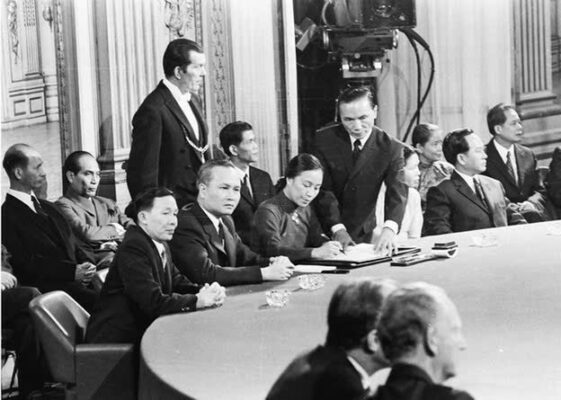
Minister of Foreign Affairs of the Provisional Revolutionary Government of the Republic of South Vietnam, Nguyen Thi Binh, signed the Paris Agreement on Vietnam on January 27, 1973, at the International Conference Center in Paris (France) (Image from archive).
During the years of negotiations at the Paris Peace Conference, the image of "Madam Binh," as she was called by the media, always made a strong impression on the Western press with her persuasive, intelligent speeches—sometimes firm, sometimes witty—that earned her the respect of the world and the enthusiasm of the people. According to French journalist Madeleine Riffaud, every politician commented: "The Viet Cong won big with the reception of Madam Binh in Paris. Ms. Binh was like a queen, welcomed like a head of state, with full formality, and received a warm welcome. Ms. Binh shook public opinion in Paris and the world. The National Liberation Front flag flew high in Paris. Wonderful! Truly rare!"
In 1985, when the Southern Vietnam Women's Traditional House (now the Southern Vietnam Women's Museum) was established, Ms. Nguyen Thi Binh donated two pens used to sign the Paris Agreement on January 27, 1973, to the museum. These are precious artifacts associated with the life and national liberation career of Ms. Nguyen Thi Binh and are currently on display at the Southern Vietnam Women's Museum as part of the special exhibition: "International Activities of Southern Vietnamese Women." This artifact is not just an ordinary memento but also carries profound historical significance, symbolizing the resilience and determination of the Vietnamese people in their struggle for independence.
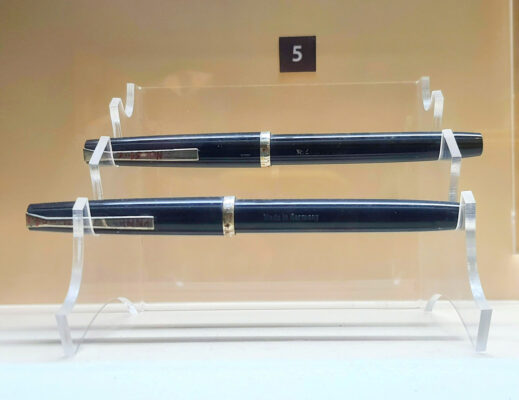
Photo: The pen used by Ms. Nguyen Thi Binh on the day the Paris Agreement was signed.
It is on display at the Southern Vietnam Women's Museum.
This is a felt-tip pen, made of black plastic, manufactured in Germany by Papeterie Josphgiberi (the English inscription on the pen body reads: “Made in Germany” and “Papeterie Josphgiberi”). The pen is cylindrical, tapering at both ends, and has two parts: The cap is 6.5 cm long, with a diameter of 1.3 cm at its widest point and 0.7 cm at its narrowest point; the cap has a stainless steel clip. The body (from the base to the spiral) is 8.6 cm long, with a diameter of 1 cm at its widest point and 0.8 cm at its narrowest point. The total length of the pen (after the cap is on) is 13.4 cm. The pen has a simple yet refined and elegant design.
Each pen is a memento, a symbol of the Vietnamese people's determination and aspiration for peace.
Displaying this pen at the Southern Vietnam Women's Museum not only helps the public better understand her life and career as an outstanding diplomat and revolutionary fighter, a symbol of the persistent and resilient fighting spirit of the Vietnamese people during the resistance war against the US, but also a symbol of the noble qualities of Vietnamese women.
Ho Chi Minh City , February 12 , 2025
Vo Cu
Department of Communications, Education, and International Relations
References:
- Nguyen Thi Binh (2012), Family, Friends and Country , Tri Thuc Publishing House.
- The National Liberation Front, the Provisional Revolutionary Government at the Paris Conference on Vietnam, National Political Publishing House, Hanoi 2001
- Nguyen Van Sau (2023) The 1973 Paris Agreement – The pinnacle of the art of fighting and negotiating at the same time , People's Army Newspaper. https://www.qdnd.vn/phong-su-dieu-tra/phong-su/hiep-dinh-paris-1973-dinh-cao-nghe-thuat-vua-danh-vua-dam-716951
Source: https://baotangphunu.com/ba-nguyen-thi-binh-and-the-historical-pen/





![[Photo] Prime Minister Pham Minh Chinh receives the Chinese Ambassador to Vietnam](https://vphoto.vietnam.vn/thumb/1200x675/vietnam/resource/IMAGE/2026/04/05/1775397481797_ndo_br_dsc-5512-jpg.webp)































![[Infographic] Key indicators for the period 2026-2030 to achieve "double-digit" growth targets](https://vphoto.vietnam.vn/thumb/402x226/vietnam/resource/IMAGE/2026/04/06/1775450004801_fb4e219c8aa77c339a75ff13c44b2e595f8db215db15da7b4648b200deade68240d89ec5e4bd2e86c42f5ed9eeb-_ndo_br_chi-tieu-2-con-so-thumb-1.jpeg)










Comment (0)