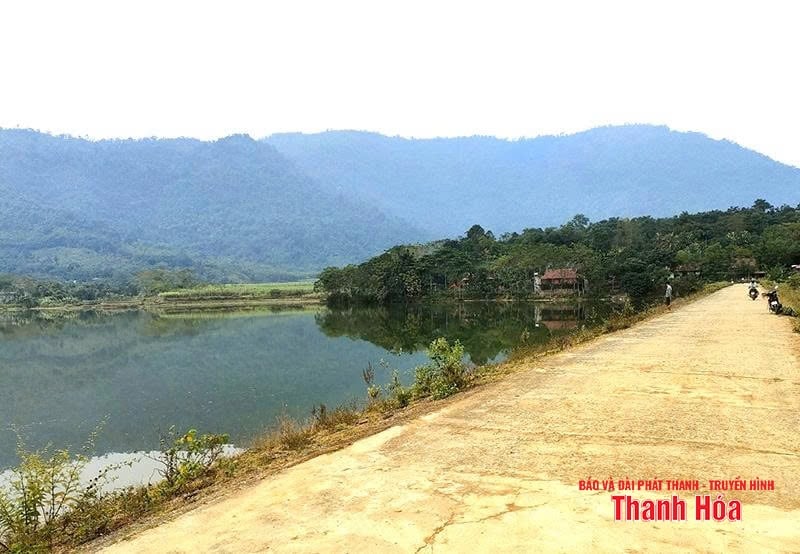
The Den Reservoir (Dien Ha commune) has stored enough water according to its design to serve agricultural production in the 2025 crop season.
Of the 167 irrigation works managed and operated by the Ba Thuoc Irrigation and Drainage Management Board, there are 15 irrigation pumping stations, 24 reservoirs, and the rest are diversion dams, providing irrigation water for over 5,210 hectares per year. The remaining works, managed by the local authorities, were mostly built before 1984. While the headworks were constructed, the canal system was almost non-existent. Currently, many works are dilapidated, limiting their effectiveness in serving agricultural production. Some diversion dams, reservoirs, and canals are severely damaged and degraded. Some irrigation works still have earthen dams and ditches, such as the Ta Lun dam, Bo Thuong reservoir, and Vac reservoir, which are detrimental to agricultural production.
With funding from the central and provincial budgets, in recent years, Ba Thuoc district has received investment for the renovation and upgrading of several irrigation works, which have been put into use and are effectively serving agricultural production, such as: Khuon Lake, Chun Lake, Tam Lake (Thiet Ong commune), Dom Dam (Thiet Ke commune), Ngoc Vit Canal Dam (Luong Noi commune), Pat Canal Dam (Ban Cong commune), Danh Dam (Thanh Lam commune), Dam Tom Dam (Ai Thuong commune), Bai Vang Dam (Dien Trung commune), Sat Dam (Ban Cong commune), Bai Ba Dam (Lung Niem commune), Bai Am Dam (Dien Thuong commune), Bo Duon Lake and Dam (Van Nho commune)...


In the first months of 2025, Ba Thuoc district continued to invest in several irrigation projects such as: Ho Quang dam, Keo Hieng canal dam, Leo canal dam, Bai Lung dam, Mo Suong canal dam... Currently, the units are focusing on upgrading and repairing irrigation works, bringing them into service for agricultural production as soon as possible.
Following the motto "The State and the People work together," communes in the area have invested funds, labor, and local materials to renovate and repair dozens of irrigation works; and built dozens of kilometers of solid irrigation canals and main canals of irrigation reservoirs. Every year, the district and communes have mobilized the entire population to participate in irrigation work, dredging and clearing the flow of canals, repairing minor damage to structures, and building embankments to retain water. In addition, communes and villages have also utilized their own resources to construct smaller projects such as temporary dams and weirs to raise water from rivers and streams to irrigate over 1,000 hectares of agricultural crops.
To proactively secure irrigation water for production and daily life, and to ensure the safety of irrigation infrastructure before the rainy season, in recent months, communes, towns, and irrigation infrastructure management units have mobilized the people to dredge and clear waterways and remove obstructions; proactively inspect, reinforce, and repair damage to ensure the safety of the infrastructure... To date, communes, towns, and irrigation infrastructure management units have mobilized officials, workers, and the people to dredge the suction and discharge basins of irrigation pumping stations and canals; temporarily repair damaged and degraded structures using local materials such as gabions and rocks; and reinforce vulnerable areas with a high risk of landslides. They have also proactively deepened and widened the inlets of pumping station suction basins to increase the water volume; and extended the suction pipes of some pumping stations to ensure sufficient water for crops.
In a conversation with us, Comrade Truong Van Vinh, Deputy Head of the Agriculture and Environment Department of Ba Thuoc District, said: For the 2025 spring crop, the entire 2,379.66 hectares of rice fields in the district have sufficient irrigation water and are currently being harvested, with an estimated yield of 57.1 quintals/hectare. According to the plan, the district will plant rice on over 2,600 hectares in the 2025 autumn crop. Communes with reservoirs and dams have proactively repaired and dredged canals and developed drought prevention plans and rational irrigation water regulation for crop growth and development. Irrigation project management units have developed plans, prepared materials, personnel, and equipment according to the "four on-the-spot" principle... to specifically respond to potential structural incidents; and have plans for rational water storage for each project during the rainy and stormy seasons.



Text and photos: Thu Hoa
Source: https://baothanhhoa.vn/ba-thuoc-dau-tu-nang-cap-he-thong-ho-dap-252850.htm
![[Image] National conference summarizing one year of operation of the overall organizational model of the political system, the three-tiered government model.](https://vphoto.vietnam.vn/thumb/1200x675/vietnam/resource/IMAGE/2026/07/01/1782882811691_ndo_br_1-jpg.webp)