


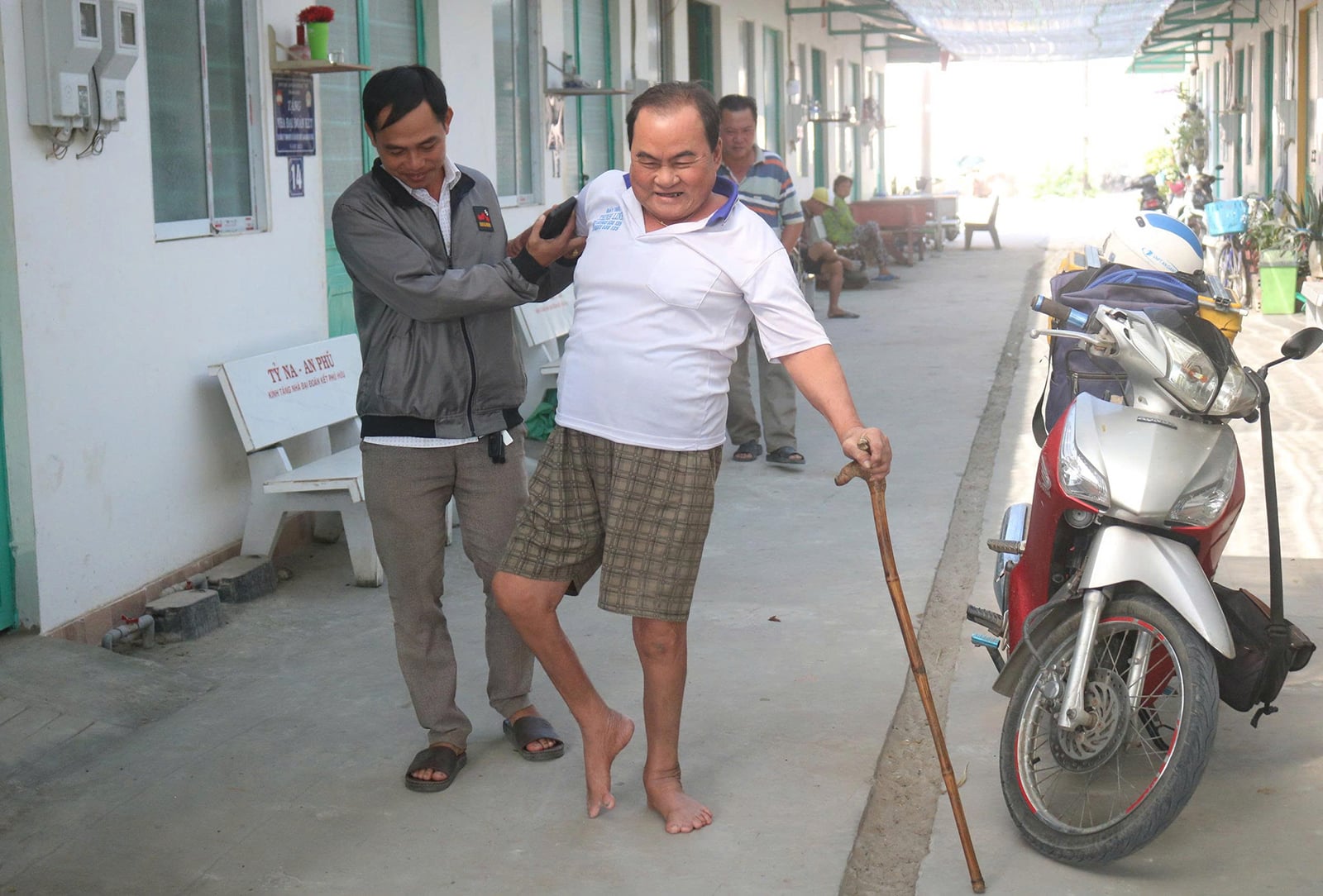
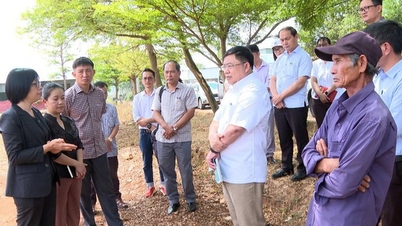
The People's Committee of Phu Thanh hamlet visits and provides support to residents in the solidarity zone. Photo: GIA KHANH
Following the merger, My Thoi ward is leading with 12 solidarity housing areas, spread across 8 hamlets, providing stable housing for 203 households for nearly 10 years. Ms. Vuong Mai Trinh, Chairwoman of the People's Committee of My Thoi ward, stated: “Over the past time, these solidarity housing areas have significantly contributed to stabilizing the lives of disadvantaged households, especially those who have moved ashore from fishing villages. With the responsibility of the locality, we have determined the management motto to be stability, integration, and development. The ward strengthens the review of residential areas; each housing area has its own self-governance regulations, ensuring security, order, and environmental hygiene. At the same time, the locality promotes community support activities, coordinating with organizations to disseminate legal information, send children to school, connect people with job opportunities, and support livelihoods so that people can gradually stabilize their lives.”
This is one of the effective methods that helps households avoid leaving their homes to work elsewhere. However, the implementation process still faces many obstacles beyond the local authority's jurisdiction. “Therefore, we propose that the province pay attention to supporting several issues. Firstly, resolving the legal difficulties of the solidarity housing areas. Secondly, assisting in resolving residency issues for households that no longer have original documents, making it impossible to obtain birth certificates or citizen identification cards… especially those returning from Cambodia without proper documentation. If these issues are resolved, we will continue to play a key role, working alongside the people to maximize the humanitarian significance of the solidarity housing areas, helping people stabilize their lives and achieve sustainable development,” Ms. Vuong Mai Trinh stated.
The issue of making a living is also receiving much attention from residents in the housing areas. Mr. Duong Chi Long (born in 1964), having gone through many life hardships and almost losing everything in his old age, was allocated house number 16 in the Phu Thanh Solidarity residential area, Phu Huu commune. Having lived there for several years, he feels sorry for the many difficulties faced by his neighbors. “Most people in this area are sick or elderly; they don’t have enough strength to work as laborers, and they lack the capital to start a business, so they just struggle to make ends meet,” Mr. Long recounted.
“We are so happy to no longer have to endure landslides and dilapidated houses; we want to stand on our own two feet and make a living. However, wanting something is one thing, but having the capital to do so is another. The residential area is usually far from the market, making it difficult to do business, and we ourselves lack the ability to start a business. Hopefully, the local government will connect us with credit institutions and create conditions for us to borrow capital to start a business. Once we have a stable place to live and can make a living, the people will escape poverty sustainably,” Mr. Nguyen Van Lua (born in 1976), residing in apartment number 5, added to Mr. Long's statement.
According to the wishes of many households, if they receive a loan of a few tens of millions of dong, they could form business partnerships with traders, sharing the burden with other residents in the neighborhood through retail sales or large-scale contract manufacturing. This would further strengthen the "unity" within the neighborhood, fostering mutual trust among residents based on existing neighborly relationships.
The model of solidarity housing on public land is not yet complete. Recently, a landslide in Phu Huu commune affected 13 houses, including 5 that completely collapsed, leaving the residents homeless. “Seeing the methods and effectiveness of the 8 adjacent solidarity housing areas in An Phu district (before the merger), we immediately thought of building a new housing area for these 13 households. Regarding public land, the local authorities have reviewed and selected a suitable location; however, the estimated construction cost is quite high due to rising prices of building materials and supplies, making it impossible to keep the cost at 66 million VND per house as before. The plan to build the housing area has been agreed upon by the Party Committee, and we are continuing to seek support from organizations and individuals to make the housing area a reality,” shared Le Minh Thuan, Secretary of the Phu Huu Commune Party Committee.
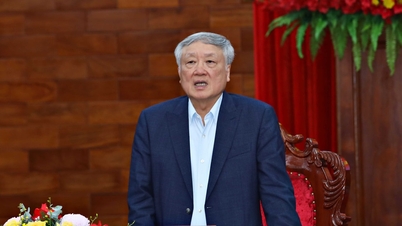
Vice Chairman of the Provincial People's Committee Ngo Cong Thuc (former Secretary of the An Phu District Party Committee from 2018 to 2023) is very interested in this humane model and has sought the province's approval and resources to build 8 housing complexes throughout the district, each with 10-20 houses. According to Mr. Ngo Cong Thuc, to maintain border security, it is necessary to help border residents settle down. The model of adjacent solidarity housing complexes is very suitable for this purpose, concretizing "the Party's will and the people's aspirations". Households are allocated houses "on a term basis," meaning they are reviewed every 5 years. If they meet the criteria for escaping poverty and have a stable life, the house will be allocated to another more disadvantaged household. If their foundation is not yet stable, they will be considered for another 5 years.
“This model can be replicated in many other places in the province. Each locality should review its existing public land, especially after the merger of administrative units, and strive to build housing areas for poor households without land. However, it is necessary to select public land that is consistent with the residential land planning to avoid legal complications later,” Comrade Ngo Cong Thuc emphasized.
Preserving and promoting the model of solidarity housing on public land is not just about simple housing arrangements, but also reflects how An Giang transforms "common assets" into "common resources," creating value that spreads beyond individual houses or households. When public land is used for the right humanitarian purpose, it becomes a leverage for the government to connect communities, while also providing people with the opportunity to rebuild their lives from small but solid foundations.
To prevent this value chain from being disrupted, the government and relevant agencies need to continue to implement more flexible mechanisms. It is suggested that the province consider incorporating this model into national target programs on poverty reduction and development in ethnic minority and border areas. Preferential loan sources should be tailored to the health and labor capacity of each household group. Businesses and philanthropists can also participate by providing supplies, livelihood support, and vocational training. A solidarity housing area is only truly sustainable when each household has a minimum livelihood, is financially independent, and rises out of poverty through their own capabilities.
In the context of climate change, landslides, and ongoing migration for work, the model of solidarity housing on public land is proving increasingly urgent. This is both a support solution and an affirmation of the government's commitment: no one will be left behind. It is believed that as more new housing complexes are built, this chain of solidarity will continue, connecting people's destinies and strengthening their faith in the correct and humane policies of the Party and the State.
Source: https://baoangiang.com.vn/bai-cuoi-giu-chuoi-doan-ket-a469960.html




















































Comment (0)