From finely sifted mung bean flour, artisans in Hue skillfully create flowers and fruits with eye-catching colors. They are so beautiful that those who hold them in their hands are reluctant to eat them.
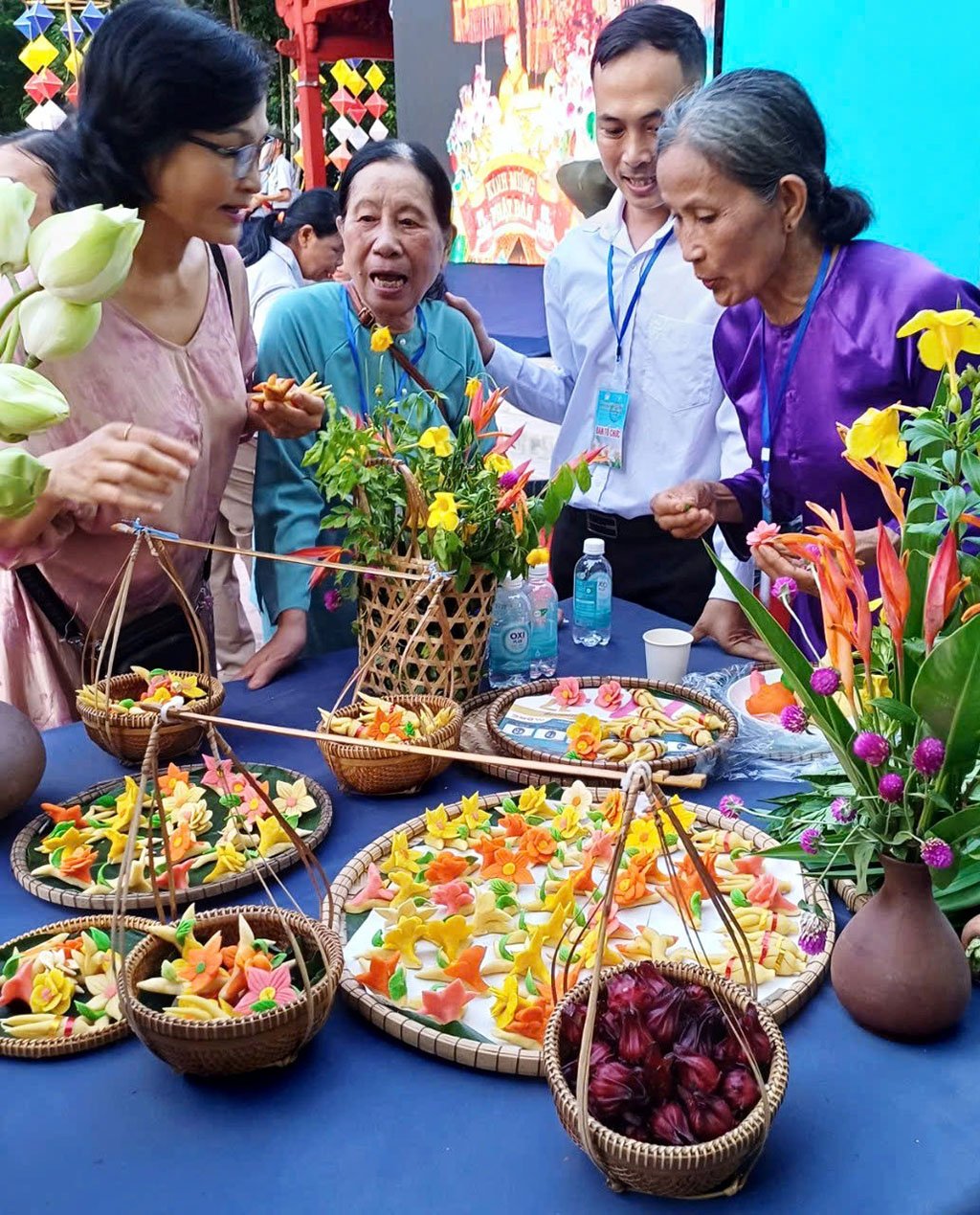
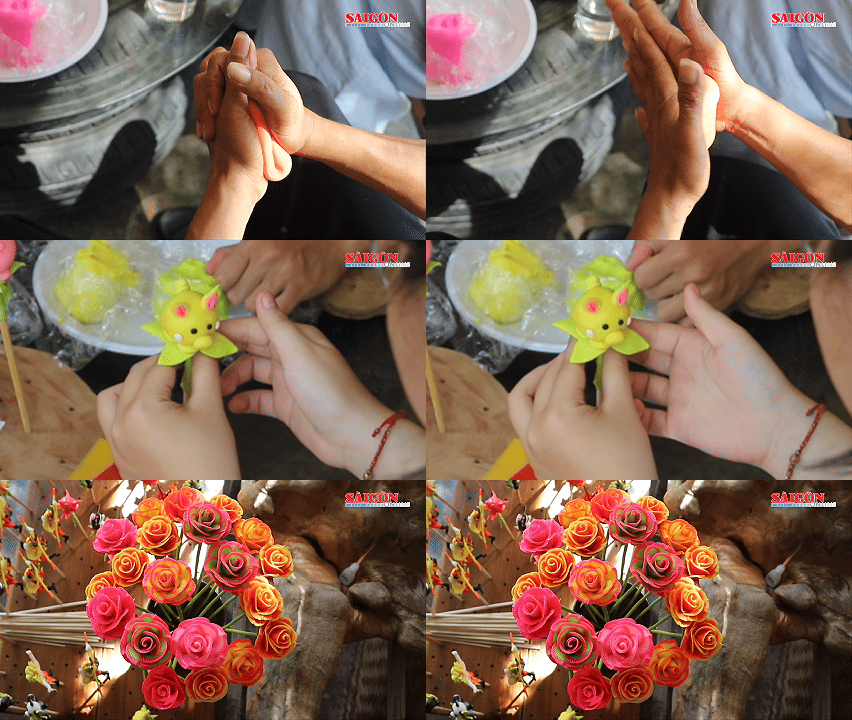
Artisan Ho Thi Kieu (right in the photo) introduces the steps in making banh cap (a type of Vietnamese cake).
S A GRAND AND ELEGANT OFFERING CEREMONY
Nestled beside the picturesque O Lau River, Phuoc Tich village (Phong Hoa Ward, Phong Dien Town, Hue City) not only embraces ancient moss-covered houses and renowned pottery, but also nurtures the centuries-old tradition of making "banh bat" (or "banh bong cay"). As another Tet (Lunar New Year) approaches, the few remaining "banh bat" artisans of Phuoc Tich village prepare their ingredients to offer to their ancestors. Mrs. Ho Thi Kieu, 66 years old, a renowned artisan with the highest level of skill in making "banh bat" in the village, recounts that since ancient times, her family has focused on making "banh bat" for Tet, selling them to many places throughout the province. Throughout the villages and hamlets along the O Lau River, "banh bat" is used as a solemn offering in religious ceremonies.
"After a while, this traditional type of cake is no longer widely known because it has been replaced by modern cakes and sweets. I've made a living making these cakes for decades, and I'm sad to see them gradually disappear. Now, I miss the craft, so when Tet (Lunar New Year) comes around, I prepare a few dozen of them to offer as sacrifices and to give to my children and grandchildren," Mrs. Kieu shared. Mrs. Kieu's maternal grandmother came from Van Xa village (Huong Van Ward, Huong Tra Town, Hue City), the birthplace of these cakes used for offerings. The story goes that when she was still in her hometown of Van Xa, Empress Thuan Thien Cao (mother of Emperor Minh Mang) loved this type of cake. When offered to the Empress, the cake retained its rustic charm but was transformed into a more elegant version with lotus seeds as an ingredient.
Having learned the craft from her grandmother when she was just 9 years old, artisan Ho Thi Kieu initially only knew how to "shape" cakes into shapes of flowers like apricot blossoms, orchids, chrysanthemums, bamboo, or ginseng and ginger roots… Thanks to her passion and skillful hands, Ms. Kieu has become creative and can "shape" any flower, leaf, or plant shape she sees. "Wherever I go, if I see any unusual flowers or fruits, I stop to admire them and then go home to practice making them. Gradually, I can 'shape' any flower. Shaping cakes is very laborious, but when I sit down to make them, I forget about time. The petals gradually appear, and it keeps urging me to make one after another," she shared.
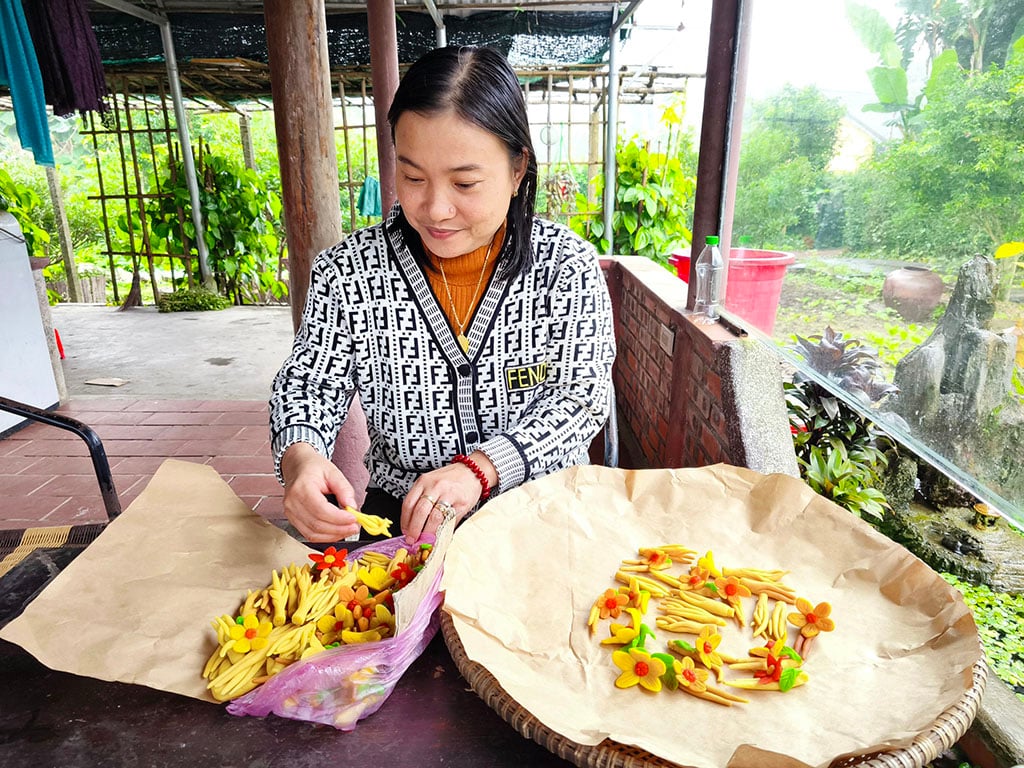
Ms. Trinh Thi Thu introduces the different shapes of the steamed rice cakes.

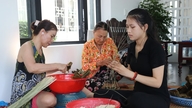
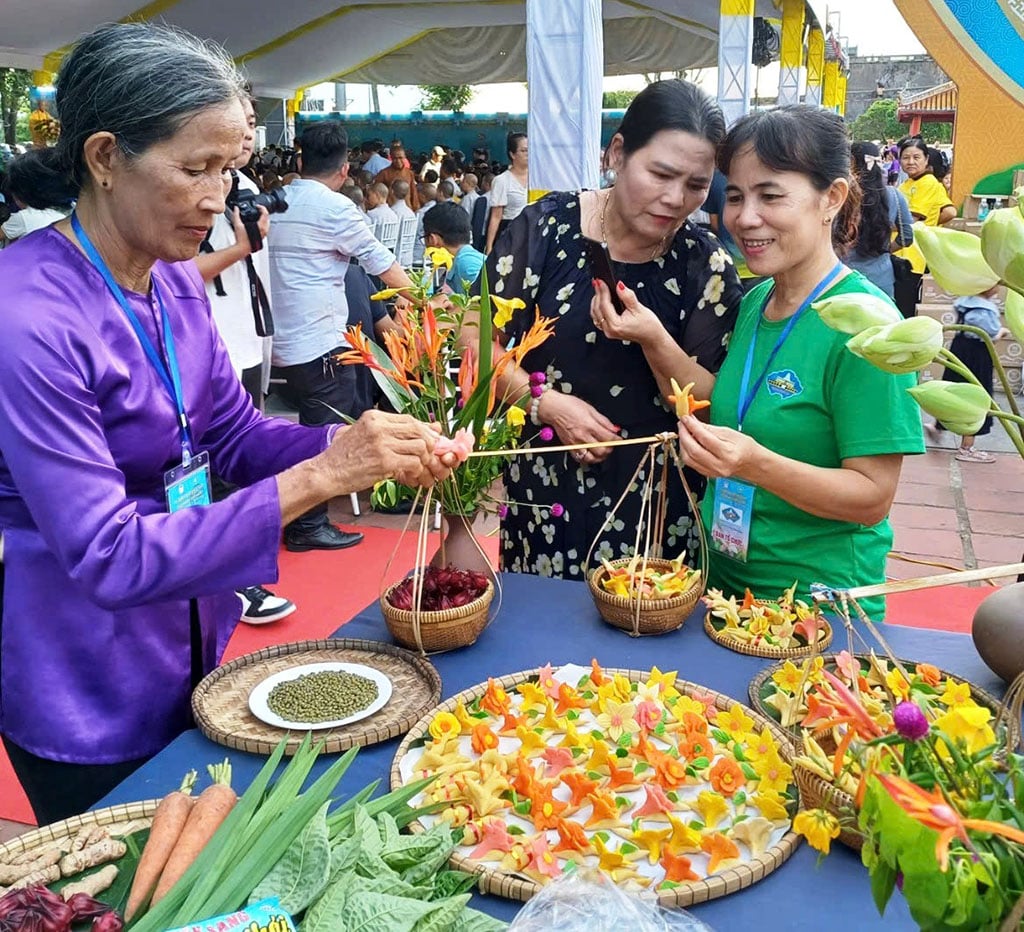
Tourists are delighted to see the cakes being made.
N "SWEET FLOWERS"
As a skilled potter in Phuoc Tich village, when she learned the craft from artisan Ho Thi Kieu, Mrs. Phan Thi Hong Thanh, despite her age (75 years old), quickly became a renowned baker of mung bean cakes. Mrs. Thanh said that in the beginning, she failed many times because the mung bean dough didn't turn out as desired. The secret to making beautiful and delicious cakes lies in the dough preparation. Too wet or too dry dough makes it difficult for the baker to shape the cakes as desired. "Nowadays, even with many machines to assist, all steps in making these cakes must be done manually. First, you have to sift the mung beans into a very fine powder and then mix it with sugar in a 1:1 ratio. When you put it on the stove to stir, the heat should be very low to prevent burning. The dough is left to dry until it's smooth and doesn't stick to your hands, then you take it off the stove to cool," Mrs. Thanh recounted the dough preparation process.
Ms. Trinh Thi Thu (41 years old, a student of Ms. Ho Thi Kieu) added that people in Phuoc Tich village often add a little roasted glutinous rice flour to create the "coating" of the cakes. This makes shaping the cakes easier. Regarding the coloring process, artisans have traditionally used natural colors. Yellow is obtained from gardenia or loofah flowers (depending on the season), green from pandan leaves or spinach leaves, red from artichoke flowers, and purple from butterfly pea flowers… "The coloring liquid is mixed with the flour and that's it. To get other colors, my aunts taught me how to combine these colors and then shape them into cakes," Ms. Thu said.
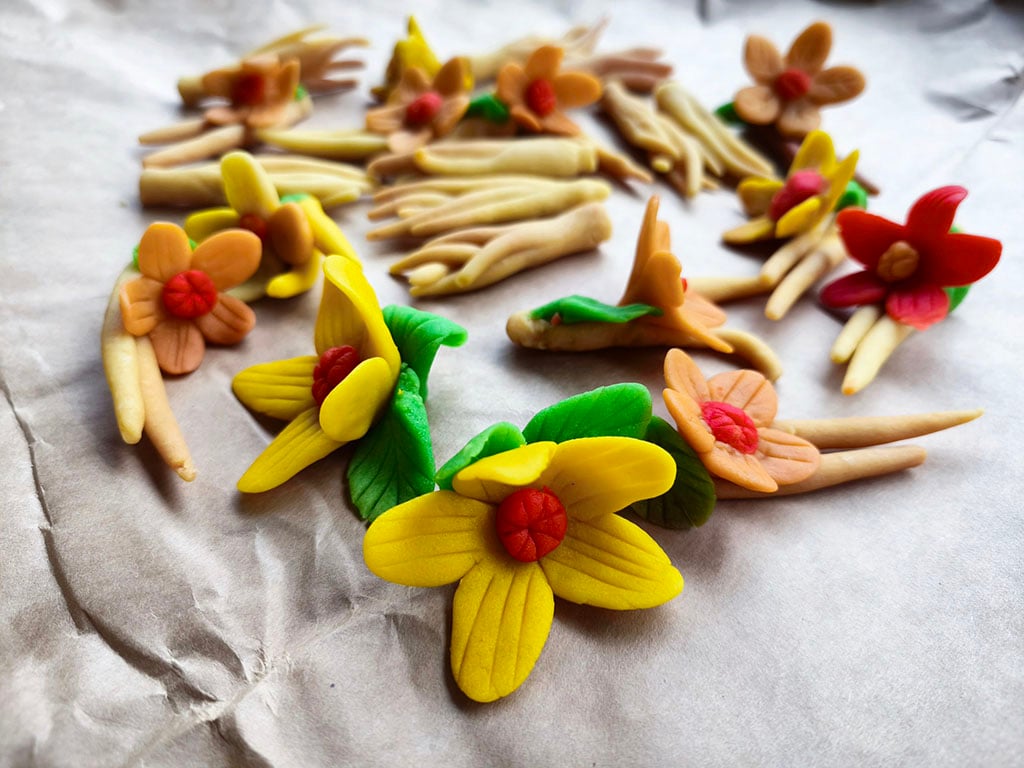
Looking at the flowers made from mung bean paste, you can feel spring arriving.
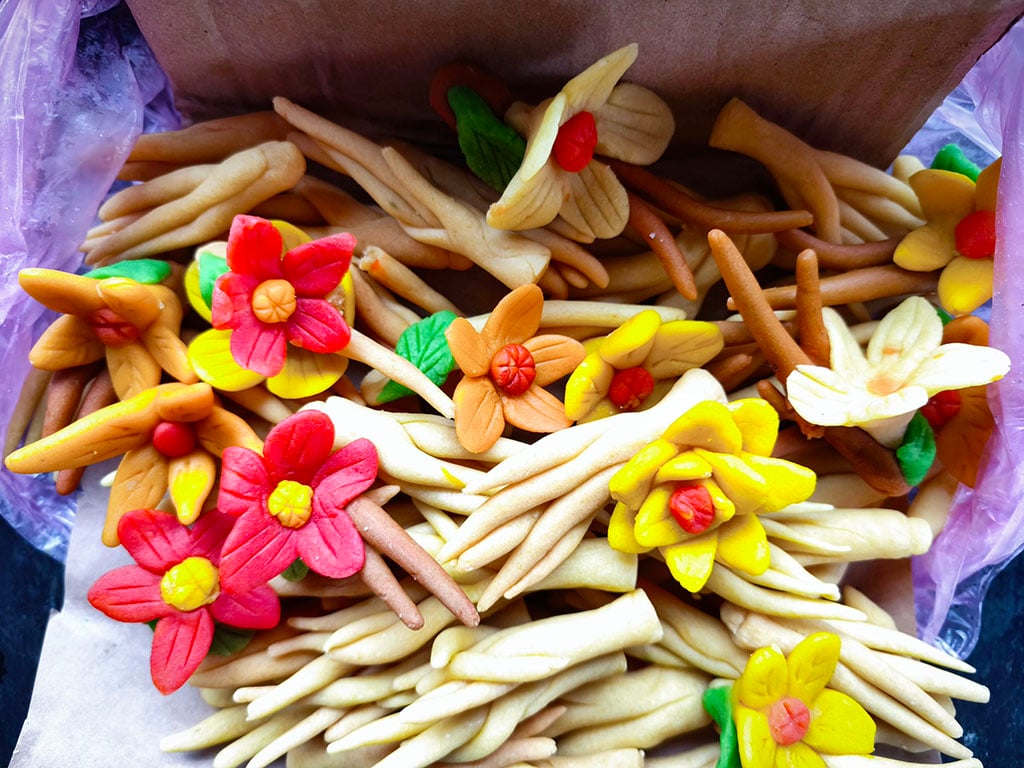
These cakes are shaped like real flowers and ginseng roots, so beautiful you wouldn't want to eat them.
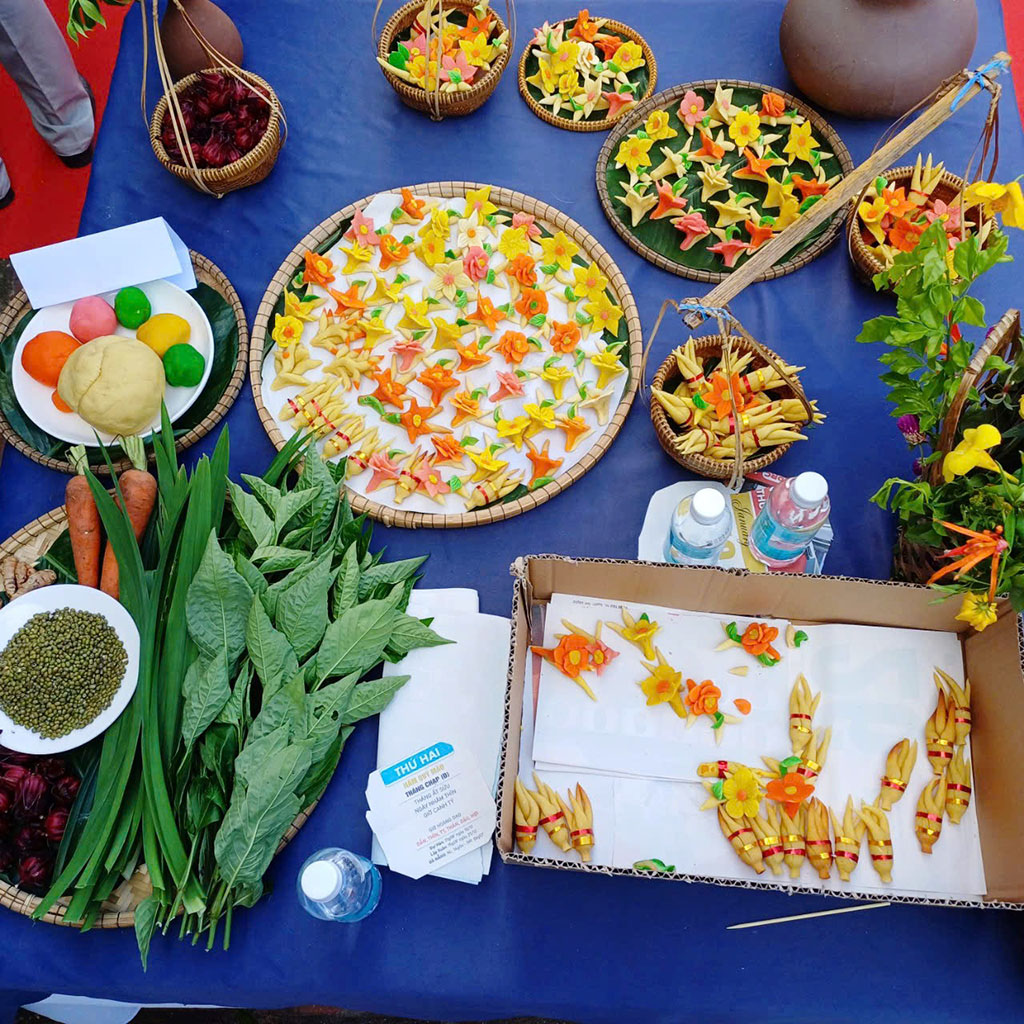
The spring garden is made up of brightly colored cakes.



In the past, these shaped cakes were often arranged on top of other traditional cakes like bánh in (rice flour cakes), bánh su sê (sweet rice cakes), and bánh ít (sticky rice cakes) for decoration due to their high artistic value, especially during Tet (Lunar New Year). To ensure the cakes could be displayed on the altar for many days, the drying process was carefully considered by the artisans. Ms. Thu shared that the cakes taste best after being dried for 2-3 hours because they are still soft. When eaten, the cake feels like it "bursts open" in the mouth because the mung bean flour is finely sifted. For longer storage, the cakes need to be firmer, so they must be air-dried. After being shaped, the cakes are placed in a tray (like a basket) and then placed on a charcoal brazier underneath to dry for 7-8 hours. When removed from the brazier, the shaped cakes retain their vibrant colors and original shape.
"For ginseng-shaped cakes (shaped like ginseng roots), after drying, we usually decorate them with gold and red foil wrapped around the cake," holding a cake in her hand, Ms. Thu explained, "Many people call them ginseng cakes, but actually they are a type of molded cake created using a method similar to making flowers. Skilled hands can mold them into any shape they want. Like Aunt Ho Thi Kieu, with just a lump of dough, she can mold an entire branch of yellow apricot blossoms without having to meticulously make each petal to assemble like we do…"
I lingered over the cakes for a long time before taking a bite. First, I heard a crisp crunch in my mouth. Then, as I chewed, the cake melted evenly, and the sweet, rich flavor spread gradually throughout my mouth. These "sweet flowers" truly awakened many senses simultaneously… (to be continued)
Source: https://thanhnien.vn/giu-huong-tet-xua-banh-bat-dep-den-muc-khong-no-an-185250114211039854.htm


![[Image] National conference summarizing one year of operation of the overall organizational model of the political system, the three-tiered government model.](https://vphoto.vietnam.vn/thumb/1200x675/vietnam/resource/IMAGE/2026/07/01/1782882811691_ndo_br_1-jpg.webp)