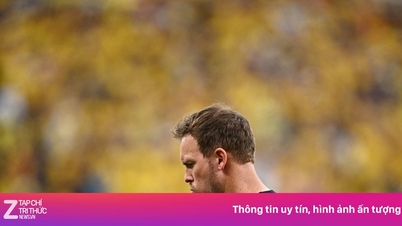
The shocking defeat to Paraguay in the round of 16 on Monday – and the first time in history that Germany has lost in a penalty shootout at the World Cup – further extends the decline of the four-time world champions.
Germany has now been eliminated early in three consecutive World Cups .
Since their 1-0 victory over Argentina in the 2014 World Cup final, the German national team has not only failed to win another knockout match at the biggest football tournament on the planet, but has also never kept a clean sheet in a knockout game.

The calls for Julian Nagelsmann's dismissal are growing, especially as former Liverpool manager Jurgen Klopp is reportedly ready to return to coaching.
However, many – including Jurgen Klopp himself – believe that the problem with German football lies not just in the coach's position, but in the need for a much broader reform.
"We are increasingly drifting away from the elite."
Despite expectations for the German national team having significantly decreased after a decade of decline, the country's media still did not hold back in criticizing coach Julian Nagelsmann and his team after their defeat against Paraguay – a team ranked only 41st in the world and which had previously suffered a heavy 1-4 loss to the host nation, the USA, in the opening match of the tournament.
The Sueddeutsche Zeitung, one of the most prestigious daily newspapers in Munich, called the result "a new humiliation," and stated that the German team "deserved to go home."
Meanwhile, the renowned football magazine Kicker described the defeat as "a painful indictment, proving that German football is increasingly falling further and further away from the world's elite."
Once a nation with a football training system admired throughout Europe, Germany's ability to produce top talent has lagged behind France, Spain, and England in the last decade or so.
Despite being the most populous country in Europe and having football still as the number one sport, Germany is lacking depth in its squad.
The absence of key players like young striker Lennart Karl, veteran Serge Gnabry, and first-choice center-back Nico Schlotterbeck due to injury has significantly impacted the team's strength. Meanwhile, many other European football powerhouses still have enough depth in their squads that they don't even need to call up many stars.
Kicker points out that the French national team still has players like Eduardo Camavinga, Christopher Nkunku, and Randal Kolo Muani who are absent, while England has Phil Foden, Trent Alexander-Arnold, and Cole Palmer, and Spain also has center-back Dean Huijsen.
The lack of depth puts immense pressure on Germany's few remaining stars.
Kai Havertz, Florian Wirtz, and Jamal Musiala all entered the World Cup after seasons that weren't particularly successful and they haven't been able to replicate their peak form in North America, although they have occasionally shown their quality.
"Let's become Germany again."
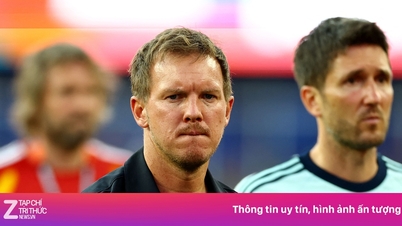
The person who received the most criticism was, of course, coach Julian Nagelsmann.
Upon his appointment, the 38-year-old strategist – who had been pursued by a host of top European clubs – was seen as a "dream signing" for the German Football Federation (DFB).

However, after his most notable achievement was a quarter-final defeat at EURO 2024 on home soil against Spain, there is growing concern that the DFB should not repeat the mistakes made with Joachim Loew and Hansi Flick – keeping a coach for too long after failed World Cup campaigns.
Legendary Lothar Matthaeus, a 1990 World Cup champion, wrote in a column for Bild newspaper that coach Julian Nagelsmann "lacks creativity," and asserted that Germany "needs to move on with a new coach."
For his part, coach Julian Nagelsmann admitted the team needed "big changes," but declared his readiness to continue the job:
"I'm not the type to run away. I'm willing to continue if the DFB still wants me to stay."
According to German media, the DFB has canceled its planned press conference on Tuesday and will instead release an official statement later that day.
Appearing as a television commentator throughout the tournament, Jurgen Klopp also cast a large shadow over Julian Nagelsmann's position as manager.
Just before Germany's World Cup opening match, coach Jurgen Klopp caused controversy when he joked that the young coach was only "temporarily" leading the team, implying that Julian Nagelsmann was merely holding the position.
However, after the defeat against Paraguay, coach Jurgen Klopp adopted a much more serious tone. He rejected the idea of replacing coach Julian Nagelsmann, and emphasized that what German football needs is a fundamental reform, starting at the U10 level.



"Look at Paraguay," said manager Jurgen Klopp as images of the South American players crying in celebration of their victory showed on screen. "They were all in tears. That shows how much this place in the round of 16 means to them."
Coach Jurgen Klopp believes that German football is becoming too complacent with its past glories.
"Are we Germany? No, we used to be Germany. If we want to become the Germany of football again, we really need to change."
He emphasized that the issue wasn't about the coach's identity: "This isn't about names. Not my name, and not Julian's name."
Coach Jurgen Klopp also defended his younger colleague: "Julian is right. The players are very determined, but in some aspects they simply can't do it."
And he concluded with a question that served as a wake-up call for German football as a whole: "Now the question we must ask ourselves is: Why is this happening?"
Source: https://danviet.vn/bao-gio-co-xe-tang-duc-tro-lai-d1439507.html

![[Image] National conference summarizing one year of operation of the overall organizational model of the political system, the three-tiered government model.](https://vphoto.vietnam.vn/thumb/1200x675/vietnam/resource/IMAGE/2026/07/01/1782882811691_ndo_br_1-jpg.webp)