

The essay was copied almost verbatim.
With the assignment to analyze the poem " A Friend Comes to Visit" by Nguyen Khuyen, the teacher hopes to see students' appreciation of the beauty and artistry of language and poetry.
The writing is undoubtedly clumsy, the ideas naive, and the expression awkward, but I cherish each genuine piece of writing from my students. Because they are learning to write essays, to appreciate poetry, to write literary analyses… Then, the red pen marking the paper suddenly stops, wondering, “I just read this essay a moment ago,” “Why does it look so familiar?”, “Could it be…”. Turning over the stack of papers, I found two essays that were almost identical copies.
I was disappointed because in every class, the teacher guided us on how to write an analytical essay on poetry, regularly practicing with similar essays and always encouraging us to write independently. Yet, the student returned to the teacher an essay that was an exact copy…
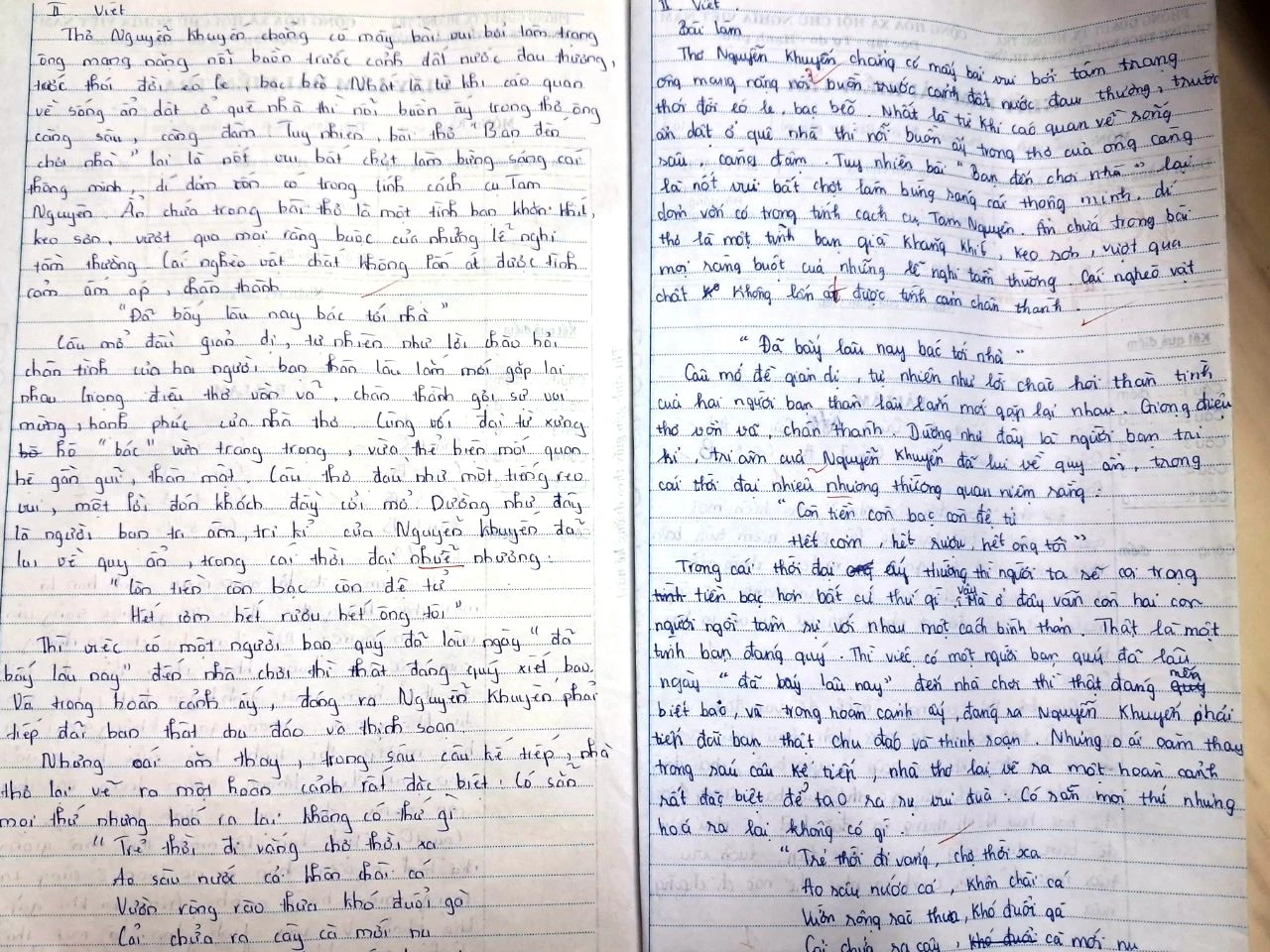
Two formulaic essays
What's even more heartbreaking is that these two students have good academic habits and fairly strong writing skills. Yet, the two essays displayed before me were copied from some template somewhere, simply for the sake of getting good grades. Upon inquiry, I learned that they both attended the same tutoring center. It's extremely worrying that there are such dangerous tutoring classes that encourage students to copy essays!
The lessons in class are learned in advance in extra classes, the test questions are solved in advance in extra classes, and students simply recall, re-solve the questions, and rewrite the essays. If we don't correct this distorted and negative situation of extra classes, we will create learning machines focused on achieving sky-high scores, snatching top honors, and competing for excellence. Meanwhile, critical thinking, creativity, and self-learning skills will be eroded and suppressed from the very first days of attending extra classes.

The issue of tutoring and supplementary education has once again attracted public attention following the proposal to include tutoring in the list of conditional business sectors.
ILLUSTRATIVE PHOTO: NHAT THINH
Students lose their creative thinking skills because they learn more about rote learning.
The two "formulaic" essays mentioned above raise concerns about the widespread and negative effects of extra tutoring, which leads to students losing their creative thinking and eroding their critical thinking skills.
Recently, the issue of tutoring and supplementary education has once again attracted public attention following the proposal to include tutoring in the list of conditional business sectors during the National Assembly discussion on November 20th.
If tutoring and supplementary education were conducted purely and honestly according to the supply and demand laws of the market, perhaps the bad reputation wouldn't have accumulated and the public's complaints and outrage wouldn't have been as intense as they have been for so long.
Public opinion has reacted negatively to a segment of teachers who have gone astray through extra tutoring classes. To maintain their overtime pay, which far exceeds their regular salaries, some educators resort to various tactics to entice and force students to attend these extra classes. The practice of "hoarding" lessons, "offering exam questions," and discriminatory treatment between students who attend extra classes is a distressing reality. "A few bad apples spoil the barrel"—the resulting bad reputation deeply troubles the hearts of honest teachers.
Previously, in 2019 and 2020, the proposal to include tutoring in the list of conditional business activities was rejected for several reasons, such as:
- Education cannot be viewed as a business (buying and selling words).
- The product of education is human beings, not commodities.
- If education is viewed as a shop where only money can enter and customers are treated like "gods," then the tradition of respecting teachers will be severely damaged, and many negative consequences will arise as many teachers chase after the allure of money, leading to inequality in education.
- Over-reliance on extra tutoring will gradually cause students to lose their critical thinking, independent thinking, self-learning, and creativity.
However, nowadays, extra tutoring is a necessity for students as the curriculum for many subjects remains quite demanding, despite the Ministry of Education and Training's guidance on reducing the workload in 2011. Students who are genuinely struggling academically can enroll in extra classes to fill in any gaps in their knowledge.
Therefore, instead of a complete ban, tutoring should be included in the list of conditional business sectors. However, the education sector must have specific and strict regulations to prevent teachers from forcing students to attend tutoring sessions.
Dao Dinh Tuan
Source link




































































































Comment (0)