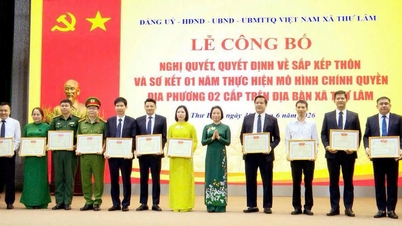
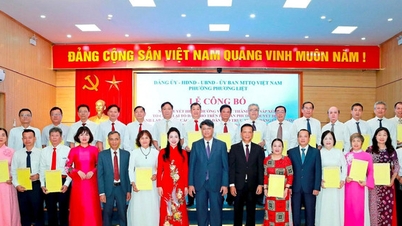
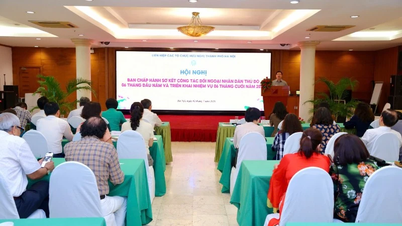
Speaking at the conference summarizing one year of implementing the three-tiered government model, General Secretary and President To Lam stated: "The new organization must create new capabilities; the new decentralization and delegation mechanisms must go hand in hand with new responsibilities; new data must create new governance methods; and the new apparatus must bring new quality of service to the people and businesses."
A qualitative shift in national governance capacity.
The message from the General Secretary and President was clear: we must shift from a purely administrative reform mindset to a modern national governance mindset, from focusing on organizational structure to prioritizing operational efficiency, and from a bureaucratic-centric approach to one that places citizens and businesses at the center of all public activities.
Looking back at nearly 40 years of reform, each stage of the country's development has been linked to institutional reform. From reforming the economic management mechanism, perfecting the socialist-oriented market economy, reforming administrative procedures to building e-government and digital government, the ultimate goal has always been to unleash development resources.

However, as the country enters a new phase of development requiring rapid, sustainable growth and competitiveness in the digital economy, technical reforms are no longer sufficient. What the country needs today is a qualitative change in national governance capacity.
Therefore, the General Secretary's message did not stop at talking about the organizational structure but emphasized the value that the structure must create.
"The new organization must create new capabilities" is the first requirement and the core of the entire reform mindset. A leaner apparatus does not necessarily mean a stronger one. A merged agency does not necessarily mean improved operational capacity.
If work processes remain outdated, coordination between units remains fragmented, officials continue to work with a short-term mindset, fear of responsibility, and a bureaucratic, centrally planned economy, then organizational change will only be superficial. What the Party aims for is not a new organizational chart, but a new capacity for implementation.
These include the capacity for scientifically-based policy planning, the ability to respond quickly to changing realities, the capacity for interdisciplinary coordination, and the capacity to serve and foster development. In other words, the value of the system lies not in its organizational structure but in its ability to solve problems.
To create new capabilities, the operating methods must also change. The General Secretary immediately followed up with the requirement: "The new mechanism of decentralization and delegation of power must go hand in hand with new responsibilities." This is not only a requirement for state management but also a core principle of modern governance.
No dynamic administration exists if all decisions are centralized at the top; nor can effective governance exist if power is delegated without clearly defined responsibilities. Years of experience have shown that in many places, there is still a tendency to pass the buck, avoid responsibility, "seek opinions," and "wait for instructions," thus losing opportunities for development and eroding public trust.



Therefore, decentralization is not about mechanically dividing power, but about empowering individuals to act proactively while establishing a rigorous accountability mechanism. The greater the authority, the greater the responsibility; the more power is expanded, the more stringent the control over that power must be. Only then can we create an administration that dares to think, dares to act, and dares to take responsibility for the common good.
If decentralization is the operating method, then data is the foundation of the new governance model. The General Secretary's emphasis that "new data must create new governance methods" shows that reform has gone beyond the scope of traditional administrative reform to enter the stage of digital governance.
In the digital age, data is no longer a byproduct of management but has become a strategic national resource. The important thing is not how many databases are built, but whether that data changes the way decisions are made and how people are served.
When data is connected and shared synchronously, policies will be built on evidence rather than emotion; governance will be based on real-time information instead of delayed reports; citizens only need to provide information once instead of repeatedly to multiple agencies; businesses will significantly reduce compliance costs; and the government can predict, prevent, and address emerging issues more proactively. This is the transformation from e-government to digital governance, from management by records to management by data.
However, if reforms stop at improving organizational capacity, perfecting decentralization mechanisms, or applying data, they will not have achieved their goals. Because all these innovations ultimately must be verified by a single criterion: whether citizens and businesses are better served.

"The new system must bring about a new quality of service for the people and businesses" is the ultimate goal of the entire reform process. This is a very important emphasis in governance thinking: the State not only performs the function of management but also performs the function of service and fostering development.
People don't judge the success of reforms by the number of merged agencies or the number of staff reduced. What they perceive is whether the processing time for procedures is shorter, costs are reduced, civil servants are more professional, and their legitimate rights and interests are better protected.
Businesses don't just need a streamlined bureaucratic system on paper; they need a transparent, stable, predictable institutional environment that supports production and business. When citizens are more satisfied, businesses thrive, social costs are lower, and trust in the government is strengthened, that is the true success of reform.
The four words "new" do not exist independently.
The profound message from the General Secretary is that the four words "new" do not exist independently but form a unified whole of national governance thinking. New organizations create new capabilities; these new capabilities are fostered through a decentralization mechanism linked to responsibility; effective decentralization must be based on data and digital governance; and ultimately, all of this aims to improve the quality of service to the people.
It is a continuous value chain, where each link is a condition for the next link to function effectively. Without any link, the goal of building a modern administrative system would be difficult to achieve.



This message also clearly reflects the requirement to build a streamlined, efficient, effective, and effective socialist rule of law state in Vietnam in the new development stage. Efficiency is created by rational organization and capable people; effectiveness is ensured by clear decentralization, transparent responsibilities, and strict control of power; and efficiency is measured by the quality of service and development results.
This is a concrete manifestation of the need to innovate leadership methods and national governance in order to realize the aspiration for national development by 2045.
The General Secretary's remarks have raised many issues regarding reform thinking. The system is no longer judged by what it possesses, but by the value it creates. Reform is no longer measured by changes in organizational structure, but by new capabilities, new management methods, and new quality of service.
That is the measure of a developmental state, of a modern governance system, and also the path to transforming development aspirations into concrete results, so that every citizen and business can feel that the innovation of the state apparatus is present in their daily lives.
Source: https://vietnamnet.vn/chinh-quyen-dia-phuong-2-cap-bo-may-moi-phai-tao-ra-gia-tri-moi-2531592.html