

 |
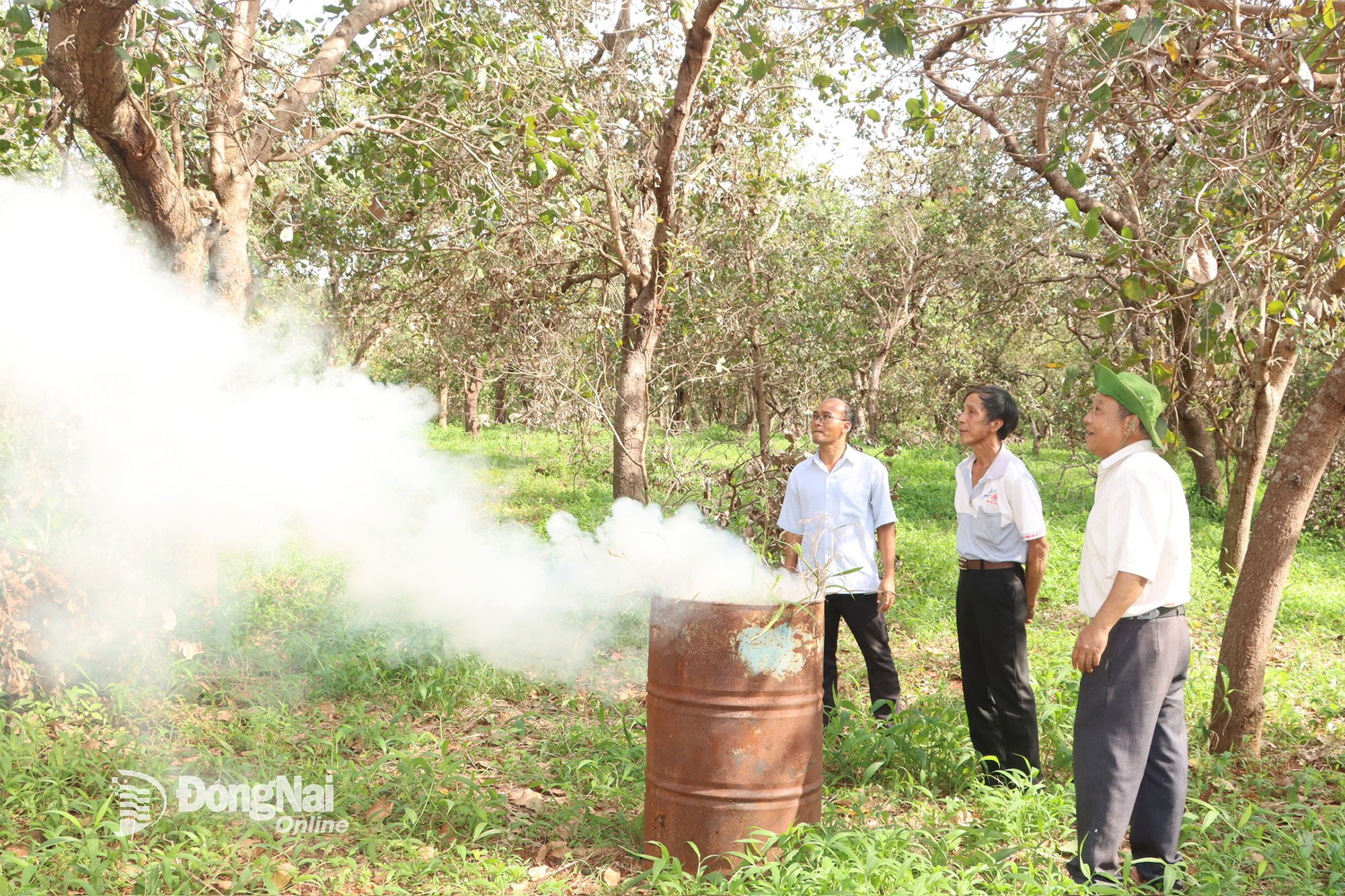
| Officials from the Farmers' Association of Bu Gia Map commune visit a model for controlling pests and diseases on cashew trees implemented by local people. Photo: Vu Thuyen. |
Recognizing the intertwined difficulties, challenges, potentials, and strengths, the Party Committee of Bu Gia Map commune has decided to focus resources on investing in infrastructure development and increasing people's income, utilizing all potentials and advantages to bring about breakthroughs and sustainable development for the locality.
Focus on increasing cashew tree productivity.
Instead of clearing their old cashew orchards to plant new, high-yielding, high-quality varieties, the 4 hectares of cashew trees, over 30 years old, belonging to Mr. Nong Thanh Thao's family (in Dak Con village, Bu Gia Map commune) remain lush and productive.
Mr. Thao said: "Trees, like people, become more susceptible to pests and diseases as they age. Therefore, to ensure healthy growth and development, we must regularly inspect the cashew trees to identify diseases and find specific treatments." Besides the guidance and support from agricultural extension officers and experts, after a long period of research, he has used traditional folk techniques to treat pests and diseases. He also focuses on pruning and shaping the trees to ensure good ventilation and promote growth. In particular, at the beginning of the harvest season, he uses iron drums to burn smoke in the direction of the wind, creating a double benefit: repelling insects and drying frost. This seemingly simple solution is very effective, as his family's cashew yield consistently reaches 2-2.5 tons per hectare annually.
“People often say, 'First water, second fertilizer, third diligence, fourth seeds,' but for the Bu Gia Map area in particular and the Southeast region in general, it's the opposite. It's 'First seeds, second diligence, third fertilizer, fourth water.' That is, besides the seeds, the most important factor is the human element; you have to diligently visit the orchard and take good care of the trees, and then the trees will not let you down. Thanks to hard work and diligence, my family has thrived for the past 30 years from just 4 hectares of cashew trees,” Mr. Thao shared.
According to Dieu Thuan, Vice Chairman of the Vietnam Fatherland Front Committee of Bu Gia Map commune and Chairman of the Farmers' Association of Bu Gia Map commune: Cashew trees are heavily dependent on the weather, and in recent years, the weather has been erratic, leading to continuous crop failures. To mitigate this situation, in addition to implementing comprehensive solutions, the Farmers' Association of the commune will replicate successful models and effective methods, including the traditional pest and disease control model of Mr. Thao's family.
Over 90% of households in Bu Gia Map commune are engaged in agriculture , cultivating nearly 4,000 hectares of various crops, including nearly 2,400 hectares of cashew trees, accounting for 60%. Cashews have long been considered a poverty-reducing crop in the area, but for many years, they have been directly affected by climate change, with unseasonal rains and continuous attacks by stink bugs, resulting in consistently poor cashew harvests, yielding only 7-8 quintals per hectare, plunging farmers into hardship. This is one of the reasons why increasing people's income is difficult; currently, the average per capita income is only 28.5 million VND per year. How to improve the income of people in this remote commune remains a difficult problem and a major concern for the local Party committee and government.
“With 75% of the population being ethnic minorities, the application of science and technology in production is limited, and farming practices are largely spontaneous. Therefore, in addition to promoting and encouraging people to apply science and technology to production in a clean and sustainable manner, the Party Committee and the government are currently directing the commune's Agricultural Service Center to directly guide people on how to spray pesticides and eradicate pests on cashew trees, ensuring high yields in the next crop season,” shared Le Hoang Nam, Secretary of the Party Committee and Chairman of the People's Council of Bu Gia Map commune.
Transforming potential into a driving force for development.
Along with the income criterion, Bu Gia Map still has 6 out of 19 new rural development criteria that have not been met, many of which require significant capital investment, such as transportation, schools, and cultural facilities.
According to the Party Secretary of Le Hoang Nam commune, in order to fulfill the set criteria, the commune will classify and identify key criteria to prioritize investment. In particular, funding support from higher levels is considered a crucial factor determining the effectiveness of implementation.
By 2030, Bu Gia Map commune strives to achieve the following goals: an average annual increase of 7.8% in the total value of products in the area; an average per capita income of 57.85 million VND/year, a 103% increase compared to 2025; a reduction in the national poverty rate to below 5%; an economic structure by 2030 of 80% agriculture, forestry, and fisheries, 15% trade and services, and 5% small-scale industries; and completion of the National Target Program for New Rural Development by 2029…
Notably, planning criteria are a major obstacle that needs to be addressed. The entire commune currently has 3,479 hectares of cultivated land, but the majority of this area is located within forest land or forest areas that have not yet been handed over to local authorities for management. Therefore, when implementing civil construction projects or issuing land use right certificates to people, planning issues arise, causing difficulties in the implementation process.
Mr. Le Hoang Nam stated: Despite many difficulties, the Party Congress of the commune for the 2025-2030 term has set the goal of achieving the new rural development status for the commune in the 2029-2030 period. To achieve this goal, the congress has outlined three breakthrough programs. These include: leveraging the advantages of land resources, especially the green areas of Bu Gia Map National Park, to promote economic development linked to ecotourism, thereby creating jobs, increasing income, and simultaneously promoting the cultural identity of ethnic groups in the area. Alongside this are: developing agricultural economy in conjunction with new rural development; focusing on clean and organic agricultural production, applying science and technology, and digital transformation in production; and transforming the structure of crops and livestock to suit local conditions.
Bu Gia Map possesses great potential, with its lush green forest landscapes ideal for ecotourism development and preserving many unique cultural values of ethnic minorities such as traditional rice wine, brocade weaving, and gong music. These are golden opportunities for sustainable tourism development and the creation of distinctive tourism products that will contribute to the socio-economic development of the commune.
“To transform potential into driving forces for development, the Party Committee of the commune has developed an action plan, the first of which is to focus on implementing the Resolution of the Commune Party Congress to all cadres, Party members, and the people. Along with that, the leadership and guidance of the Commune People's Committee have concretized key programs into specific plans for effective implementation,” emphasized Le Hoang Nam, Secretary of the Party Committee and Chairman of the People's Council of Bu Gia Map commune.
Vu Thuyen
Source: https://baodongnai.com.vn/kinh-te/202511/bu-gia-map-tan-dung-loi-the-de-but-pha-4c03445/
![[Photo] Conference on the transfer and reception of Party organizations and Party members between the Party Committee of the Government and the Party Committees of the Central Party Agencies](https://vphoto.vietnam.vn/thumb/1200x675/vietnam/resource/IMAGE/2026/04/01/1775036784472_ndo_br_bnd-2620-jpg.webp)



![[Photo] Conference announcing the Politburo's Decision on organizational and personnel matters](https://vphoto.vietnam.vn/thumb/1200x675/vietnam/resource/IMAGE/2026/04/01/1775017881825_bnd-2410-1472-jpg.webp)
















![[Photo Gallery] Tri An - an ecological urban area beside a green lake](https://vphoto.vietnam.vn/thumb/402x226/vietnam/resource/IMAGE/2026/04/01/1775014583510_z7672831871486_21772015e9b8af220696a711658b1284_20260331201612_20260331222745.jpeg)







































Comment (0)