

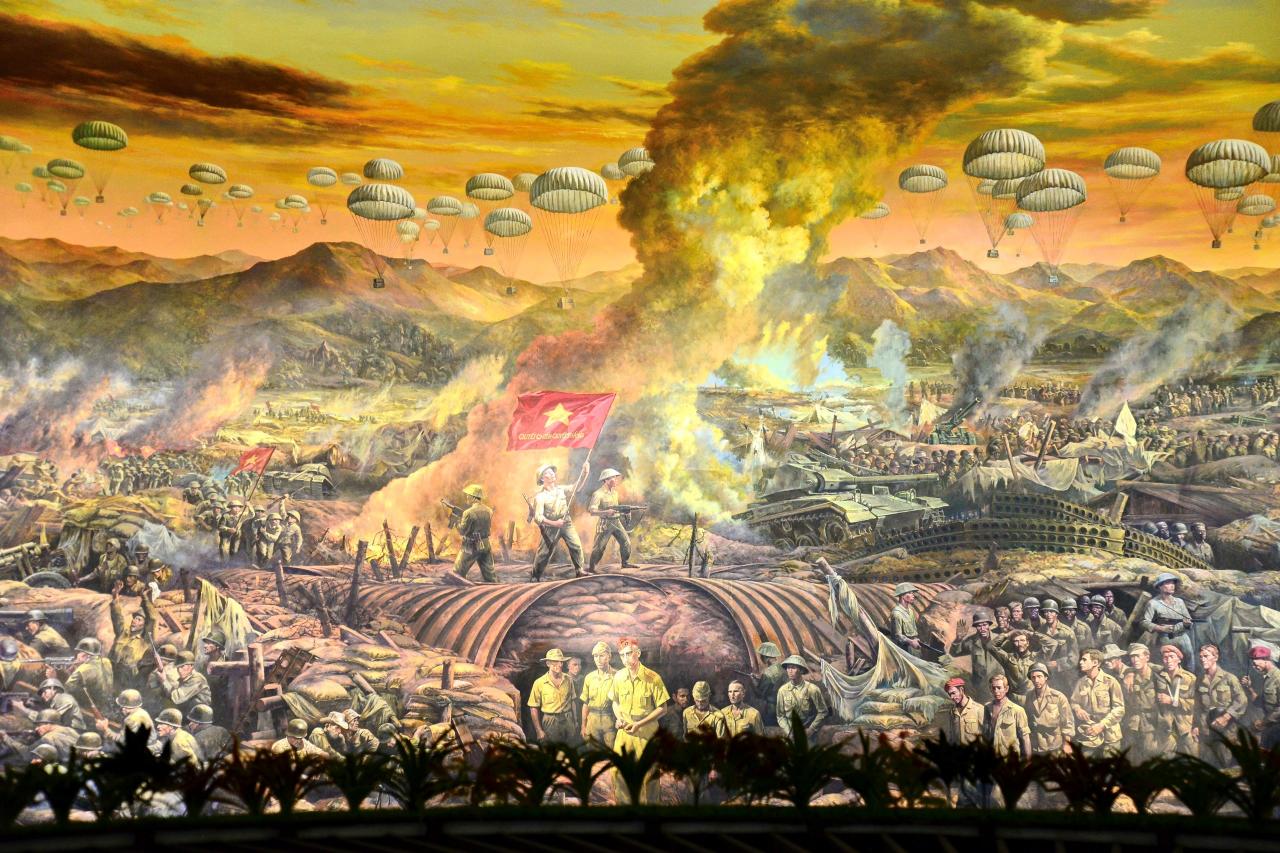
 |
| The artwork is meticulously crafted, vibrant, and considered an invaluable asset, marking the historical values and heroic fighting traditions of our army and people. |
The weather in late April was quite hot, but it didn't diminish our enthusiasm for the trip. Joining tens of thousands of tourists, locals, and veterans who have been returning for days to the historical sites that contributed to the Dien Bien Phu victory, we came to learn about history and reminisce about a legendary campaign by a young army that, with the combined strength of the entire nation and a resolute will to win, defeated a powerful colonial empire through the sacrifices and hardships of nine years of protracted resistance and 56 days and nights of digging tunnels and sleeping in bunkers.
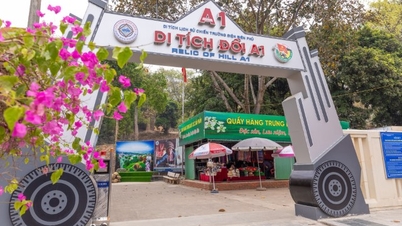
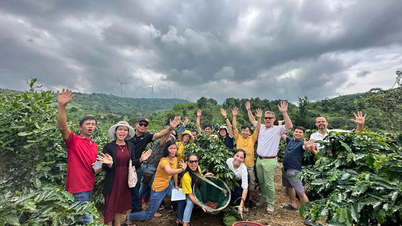
We – artists and writers from the land of King Hung – embarked on this trip to explore the Northwest region, each pursuing our own ideas and emotions to serve our creative and research work. The journey to Dien Bien Phu also gave us the opportunity to visit and learn about historical sites such as: Co Noi Junction – where 70 years ago the French army was determined to block the supply route to our Dien Bien Phu battlefield, where hundreds of young volunteers bravely sacrificed their lives, writing an immortal epic; Son La Prison – where thousands of loyal communist soldiers were imprisoned, moving us with the brutal torture endured by the prisoners and the miraculous escapes…; Pha Din Pass – a legendary route that has been immortalized in poetry, music, and art, as poet To Huu wrote: "On Pha Din Pass, sisters carry loads, brothers haul; On Lung Lo Pass, brothers sing, sisters chant…"; We visited Muong Phang – the campaign headquarters of General Vo Nguyen Giap and other generals of our army; De Castries' Bunker, Hill A1, the Martyrs' Cemetery, the Martyrs' Memorial and the Victory Monument; and also had warm meetings and exchanges of research and creative experiences with leaders and artists from the Arts and Culture Associations of Hoa Binh, Son La, and Dien Bien provinces… But the most impressive thing for us – artists on this trip, besides the feeling of economic and social development in Dien Bien province, the rapid urbanization of Dien Bien Phu City amidst the vibrant flags and flowers leading up to the 70th anniversary of the victory, was the Dien Bien Phu Victory Museum – where the relics of the war are displayed. Especially the Panorama painting (a panoramic painting) recreating the entire Dien Bien Phu Campaign in the main space of the Museum.
To be honest, when I visited this museum before, looking from the outside, I wondered: Why did the architects create the shape of a truncated cone in the center of the museum? Although I understood that the rhombus-shaped decorative motif around it was reminiscent of the camouflage netting on the helmets – a characteristic of soldiers at that time – the interior space had no functional purpose. Now, that question has been answered when standing before this "massive" artwork. That's certainly true, because as an artist with many years of experience in foreign affairs, I've visited many large museums around the world , but this is the first time I've seen such a large-scale and magnificent artwork, beautifully rendered, in Vietnam.
This is truly a meticulously crafted and vibrant work of art, considered an invaluable asset, preserving the historical values and heroic fighting traditions of our army and people for future generations. The first and only panoramic painting in Vietnam, the largest in Southeast Asia, is considered one of the three largest war-themed paintings in the world. The work measures 132 meters in length and over 20.5 meters in height (larger than the famous panoramic painting depicting the Battle of Borodino in the Victory Museum in Moscow, which is 115 meters long and 15 meters high). With its adjacent dome depicting clouds and sky, the painting has a surface area of 3,225 square meters. The painting is displayed across the entire interior surface of the truncated cone-shaped building of the Museum – a cylindrical structure with a diameter of 42 meters. Over 4,500 characters and scenes of the Northwest mountainous region are realistically and vividly recreated through the masterful brushstrokes of more than 100 artists with the ability to depict reality, along with their assistants. The artwork is painted with oil on canvas, in a 360-degree space. The stages of the Campaign are recreated sequentially, combined with raised elements and various war tools such as guns, ammunition, vehicles, tents, and even the corpses of soldiers, arranged realistically and seamlessly transitioning with the images in the paintings, creating a space that is both real and surreal, making a strong visual impact on the viewer.
The painting's content is divided into four sections: The Entire Nation Goes to War, The Epic Prelude, The Historic Confrontation, and The Triumphal Song of Victory. All images and events are strung together, seamlessly connected according to the course of the campaign, giving viewers a complete, intuitive, and vivid view. Section 1 depicts countless militia groups carrying supplies and food to Dien Bien Phu and the front lines with enthusiastic spirit, crossing mountain passes and streams to achieve the highest possible results for the campaign. Section 2, with its emphasis on the battle at the Him Lam Resistance Center on March 13, 1954, demonstrates the determination of our army and people to win the opening battle of the campaign, affirming the strength of our artillery. After destroying the Him Lam Resistance Center, our forces advanced to attack the Doc Lap and Ban Keo strongholds and entered the central Muong Thanh sector, capturing the eastern hills, including the important A1 hill. Segment 3 - "The Historic Confrontation" recreates the ferocity of the battlefield with trenches, barbed wire, and close-quarters combat, especially at the A1 hill stronghold. On the night of May 6, 1954, a column of smoke rose high in the middle of the battlefield, a flash of fire illuminated the area, accompanied by a loud explosion that shook A1 hill. This was the explosion of a nearly 1,000kg explosive charge that the Vietnamese army and people had meticulously planned and executed over many days and nights, carefully positioned to destroy the crucial A1 hill stronghold of the French army. Segment 4 - "The Triumphal Song of Victory" depicts the contrasting image of French prisoners of war and mercenaries surrendering against the historic moment at 5:30 PM on May 7, 1954, when the "Determined to Fight - Determined to Win" flag of the Vietnamese People's Army flew atop the De Castries bunker, signaling the hour of victory after 56 days and nights of fighting and heroic sacrifice by our army and people. The victory at Dien Bien Phu forced France to sign the Geneva Accords, ending the nine-year long resistance war against the French by the Vietnamese people.
It can be said that this is a perfect work of art, with rich and vivid content, beautiful aesthetic form, and showcasing the ability and skill of Vietnamese artists in creating magnificent works of art. To ensure that the public can explore the painting and gain the deepest and most authentic understanding of the historic Dien Bien Phu Campaign, in each projection session, museum staff guide approximately 30-40 visitors to the observation point. The space, sound, light, and images are harmoniously combined with the expressive narration, providing us and other visitors with a comprehensive view and the most vivid understanding of the historic Dien Bien Phu Campaign through the painting.
It is known that more than 10 years ago (in 2012), when the museum was being built, the idea of a panoramic painting depicting the overall Dien Bien Phu Campaign was designed for the museum. However, at that time, no organization or individual in the country had the capacity or confidence to undertake the creation of such a large-scale painting. Dien Bien Province even invited foreign experts to survey and develop a plan, but ultimately it could not be implemented because they did not fully understand the characteristics and legendary nature of the Vietnamese people's war. In 2014, the Cultural Heritage Preservation Company proposed a plan and a preliminary design. After many revisions based on feedback from experts in various fields, including veterans who participated in the Campaign, the final design was approved and implemented, resulting in this monumental work today. This artwork was also awarded the First Prize in the 2022 Vietnam Fine Arts Association Awards.
If you've come to Dien Bien, be sure to visit the Dien Bien Victory Museum and admire this special panoramic painting to further understand, appreciate, and cherish the historical and traditional values of the nation.
Source
























































Comment (0)