

"We must find a way to get back home."
From the early years of the 20th century, when the country was plunged into the darkness of colonial rule, the patriotic young man Nguyen Tat Thanh harbored a burning desire: "I decided to find a way to go abroad, to find a path to save the country and the people."
With a fervent desire to save the country, a brilliant intellect, keen political insight, and inheriting the traditional patriotic values of the Vietnamese nation, after nearly 10 years since leaving Nha Rong port to seek a way to save the country (1920), he embraced Marxism-Leninism, affirming his commitment to following the path of the proletarian revolution to liberate the nation and bring happiness to the people.
 |
| Painting depicting President Ho Chi Minh returning to Vietnam on January 28, 1941. |
From here, he pondered how to return to Vietnam to spread Marxism-Leninism. Despite the strict control and suppression by the enemy, during his activities abroad, leader Nguyen Ai Quoc always closely monitored the situation in the country to find the appropriate time to return to the homeland to directly lead the revolution. Implementing the plan, he, along with comrades Phung Chi Kien, Pham Van Dong, Vo Nguyen Giap, Dang Van Cap, and guided by comrade Hoang Sam, moved to Nam Quang, near the Vietnam-China border.
On January 28, 1941, after 30 years of wandering abroad in search of a path to national salvation, leader Nguyen Ai Quoc returned to his homeland. This was an extremely important moment for the history of the Vietnamese revolution, just as he predicted: "This is a favorable opportunity for the Vietnamese revolution. We must find every way to return to the country to seize this opportunity. Delaying at this time would be a crime against the revolution."
Leader Nguyen Ai Quoc crossed border marker 108 (now marker 675) on the Vietnam-China border and arrived in Pac Bo, Truong Ha commune, Ha Quang district, Cao Bang province - the northeastern "frontier" of the Fatherland, a place that possessed all the necessary elements of "favorable timing, geographical advantages, and human harmony" to build a revolutionary base for the entire country.
The person who returns brings joy.
Just four months after returning to Vietnam (from May 10th to May 19th, 1941), leader Nguyen Ai Quoc convened the 8th Central Executive Committee Conference (1st term) of the Party at Khuoi Nam, Pac Bo, Cao Bang. Attending the conference were Acting General Secretary Truong Chinh, Hoang Van Thu, Phung Chi Kien, Hoang Quoc Viet, along with several delegates from the Northern and Central Regional Party Committees and representatives from Party organizations operating abroad.
Under his chairmanship, the Conference consolidated the highest leadership body of the Party, elected the official Central Executive Committee, the Central Standing Committee, and elected Comrade Truong Chinh as General Secretary of the Indochinese Communist Party; on that basis, it consolidated the Party committees at all levels from the Regional Committee to the Party committees in localities - this was the leading factor determining the direction of the Vietnamese revolution. In particular, the Conference identified the task of national liberation as the most urgent and top priority of the Vietnamese revolution at that time.
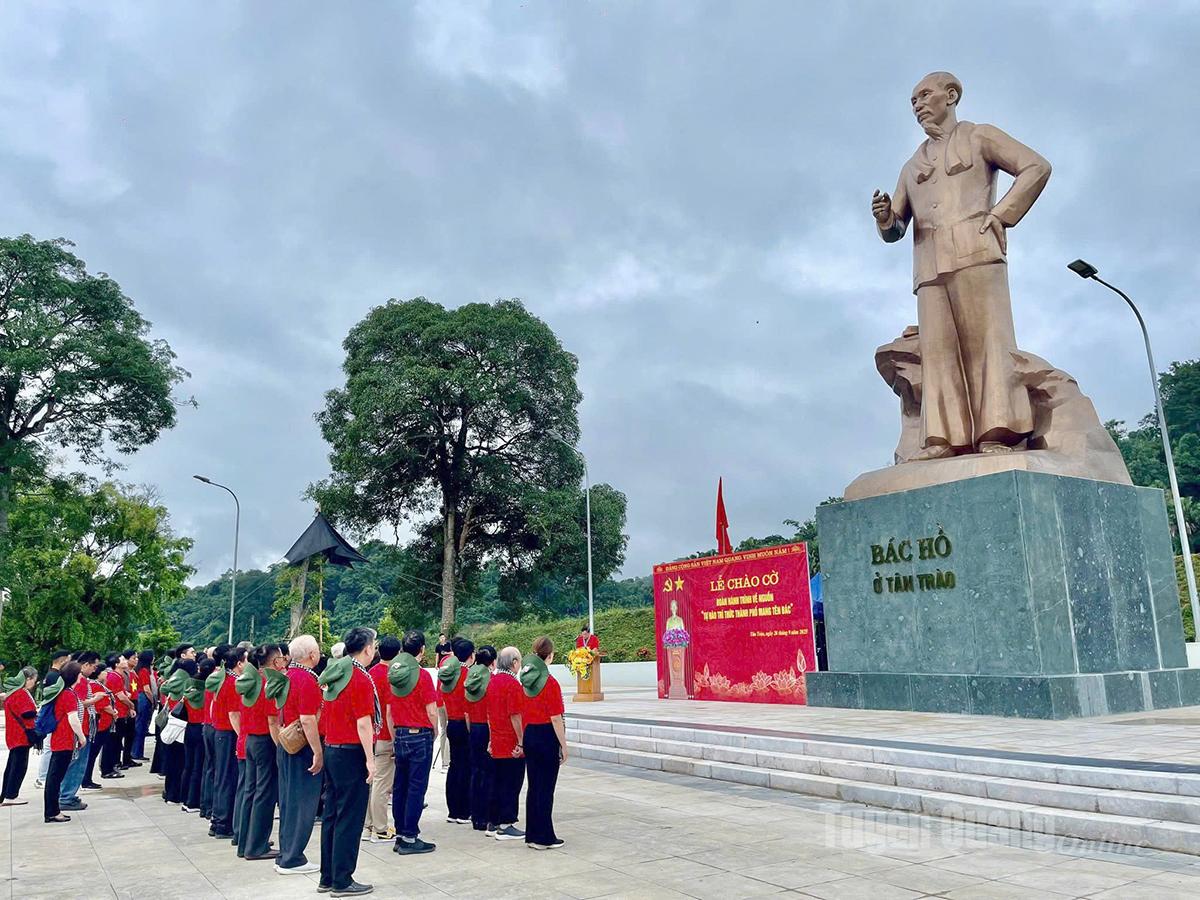 |
| Visitors return to the historical site and perform the flag-raising ceremony under the Ho Chi Minh Monument in Tan Trao, Tan Trao Special National Historical Site. |
The conference decided to establish three separate fronts in the three Indochinese countries to unite forces and address revolutionary tasks within their respective nations. In Vietnam, the Vietnam Independence League Front, abbreviated as Viet Minh, was established to broadly unite all patriotic forces within the Viet Minh Front.
The most important contribution of the 8th Central Committee Conference of the Party, chaired by leader Nguyen Ai Quoc, was the supplementation and development of the strategic line of the Vietnamese revolution – the line of national liberation in a colonial country, adapted to the realities of Vietnam.
The correct resolution of the Conference was implemented by the entire Party and the entire people, igniting a high tide of fighting the French and expelling the Japanese, promoting the entire process of the national liberation revolutionary movement, and contributing to the spread and expansion of national liberation movements from the North, Central, to the South.
The nationwide revolutionary movement led to the victory of the August Revolution in 1945, giving birth to the Democratic Republic of Vietnam – the first people's democratic state in Southeast Asia, ushering the Vietnamese nation into a new era – an era of national independence linked with socialism. From then on, the Party became the ruling party, openly leading the Vietnamese people in the resistance and nation-building efforts.
In the spring of 2026, commemorating the 80th anniversary of President Ho Chi Minh's return to Vietnam (January 28, 1941 - January 28, 2026), amidst the heroic and enthusiastic atmosphere as the whole country joyfully celebrates the success of the 14th National Congress of the Party, it is an opportunity for the entire Party, army, and people to continue to honor the life, revolutionary career, and great contributions of President Ho Chi Minh to the revolutionary cause of the Party and the Vietnamese nation. This will affirm the great significance and value of Ho Chi Minh Thought in the current national renewal and international integration process; and to resolutely implement the Resolution of the 14th National Congress of the Party, striving to make Vietnam a developing country with modern industry and high middle income by 2030, and a developed country with high income by 2045.
Huong Giang
Source: https://baotuyenquang.com.vn/thoi-su-chinh-polit/tin-tuc/202601/buoc-ngoat-mang-tam-thoi-dai-8155640/












































































Comment (0)